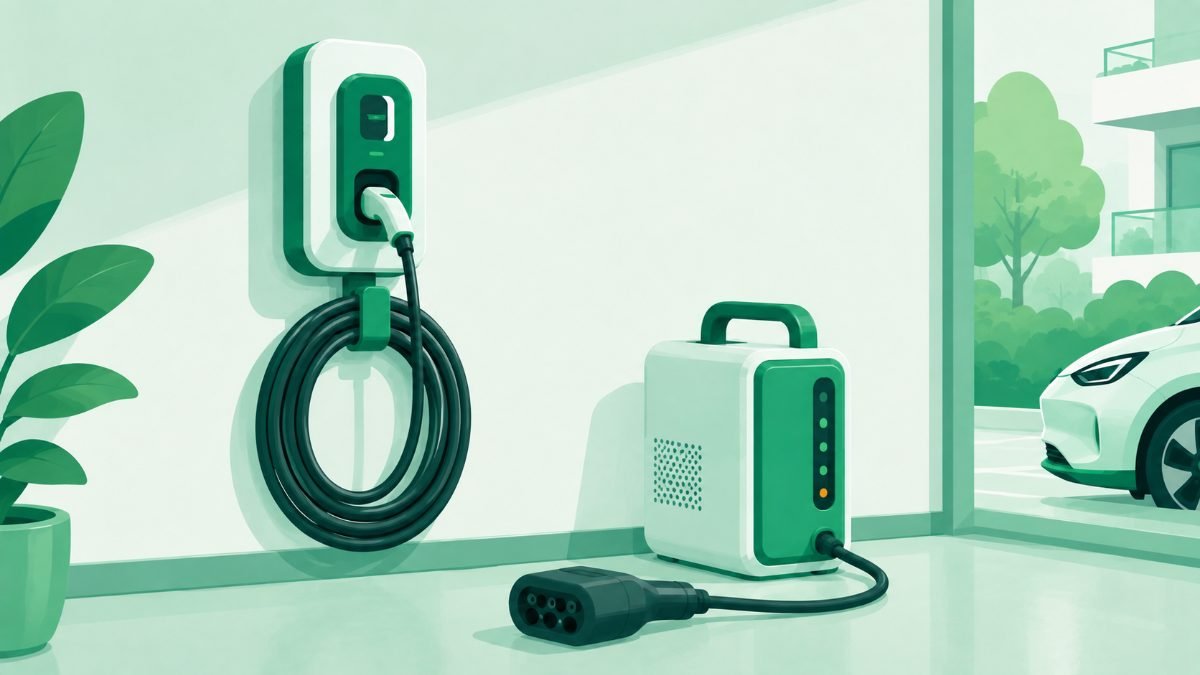
A housing society's specification for a shared EV charger starts from the vehicles residents own, and names for each a connector that fits its inlet natively, because the Central Electricity Authority's 2023 safety regulations bar, at an electric vehicle charging station, any adaptor between vehicle connector and vehicle inlet and any cord extension set or second supply lead. It then demands what the Ministry of Power's 2024 guidelines list: a valid type test certificate from an NABL-accredited testing agency, and Type-1 and Type-2 surge protection. Finally it contracts for what no instrument we have read requires: society-held administrator access, data export, a firmware support term and freedom to change platform. None of this is legal or electrical advice.
Start from your fleet: cars, scooters and autos
Clause 16(3) of the Ministry of Power's guidelines says "Residents can decide on the types and number of community EV chargers to be installed." Before any supplier visits, collect four facts for every EV in the building, and every one residents expect to buy, from the owner's manual or brochure, never from a model table on a website:
- the vehicle type: car, two-wheeler or three-wheeler;
- the charging inlet the manual names, with its standard if given, for AC and for DC;
- the AC power it accepts (the onboard charger's kW rating), or, for a vehicle charged through a supplied portable charger, that charger's rating and plug;
- whether the battery comes out, which may take the vehicle off the bay altogether (two-wheeler charging options).
Then split the demand by connector. Suppose your survey counts six cars, each owner reporting 250 km a week at 6.5 km per kWh from their own trip records, and twelve scooters, each doing 120 km a week at 25 km per kWh. Suppose every car manual gives a 7.2 kW onboard AC rating and every scooter's supplied charger is rated 0.6 kW. Substitute your own survey:
- Cars: 250 ÷ 6.5 = 38.5 kWh per car a week; 6 × 38.5 = 231 kWh; 231 ÷ 7.2 = 32 connector-hours a week.
- Scooters: 120 ÷ 25 = 4.8 kWh each; 4.8 ÷ 0.6 = 8 hours each; 12 × 8 = 96 outlet-hours a week.
- Suppose the bays are open 12 hours a night: 12 × 7 = 84 hours per outlet a week. Cars need 32 ÷ 84 = 0.38 of one connector; scooters need 96 ÷ 84 = 1.14, so at least two outlets.
The scooters draw a quarter of the cars' energy (57.6 kWh against 231) yet need three times the outlet time. These hours are a floor: a car plugged in all night occupies its point however full the battery, so the total point count belongs to how many points a society needs; this page splits that count by connector. A three-wheeler takes the same four facts and sum. Clause 16(4) says community stations "can be equipped to allow charging for authorized visitor vehicles"; those vehicles bring connectors you have not surveyed, and a socketed point (below) may cover them (visitor charging).
Karnataka adds one clause to check. The Karnataka Electricity Regulatory Commission's order "Streamlining of Procedure for installation of EV (Electric Vehicle) Charging Units", dated 30.07.2024, recites in its preamble a clause "9A.00" that the Commission inserted by its Conditions of Supply (Eighth Amendment), 2019, for buildings in "Metropolitan areas/Urban Development Authority Areas of all cities/City Corporation areas in the State of Karnataka" where "(a) The requisitioned load is 250 kW or more; or (b) The built-up area of the building is more than 5,000 Square meters". For those buildings the clause, as the order quotes it, provides "for the Owner/Promoter/Occupier of the above buildings to install not less than two number of charging points capable of charging Electric Vehicles, i.e., four/three/two-wheeler with adequate space in such buildings" (preamble, pages 1 to 2; copy published by HESCOM, last verified 21 October 2026). Two things the words leave open: the duty is written on the "Owner/Promoter/Occupier", not on an association as such, and the text does not say whether each point must take all three vehicle types or only the two together. Put both to your ESCOM in writing, against the clause as its current Conditions of Supply print it.
The connector table in the 2024 guidelines, row by row
The Ministry of Power's "Guidelines for Installation and Operation of Electric Vehicle Charging Infrastructure-2024", No. 12/2/2018-EV, dated 17 September 2024 (copy hosted by the Bureau of Energy Efficiency, last verified 21 October 2026; our clause-by-clause reading), say in clause 6(1): "All Electric Vehicle Supply Equipment shall comply with BIS standards indicated at ANNEXURE — I." Clause 2 extends them to charging infrastructure in "Group Housing Societies". Annexure I, page 14, has six rows and seven columns, and prints each standard with the prefix for Indian Standard; we give the numbers after it. Part titles come from the Bureau of Indian Standards list in a Ministry of Heavy Industries reply to the Rajya Sabha, published by the Press Information Bureau on 1 August 2025 (pib.gov.in, last verified 21 October 2026).
| Power level and charger type, as printed | Vehicles and capacity, as printed | Device; communication; charge-point plug or socket; vehicle inlet or connector | What it means for your specification |
|---|---|---|---|
| Level 1, "Light EV AC Charge Point" | "2W, 3W and 4W — M1 Category"; "Up to 7 kW" | 17017-22-1; Bluetooth Low Energy; 60309; 17017-2-7, 17017-2-2 | Low-power AC for scooters, three-wheelers and cars alike; two vehicle-end parts are listed, and your manuals decide which |
| Level 1, "Light EV DC Charge Point" | "2W, 3W"; "Up to 12 kW" | 17017-25 [CAN]; 17017-2-6 at both ends | DC for two- and three-wheelers whose manuals name this inlet. The BIS list labels Part 25 "LEV DC EVSE" |
| Level 1, "Light EV AC/DC Combo" | "2W, 3W"; "Up to 7 kW (AC) or up to 12 kW (DC)" | 17017-31; 17017-2-7 at both ends | The row behind the term LECCS: the BIS list labels Part 31 "LECCS EVSE". Useful only if your manuals name this inlet |
| Level 2, "Parkbay AC Charge Point" | "3W and 4W — M1 Category"; "Normal Power —11kW/ 22 kW" | 17017-1; 15118 [PLC]; 17017-2-2 at both ends | Higher-power AC; check it against your sanctioned load and your car manuals' AC ratings first |
| Level 3, "DC Charging Protocol" | "4W (M1 Category), Buses and Trucks (M3 Category)"; "DC 50 kW to 250 kW" | 17017-23; 17017-24 [CAN] and 15118 [PLC]; 17017-2-3 at both ends | Starts at 50 kW for one point; compare that with your building's sanctioned load |
| Level 4, "DC High Power for e-Bus and Trucks Charging Station" | "M3 Category"; "250 kW --> 500 kW" | As Level 3 | Not a residential row |
First, the vehicle-end column decides compatibility; capacity decides only speed, and a vehicle charges no faster than its onboard rating (3.3 kW versus 7.2 kW). Second, connector nicknames such as "Type 2" or "LECCS" do not appear in Annexure I. The BIS list titles Part 2 Section 2 "Dimensional compatibility and interchangeability requirements for a.c. pin and contact-tube accessories", and Section 7 covers "a.c., d.c. and a.c./d.c." vehicle couplers for equipment "where Protection Relies on Electrical Separation". Make each bidder state the vehicle-end part number and match it to your manuals.
Third, the 7.4 kW figure. Clause 12(1) says "Charge Point Operators will preferably provide a minimum 7.4 kW AC or DC EV chargers", but clause 12 is headed "Public Charging Stations — General Requirements", and clause 4(p) defines a public station as one usable "without access restriction". Clause 4(e) defines a "Community Charging Station" as one "where only residents or authorized visitors can get their EV charged". The preference is for public stations and does not bind a community charger; size yours from the fleet and your sanctioned load.
Can a scooter use a car charger? Native fit versus adaptors
Only if the scooter's own inlet takes the car charger's connector, as its manual states. The Central Electricity Authority (Measures relating to Safety and Electric Supply) Regulations, 2023, notified on 8 June 2023 in the Gazette of India, Extraordinary, Part III, Section 4, give EV charging stations Chapter XI, regulations 123 to 128 (copy archived from cea.nic.in, last verified 21 October 2026). Three sub-regulations decide the scooter question:
- 124(3): "A cord extension set or second supply lead shall not be used in addition to the supply lead for the connection of the electric vehicle to the charging point and shall not be used as a cord extension set."
- 124(4): "No adaptor shall be used to connect a vehicle connector to a vehicle inlet."
- 124(6): "The portable socket outlets shall not be permitted for electric vehicle charging."
A gadget that lets a scooter's own charger plug into a car connector puts a converter and a second lead into the chain. Whether a given product falls inside 124(3) or 124(4) is for your licensed electrician or your state's electrical inspector; a specification has no reason to plan around one, because a design that needs an adaptor has not served that vehicle. A multi-plug board at the bay is plainly out under 124(6). We quote the 2023 text from the archived gazette copy; we could not confirm from the Authority's own site that no later amendment touches these sub-regulations, so check before these words enter a purchase document.
Where a scooter manual says it charges through a supplied charger with a household-type plug, that scooter needs an outlet, not a car connector. Annexure I does not list the household socket; its light-EV AC row names a 60309 socket at the charge point. Whether a dedicated outlet for a scooter's own charger is supply equipment that must meet Annexure I, the guidelines do not say. Ask bidders to price both: light-EV charge points to the row your scooters' inlets match, and dedicated outlets for supplied chargers, with circuits, protection and earthing specified and certified by a licensed electrician, and choose on that electrician's written advice. Riders who would rather not charge at the bay can compare battery swapping against home charging.
One more reason to read each manual: the same Rajya Sabha reply says vehicle inlet requirements were prescribed for "all M (Passenger) and N (Goods) categories except N1", and says nothing there about two- and three-wheelers.
Socketed or tethered
A tethered charger has its cable and vehicle connector fixed to the unit. A socketed charger has a socket, and each driver brings a lead that fits it at one end and their vehicle at the other. Annexure I has separate columns for the charge-point plug or socket and the vehicle inlet or connector, and does not itself choose between the two designs.
- Tethered fits only vehicles whose inlet matches that one connector. The society owns the cable and connector, which wear with use, but no resident brings a lead the society has never seen. The cable must reach every vehicle from its bay without an extension: 124(5) says "The distance between the charging point and the connection on the electric vehicle shall not be more than five metre during charging", so five metres is a dimension for the bay layout you issue with the tender.
- Socketed serves any vehicle whose owner has a suitable lead, which suits a mixed fleet and visitors. Residents' leads are outside the society's sight, so the society's policy should require leads in good condition and repeat the 124(3) ban on extensions.
A mixed fleet sometimes justifies one of each. Either way the specification line states: tethered or socketed; the part number at each end; for a tethered unit, cable length in metres; for a socketed one, whether it holds the plug during charging.
Certificates to demand: type tests and surge protection
Annexure II of the guidelines, to which clause 6(3) points, opens with Checklist A (Safety Requirements) on page 15. Mind the force: clause 6(1) says equipment "shall comply" with Annexure I, while 6(3) only says requirements are "specified in ANNEXURE — II". Checklist A is a list your tender adopts and your contract enforces, not a provision you can hold over a supplier by itself. Its testing item asks for each EVSE "with different power ratings and communication protocols" to be "type tested by the Original Equipment Manufacturer in accordance with BIS standards specified in ANNEXURE - I in a testing agency accredited by the National Accreditation Board for Testing and Calibration Laboratories (NABL), with a valid Type Test certificate". Its surge item asks for "Type-1 and Type-2 protection" under the codes it cites, 62305-4 and 61643-12. Weather protection is "As per Clause 12.4" of Part 1 (2018) of Indian Standard 17017.
| Checklist A item | Tender line | Evidence at bid | Check at handover |
|---|---|---|---|
| Equipment testing | Every model and rating quoted holds a valid type test certificate, to the Annexure I part for its row, from an NABL-accredited agency | Certificate copy; the agency's accreditation certificate showing its scope | Model and rating on each delivered unit's label match a certificate |
| Surge protection | Type-1 and Type-2 surge protection to the cited codes, with location and rating stated | Single-line drawing showing each device | Devices installed as drawn |
| Weather protection | How the unit meets clause 12.4 of Part 1 for the location you name: basement, stilt or open | Supplier's written statement and the enclosure's rating | Unit installed where the statement covers it |
| Fire safety | Fire protection equipment "as per relevant Indian Standards" | List of equipment and its location | Installed and accessible |
| Reliable wiring and national regulations | Design and certification by a licensed electrician to the CEA regulations | Electrician's licence details | Signed test records |
Read each certificate for four things. The model and rating must match the quote exactly: the item ties type testing to each EVSE with "different power ratings and communication protocols", so one variant's certificate does not cover another. The standard tested must be the Annexure I part for that row. The agency must be accredited, with the test inside its accreditation scope. And "valid" is the checklist's word, so get the supplier's written statement that the certificate is current. Once installed, the society owns these papers: regulation 128 requires a station owner to keep test certificate records for at least seven years (what paperwork to keep).
Hardware lines from the CEA regulations
Clause 6(2) of the guidelines says supply equipment safety "shall be as specified in" the CEA regulations "as amended from time to time". Whether Chapter XI reaches every charging point is debated; a buyer loses nothing by specifying a community station to it.
| Regulation | Specification line | Evidence to demand |
|---|---|---|
| 124(3) | One supply lead between point and vehicle; no extension set or second lead in the design, the price list or the user instructions | Bay layout showing every vehicle within reach of its point |
| 124(4) | Every vehicle in the fleet survey connects natively; no adaptor supplied, quoted or recommended | A compatibility schedule listing each surveyed vehicle against the connector it will use |
| 124(6) | Fixed outlets only; no portable socket outlets at any bay | Drawing and site inspection |
| The rest of 124, and 125 to 128 | Supplier and licensed electrician state how the installation meets each sub-regulation, or supports the owner's duty under it | A signed compliance schedule, one row per sub-regulation |
The last row covers socket height, lightning protection, reverse power flow, a dedicated sub-circuit per point, earth continuity monitoring, enclosure material, fire detection, the owner's tests and records. A blank row in the schedule tells you which question to ask before signing. Pre-plug-in checks stay on the safety checklist, and installation quote lines in comparing installation quotes.
Open protocols: what "OCPP compliant" does and does not promise
Why a society needs an exit route if a vendor's server shuts down is set out under "What happens when the internet drops" in our guide to smart charger features. Clause 4(o) of the guidelines defines OCPP as "an open protocol used for communication between EVSE and the Charger Management system". Clause 12(3) reads: "Open Standards are recommended. Public Charge Point Operators (CPOs) may adopt open communication protocols like UEI, OCPP, OCPI or open ADR for efficient communication with DISCOMs regarding demand response." Clause 13(2) says public operators "are advised to adopt" open protocols "for data sharing".
Recommended, may, advised, and all addressed to public operators. No instrument we have read requires the protocol at a community charger, so whatever protection your society gets comes from its contract. "OCPP compliant" on a brochure does not, by itself, promise:
- that the society can change the management system the charger reports to, a setting the vendor may lock;
- that its version matches a platform you might move to, since the protocol has more than one published version;
- that access cards, tariffs, session history or load-sharing settings move with you;
- that firmware updates continue;
- that anyone other than the seller has tested the claim.
Wording for bidders, for your advocate to review: "The Supplier states the version of the Open Charge Point Protocol each charger implements. Within seven days of the Society's written request, at no charge, the Supplier will connect each charger to any charger management system the Society names, or give the Society the access needed to do so itself. The Supplier will not, by firmware, configuration or contract, prevent the chargers from connecting to another system." If several chargers share capacity, ask too whether load management survives the move.
An acceptance test before payment
Run this after commissioning and before the final payment. Each test checks a line of your specification; the licensed electrician performs the electrical tests while committee members watch and record. Payment approval, the completion file and general-body sign-off are procurement procedure, not this page.
- Native fit. One vehicle of each inlet type in your survey starts, charges and stops on its intended point with no adaptor, extension or second lead.
- Logging. Each test session appears in the log with credential, start, end and kWh. Compare the kWh with the movement on the sub-meter or reference meter, within a tolerance written into the contract beforehand (sub-meter versus charger billing).
- Offline behaviour. Disconnect the network, start a session with a society access card, and confirm the charger does what the specification says; reconnect, and confirm that session reaches the log with its kWh.
- Leakage protection. The electrician tests the residual-current protection by the manufacturer's method, a test regulation 127 puts on the station owner, and records that it tripped (RCCB, MCB and RCBO explained).
- Earth continuity. Regulation 125(3) requires monitoring that disconnects supply if the earthing connection to the vehicle becomes ineffective. The electrician demonstrates it by the manufacturer's procedure and records the result (earthing basics).
- Administration and export. Using the society's own administrator login, add and remove a test user, then download the full session export in the agreed format.
- Paper against hardware. Serial and model numbers on the delivered units match the type test certificates.
Record each result in writing, signed and dated; a failed test is a defect for the supplier to fix, not a point to negotiate.
Exit plan: admin credentials, data export and firmware support
Exit here means leaving the platform or vendor; a handover between maintenance contractors belongs in the service contract, and who holds the user list day to day is in access control for shared chargers. At purchase, write these in:
- Credentials. The administrator account sits on a society email address, not an office-bearer's own, and is handed over at commissioning with at least two named roles.
- Data. The society can export all session records and the user list at any time, in a machine-readable format, without a fee, and receives a full export within a stated number of days of termination.
- Firmware. Security and fault updates for a stated number of years from commissioning, at least the horizon in your fee arithmetic below, with written notice before support ends, and no update that deletes session history.
- Platform closure. If the supplier stops the platform, the chargers keep working locally and the reconnection clause in the protocols section applies.
You can price the risk. Suppose your hardware costs ₹2,40,000 and you plan to keep it seven years. If the platform closes after four and the chargers cannot be moved, the planned life you lose is ₹2,40,000 × 3 ÷ 7 = ₹1,02,857. Substitute your own quote and horizon.
Software fees over the charger's life, worked
Software arrives as small monthly lines beside a large hardware price; put them on one horizon. Suppose a quote shows four points' hardware at ₹2,40,000, a platform fee of ₹400 per point per month, and one gateway SIM at ₹250 a month. Substitute your own quote:
- platform: 4 × ₹400 × 12 = ₹19,200 a year; connectivity: ₹250 × 12 = ₹3,000; year one: ₹22,200;
- at flat fees, five years: ₹22,200 × 5 = ₹1,11,000; seven years: ₹22,200 × 7 = ₹1,55,400, and ₹1,55,400 ÷ ₹2,40,000 = 0.65 of the hardware price.
Now suppose the contract lets the vendor raise fees by up to 10% a year:
| Year | Platform and connectivity, rising 10% a year | Running total |
|---|---|---|
| 1 | ₹22,200 | ₹22,200 |
| 2 | ₹22,200 × 1.1 = ₹24,420 | ₹46,620 |
| 3 | ₹24,420 × 1.1 = ₹26,862 | ₹73,482 |
| 4 | ₹26,862 × 1.1 = ₹29,548 | ₹1,03,030 |
| 5 | ₹29,548 × 1.1 = ₹32,503 | ₹1,35,533 |
| 6 | ₹32,503 × 1.1 = ₹35,753 | ₹1,71,286 |
| 7 | ₹35,753 × 1.1 = ₹39,328 | ₹2,10,614 |
Over seven years, ₹2,10,614 ÷ ₹2,40,000 = 0.88 of the hardware price. On these figures the escalation clause deserves as much negotiation as the hardware. Per unit, suppose your projection is 1,200 kWh a month across the points: year one is ₹22,200 ÷ (1,200 × 12) = ₹1.54 per kWh, which must fit inside the rate residents pay; check that rate against the service-charge ceiling.
Suppose a second bidder charges ₹0.75 per kWh instead. The flat fee is 4 × ₹400 = ₹1,600 a month, so the break-even is ₹1,600 ÷ ₹0.75 = 2,133 kWh a month. At your 1,200 kWh, the per-kWh model costs ₹0.75 × 1,200 × 12 = ₹10,800 a year against ₹19,200; above 2,133 kWh, the flat fee is cheaper. A percentage of collections grows with the electricity tariff as well as with use, since the tariff sits inside what residents pay. Carry the seven-year total into the reserve projection, not just year one.
Common questions
Can an electric scooter charge at a Type 2 car charger in our society?
Only if the scooter's manual names an inlet that accepts that connector. At a charging station, CEA regulation 124(4) bars an adaptor between vehicle connector and vehicle inlet, and 124(3) a second lead. Specify outlets or light-EV charge points matched to your scooters, on circuits a licensed electrician certifies.
Is a "BIS-compliant" claim the same as a type test certificate?
Not necessarily. Checklist A asks for "a valid Type Test certificate" from an NABL-accredited testing agency, for each EVSE "with different power ratings and communication protocols". Whatever marks a brochure shows, ask for that document by name and check its model, rating, standard and date.
Does our society's charger have to support OCPP?
No instrument we have read requires it. Clauses 12(3) and 13(2) recommend and advise open protocols for public operators only. If you want freedom to change platform, write it into the purchase contract.
Do we need chargers of at least 7.4 kW?
No. Clause 12(1)'s "minimum 7.4 kW" is a preference for public charging stations. Size a community charger from your residents' vehicles, the AC ratings in their manuals and the building's sanctioned load.
What is LECCS, and do we need it?
The BIS list published by the Press Information Bureau labels Part 31 of Indian Standard 17017 "LECCS EVSE". Annexure I uses Part 31 in its "Light EV AC/DC Combo" row for two- and three-wheelers, with Part 2 Section 7 at both ends. You need it only if your residents' manuals name that inlet.
What happens if the charger's app company shuts down?
That depends on your contract. Without clauses for local operation, reconnection to another management system and data export, a society can lose billing records and part of the hardware's planned life; the exit section shows how to estimate that loss.
Should we pay extra for a vehicle-to-grid charger?
Ask your DISCOM first. Clause 18(1) says vehicle-to-grid "may be enabled as per the requirements of respective Distribution Licensee", and 18(2) leaves its tariff to the regulator. Without a DISCOM arrangement you can use, a premium for two-way capability buys nothing yet.