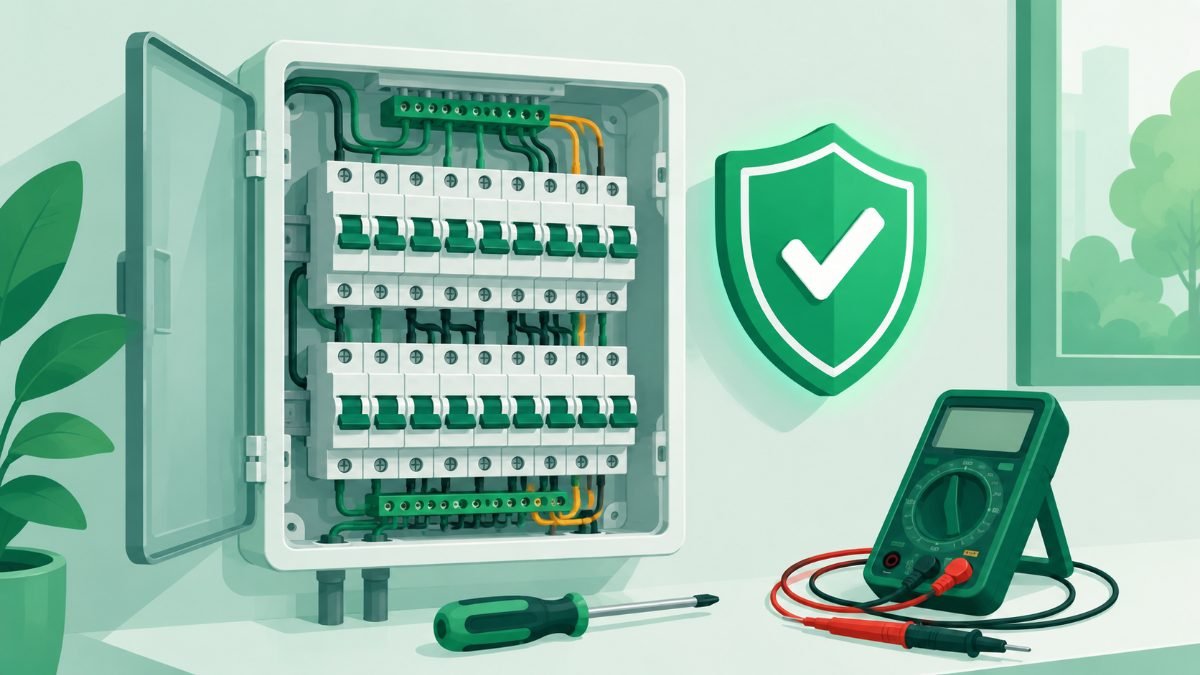
An MCB (miniature circuit breaker) protects the wiring of your EV charging circuit from overcurrent — too much current flowing because of an overload or short circuit. An RCCB (residual current circuit breaker) protects people from earth leakage — current escaping to earth through a fault or through someone's body. An RCBO combines both jobs in one device. An apartment EV charging point needs both protections on a dedicated circuit, because charging draws high current for hours and any leakage fault is dangerous in a parking area. Which ratings and types to use is a sizing decision for a licensed electrician, not a DIY choice — this guide explains what each device does so you can ask better questions.
The MCB: protection for wires, not for people
Think of an MCB as a resettable fuse. It sits in your distribution board and watches how much current flows through a circuit. If the current climbs above the breaker's rating — because too many loads are running at once, or because a short circuit has removed all resistance — the MCB trips and cuts the supply before the wiring overheats. Overheated wiring inside walls and ducts is how electrical fires start, so an MCB is fire protection first and foremost.
What an MCB does not do is protect a person. The current that can hurt or kill a human being is far smaller than the current needed to trip a breaker sized for an EV circuit. If current is leaking through a damaged cable sheath, a damp connector, or someone's hand, the MCB sees nothing unusual. That gap is exactly what the RCCB exists to close.
The RCCB: protection for people, not for wires
An RCCB works on a different principle. It continuously compares the current flowing out through the live conductor with the current returning through neutral. In a healthy circuit the two match exactly. If some current is escaping to earth instead — through damaged insulation, moisture, or a person's body — the balance breaks and the RCCB trips in a fraction of a second. The sensitivities involved are tiny: devices meant for personal protection react to leakage measured in milliamps, a small fraction of what an MCB watches for.
The mirror-image limitation applies. An RCCB does not care how much total current flows, only whether it balances, so a heavily overloaded circuit with no leakage will never trip it. The two devices are partners, not alternatives.
The RCBO: both jobs in one module
An RCBO (residual current breaker with overcurrent protection) combines the MCB's overcurrent sensing and the RCCB's leakage sensing in one module. For an apartment EV installation this has a practical attraction: the charging point gets its own dedicated protection, so a fault on the EV circuit trips only the EV circuit — not an RCCB shared with your flat's lights and appliances. It also saves space in a crowded distribution board, which matters in parking-area DBs and older meter rooms.
Whether your installation uses an RCBO or a separate MCB-plus-RCCB pair depends on the board's layout, what protection exists upstream, and cost. Both arrangements can be done well. The point to hold on to is simpler: your charging circuit must end up with both protections, however they are packaged.
Why an EV charging point needs both protections
An EV charging circuit is unusual by household standards. It carries close to its maximum current for hours at a stretch, night after night. It usually runs a long way from the meter to the parking spot — often through basements, ducts, and outdoor stretches where cables face moisture, dust, and the occasional rodent. And the load at the far end is a metal vehicle that a person touches with bare hands. Sustained high current argues for careful overcurrent protection; the environment and the human contact argue for leakage protection. You genuinely need both.
One more wrinkle is worth knowing, even though you will not act on it yourself. EV chargers contain power electronics that can, under fault conditions, leak current with a DC component — something ordinary residual-current devices are not designed to sense. Installers handle this through the charger's built-in leakage detection, through a specific class of RCCB, or both. The right combination depends on the charger and the circuit, which is precisely the kind of detail a licensed electrician resolves during design. If you are still weighing charger sizes, see how the choice between 3.3 kW and 7.2 kW charging affects the circuit it needs.
| Device | Protects against | How it senses trouble | A trip usually means |
|---|---|---|---|
| MCB | Overload and short circuit (fire risk to wiring) | Total current exceeds the breaker's rating | The circuit is overloaded, or there is a short somewhere |
| RCCB | Earth leakage (shock risk to people) | Current leaving on live does not match current returning on neutral | Current is escaping — damaged insulation, moisture, or contact with a live part |
| RCBO | Both of the above | Both mechanisms in one unit | Either kind of fault, isolated to that one circuit |
The test button habit — and what tripping is telling you
Every RCCB and RCBO carries a small button marked T or Test. Pressing it deliberately creates a tiny, safe imbalance; a healthy device trips instantly. Make this a habit — the first charge of every month is an easy anchor. Press, hear the clunk, reset, carry on. If the button does not trip the device, stop charging on that circuit and call your electrician: your leakage protection may have failed silently, and a failed RCCB looks exactly like a working one until the day it matters.
Tripping during use is information. A one-off trip that resets cleanly and never recurs may follow a nuisance event, but repeated RCCB trips mean current is leaking somewhere — a damp connector after rain, a cable nicked during other work, a fault inside the charger or even the vehicle. Repeated MCB trips mean overload or a short. Either way, the response is the same: do not tape the breaker down, do not swap in a bigger one, do not bypass anything. Unplug, reset once, and if it trips again, stop and get the circuit inspected. If your spot is below ground, our basement parking charger checks cover the extra points worth reviewing.
Why sizing and selection belong to your electrician
It is tempting to read a charger's power rating and reverse-engineer breaker sizes from an online chart. Resist it. Correct selection depends on the charger's continuous draw, the cable size and run length, how the cable is installed, the ambient temperature in your parking area, what else shares the supply, your flat's sanctioned load, and the quality of earthing — often the weakest link in older societies. Err in one direction and the breaker nuisance-trips every night; err in the other and it fails to protect when it must.
A licensed electrician sizes all of this as one design, and your DISCOM may have its own requirements for a dedicated EV connection or meter — confirm the current position directly with them. Before that visit, run the apartment EV readiness checklist to see where your parking spot stands, and read our full guide to installing a charger in an Indian apartment so you know the sequence end to end. If the cable route crosses common areas, settle who pays for the wiring with your society early.
Common questions
Can an RCBO replace a separate MCB and RCCB?
Functionally, yes — an RCBO performs both jobs for the circuit it protects. Whether it is the right choice for your installation depends on the distribution board's layout, existing upstream protection, and cost. Treat it as a design option your electrician weighs, not an upgrade you specify yourself.
My charger claims built-in leakage protection. Do I still need an RCCB?
Built-in protection complements switchboard protection; it does not automatically replace it. In some designs the charger's internal detection changes which class of RCCB the circuit needs, which is exactly why the installer should see the charger's documentation before finalising anything. Never assume a spec-sheet feature removes the need for protection in the board.
My RCCB trips only in the rainy season. Why?
Seasonal tripping strongly suggests moisture is entering a connector, junction box, or damaged stretch of cable and creating a leakage path. The RCCB is doing its job. Have the circuit inspected rather than resetting it through the monsoon — the leak will not fix itself, and it may get worse.
Does a trip damage the charger or the car?
A protective trip simply disconnects supply, much like a power cut, and charging equipment is built to tolerate interrupted supply. The trip is not the harm; the fault behind it may be. Put your attention on why it tripped, not on the disconnection itself.
Everything above is background to help you ask informed questions — not a substitute for professional work. Selection, sizing, and installation of MCBs, RCCBs, and RCBOs belong to a licensed electrician, and any requirement for a separate EV connection or meter should be confirmed with your DISCOM before work begins. Once installed, keep our apartment EV charging safety checklist handy for the small habits that keep the system trustworthy.