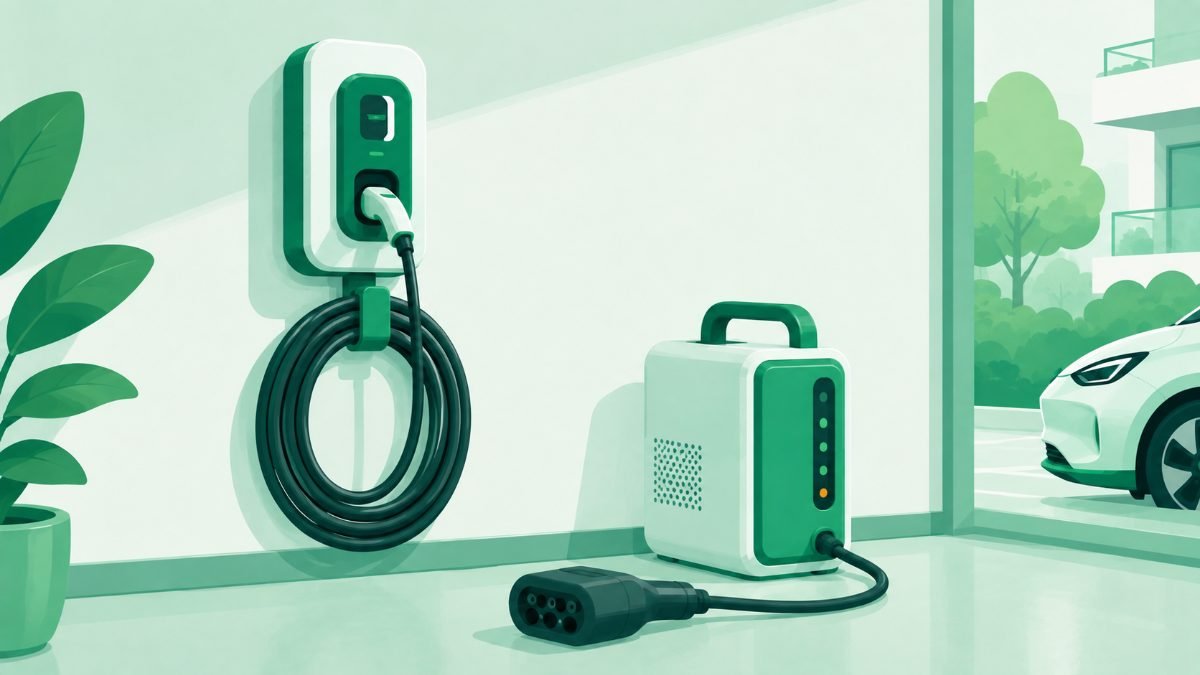
For most apartment residents who park overnight in their own spot, 3.3 kW is enough. It adds roughly 3 units of charge an hour, so an ordinary city commute is replaced in two or three hours while you sleep — and you have eight or more. A 7.2 kW wall box roughly halves that time, which earns its keep only when daily distances are long, parking hours are short, the point is shared, or the battery is large. It also draws far more current, often needs a sanctioned-load enhancement, and costs meaningfully more to wire. Speed is a convenience; capacity is a commitment.
Work out your own requirement first
The right charger size is not a matter of opinion. It falls out of three numbers you can find in ten minutes: your daily kilometres on an ordinary weekday (most people overestimate it), your car's real-world efficiency in kilometres per unit (kWh), and your honest overnight parking window.
Then: daily kilometres ÷ km per unit = units needed per day, and units per day ÷ charger kW = hours of charging.
A worked example with deliberately illustrative numbers — substitute your own. Drive 45 km a day at about 6 km per unit and you need 7.5 units: under three hours on a 3.3 kW point, allowing for losses. If the car sits in the stilt parking from 9 pm to 7 am, that uses under a third of the window.
Change one input and the answer flips. At 120 km a day — 20 units — with only six hours parked, a 3.3 kW point adds about 10 units and you fall behind daily. That is where 7.2 kW stops being a luxury; our guide to how long home EV charging actually takes covers where the real hours go.
The maths that actually matters
| Question | 3.3 kW | 7.2 kW |
|---|---|---|
| Energy added per hour (approx.) | ~3 units | ~6.5–7 units |
| Time to add 20 units (a typical 20→80% on a mid-size car) | ~6–7 hours | ~3 hours |
| Current drawn, single phase (approx.) | ~15 A | ~32 A |
| Two-wheeler charge (roughly 3 units) | About an hour's energy | Vehicle usually cannot accept it |
The right-hand column is only reachable if your vehicle can accept it. Run your own figures through the apartment charger cost calculator, which shows time and cost at both levels.
Your car, not the wall box, sets the ceiling
An AC charging point does not push power into the battery. It supplies alternating current to a converter inside the vehicle — the onboard charger — and that converter's rating is the hard ceiling. If your car's onboard charger is rated at 3.3 kW, a 7.2 kW wall box delivers 3.3 kW and not a watt more. You will have paid for capacity the car cannot use.
This is not a rare edge case: smaller cars and almost all electric two-wheelers carry modest onboard chargers, because a larger converter adds weight, heat and cost. We deliberately do not publish ratings by model — they differ between variants and model years, and a forum figure is how people end up buying the wrong thing. Check your own specification sheet or owner's manual under "AC charging" or "onboard charger"; if no kW figure appears, ask the dealer to confirm it in writing before you buy.
Highway DC fast chargers bypass the onboard charger entirely, which is why a car limited to 3.3 kW at home can still take a much larger charge on a road trip. For two-wheeler households, charging electric two-wheelers in apartments raises different questions.
What each option asks of your connection
Power becomes current, and current is what cables, protective devices and your DISCOM connection care about. On single phase, 3.3 kW draws roughly 15 amperes — the order of a water heater. 7.2 kW draws roughly 32 amperes, more than many flats run in total.
- Sanctioned load. Your connection is approved for a certain load, printed on your bill, and a charger occupies that headroom for hours rather than in bursts. Whether 3.3 kW fits inside your existing sanction depends on your flat and your habits; 7.2 kW very often does not. See sanctioned load and apartment EV charging.
- Cable and protection. Higher current needs a larger conductor cross-section over the same run and correspondingly rated devices. A cable adequate at 15 A may be unsafe at 32 A over that distance — a design calculation, not a judgement call.
- The DISCOM process. More sanctioned load means a formal application. The procedure, documents, fees and any change to your monthly fixed charge differ by state and by utility, so confirm the current process directly with your DISCOM, not with a neighbour's memory of theirs. Our overview of the load-enhancement process describes what to ask.
Both options, without exception, need a dedicated circuit from the board, correctly rated overcurrent protection, residual-current protection suited to the charger, and tested earthing.
The cost and approval consequences of going bigger
The 7.2 kW route costs more in several ways and only one is hardware. The unit is dearer, the cable run costs more per metre over a distance that is rarely short, and load enhancement — where required — adds application costs and may raise your monthly fixed charge regardless of how much you drive. A larger load is also a bigger ask of the managing committee than a charger that fits inside your existing sanction.
Note what does not change: your cost per unit. A battery needing 8 units needs 8 units whether it takes three hours or seven. Faster charging changes when you consume, not how much. Compare monthly running costs at your own tariff — take the rate off your bill — with the monthly charging cost calculator.
A short sequence for deciding
- Find your vehicle's onboard AC charging limit. If it is 3.3 kW, the decision is already made.
- Do the daily-kilometres arithmetic and compare hours needed against hours genuinely parked.
- Read your sanctioned load off your bill and note your usual evening peak.
- Have a licensed electrician assess the real route — board-to-parking distance, panel condition, earthing, and what each option needs. Do this before shortlisting hardware, not after.
- Treat future-proofing separately. Sometimes the sensible compromise is sizing cable and conduit for the higher load now while fitting the smaller charger, since the expensive, disruptive part is the cable and civil work, not the box on the wall.
For a shared point, throughput matters more than any one owner's speed, since a faster point frees the bay sooner — a trade-off covered in private versus shared EV charging.
Common questions
Will charging at 7.2 kW damage my car's battery?
Home AC charging at either level is gentle compared with DC fast charging, and the vehicle's battery management system governs how energy is accepted. No realistic home charging speed takes that control away from the car. If your owner's manual gives guidance on routine charging habits, follow it.
Is 3.3 kW enough for a car with a large battery?
Usually, because you almost never charge from empty to full at home. What matters is replacing one day's driving, not filling the pack, so a large battery on a modest commute just means charging less often. The exception is genuinely high daily mileage — the arithmetic above will show it.
Can I install 3.3 kW now and upgrade to 7.2 kW later?
Often, but the upgrade is rarely just swapping the box. It may mean a heavier cable, different protective devices and, if your sanction is short, a fresh application to your DISCOM. If an upgrade looks likely, say so at the design stage so the cable route is planned once.
Does a faster charger increase my electricity bill?
Not by itself. Your bill reflects units consumed, and the same driving consumes the same units at either speed. What can change the bill is a higher sanctioned load, which under many tariff structures affects fixed charges monthly. Ask your DISCOM what a load change would mean for you.
Charger sizing looks like a shopping decision and is really an electrical one. For most apartment residents, 3.3 kW does the job at lower cost and with an easier approval path. But "most" is not "you". Before committing, have a licensed electrician inspect your board, earthing and cable route, and confirm with your DISCOM what your connection is sanctioned for and what changing it would involve.