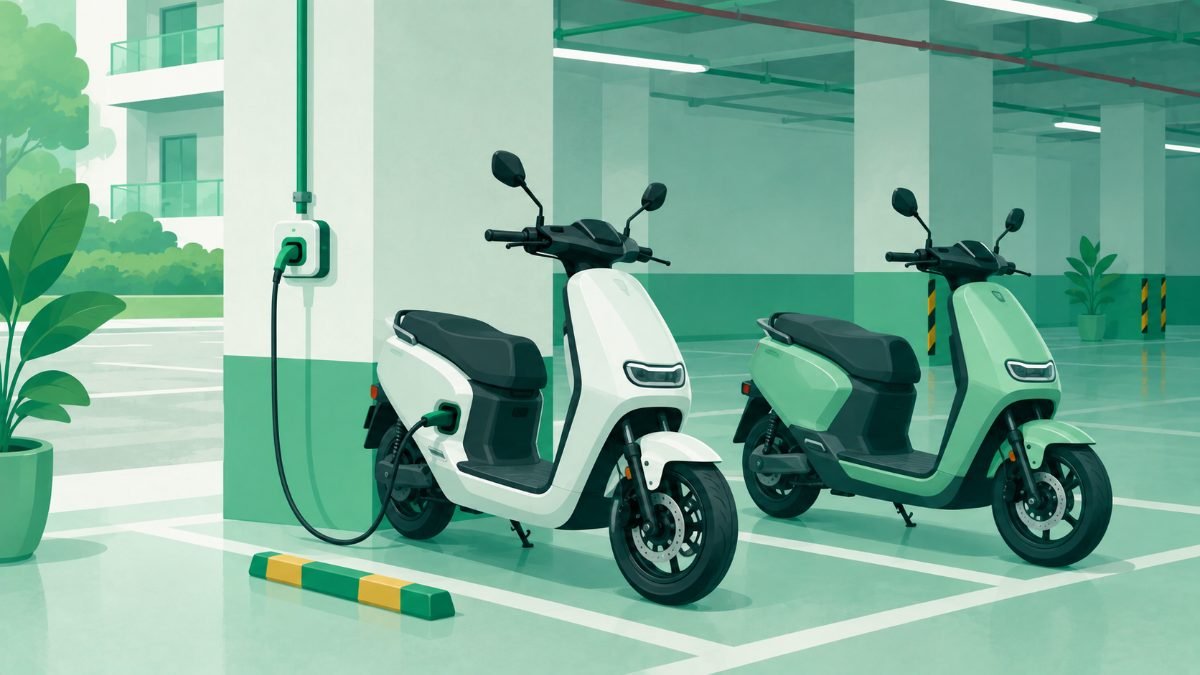
If you own an electric scooter or motorcycle and live in an apartment, you have three realistic charging options: carry a removable battery up to your flat and charge it from a wall socket, get a proper 15A charging point installed at your parking spot, or use a shared two-wheeler charging bay set up by the society. Which one fits you depends on whether your battery is removable, whether you have an allotted parking spot, and what your RWA permits. Each route has genuine trade-offs on convenience, safety, and cost — and the removable-battery habit, though the easiest to start, comes with fire-safety considerations most riders are never told about. This guide walks through all three.
Start with your battery: removable or fixed?
Everything else follows from this one fact about your vehicle. Many electric scooters sold in India come with a removable battery pack that slides or lifts out, designed so you can charge it away from the vehicle. Others — particularly higher-capacity scooters and electric motorcycles — have a fixed battery, which means the vehicle itself must reach a socket.
Check your owner's manual for two details: the pack's weight (carrying one up even two floors daily gets old fast) and the charger's rated current, which tells you what socket it needs. If your battery is fixed, skip straight to the parking-point and shared-bay options below.
Option 1: charging a removable battery in your flat
This is how most people start, because it needs no permission and no wiring: pull the pack, carry it up, plug it in. It works — but treat the pack with the respect due to any large lithium battery, because that is exactly what it is.
- Charge on a hard, non-flammable surface — a tiled floor works well; never a bed, sofa, or carpet, and keep it away from curtains and clutter.
- Keep the charging spot clear of your exit path. A battery fire, though rare, develops fast; do not let the only door out of the flat sit behind a charging pack.
- Use only the charger supplied with the vehicle, and stop charging any pack that is swollen, unusually hot, or has been dropped hard — a fall on the stairs can damage cells invisibly.
- Let the pack cool after a ride before plugging it in, and prefer charging while someone is home and awake rather than overnight in a bedroom.
Also weigh the daily routine honestly: a heavy pack in a crowded lift, most days of the week. Some societies restrict charging batteries in flats or carrying them through common areas — check your society's position before you assume. Our apartment EV charging safety checklist covers the full set of precautions.
Option 2: a 15A point at your parking spot
For a fixed-battery vehicle — or anyone tired of hauling packs upstairs — the durable answer is a dedicated 15A socket at your parking spot, the heavier-pin type used for geysers and air conditioners. Done properly it is a small, tidy installation: a weatherproof socket box near your stall, its own MCB for protection, proper earthing, and a cable run back to a meter.
The metering question decides most of the arrangement. If your flat's meter is close enough, an electrician can run the point from it and the units simply appear on your own bill. If the distance is too great, the common alternative is a point fed from the society's supply through a small sub-meter, with you reimbursing the society for the units you use. We compare these approaches in sub-meter versus smart-charger billing.
Two firm rules. First, never trail an extension cord from a window or balcony down to the parking level — it is dangerous and usually against society rules. Second, get permission before wiring anything in a common area: read how to request charger permission from your RWA and use the permission request letter template to start the conversation properly.
Option 3: a shared two-wheeler charging bay
If parking is unallotted, you rent your flat, or several residents own electric two-wheelers, a shared bay often beats a scatter of individual points. The typical shape: a row of 15A sockets in a designated corner of the parking area, fed through a common sub-meter, with simple usage rules — charge and move on, no overnight squatting, and the electricity cost recovered from users rather than from everyone's maintenance dues.
Billing can be as simple as a logbook with a flat per-session rate, or as structured as individually metered sockets. The principle that keeps the peace: the society recovers its actual cost, transparently, and no more. If your society has nothing yet, how to propose a common EV charging station walks through building the case — the same logic scales down neatly to a two-wheeler-only bay.
Which option fits your situation?
| Option | Works best when | Main advantages | Watch-outs |
|---|---|---|---|
| Removable battery charged in the flat | Battery is removable and light enough to carry comfortably | No permission or wiring needed; works from day one | Fire-safety discipline is entirely on you; daily carrying wears thin; some societies restrict it |
| 15A point at your own parking spot | You have an allotted spot and plan to keep the vehicle for years | Most convenient long term; clean billing via your meter or a sub-meter | Needs RWA permission and a licensed electrician; upfront installation cost |
| Shared society charging bay | Parking is unallotted, you rent, or several residents need charging | One installation serves many; fair for renters and future owners | Needs society initiative and usage rules; possible waiting at busy times |
What might charging cost? A worked example
You can sanity-check charging cost on the back of an envelope. The numbers below are purely illustrative — substitute your own from your electricity bill and your vehicle's manual.
Say your scooter has a 3 kWh battery and you typically charge from 20% back up to 90%. That is 70% of 3 kWh, about 2.1 units per session — call it 2.4 units after charging losses. If your tariff is, say, ₹8 per unit (check your own bill — slab rates mean your marginal rate may differ), one session costs roughly ₹19, and four sessions a week works out to around ₹300–₹350 a month. Even doubling every assumption keeps the figure modest.
To run the same arithmetic with your actual daily kilometres and tariff, use the monthly charging cost calculator — it shows the formula beside the result so you can verify every step.
Common questions
Can my society stop me from charging a battery inside my own flat?
What you do inside your own flat is normally your own affair, but bye-laws differ between societies, and the moment a battery is carried through lifts and corridors or charged in a common passage, common-area rules genuinely apply. Follow sensible safety practice, keep charging strictly inside your flat, and check your society's bye-laws — a cooperative approach usually keeps this option open for everyone.
Is a regular 5A socket enough, or do I need a 15A point?
Follow your charger's rating plate. Many two-wheeler chargers draw a modest current that a healthy household socket can supply, but the socket, wiring, and plug must all be in good condition — anything warm to the touch while charging is a warning sign. For a permanent point at parking level, a 15A socket on its own MCB with proper earthing is the sensible standard.
I do not have an allotted parking spot. What are my options?
A shared bay is the practical answer, because it does not tie a socket to a spot you cannot claim. If your battery is removable you can charge upstairs meanwhile, but raise the shared-bay idea with your RWA early — these proposals take a few committee meetings to mature.
Do I need to inform my DISCOM before installing a charging point?
It depends on how the point is wired and how much load it adds. A small point run from your existing meter may sit within your sanctioned load, while a new connection or a society-level installation may involve the DISCOM directly. Requirements vary and change, so confirm the current position with your DISCOM before work begins, not after.
A closing note: every option that involves wiring — the 15A point, the shared bay, even judging whether an existing socket is up to the job — is work for a licensed electrician, not a weekend project. Have a professional inspect the cable route, earthing, and protection, and confirm load and connection requirements with your DISCOM. An electric two-wheeler is a genuinely practical apartment vehicle; a safe charging setup is what keeps it that way.