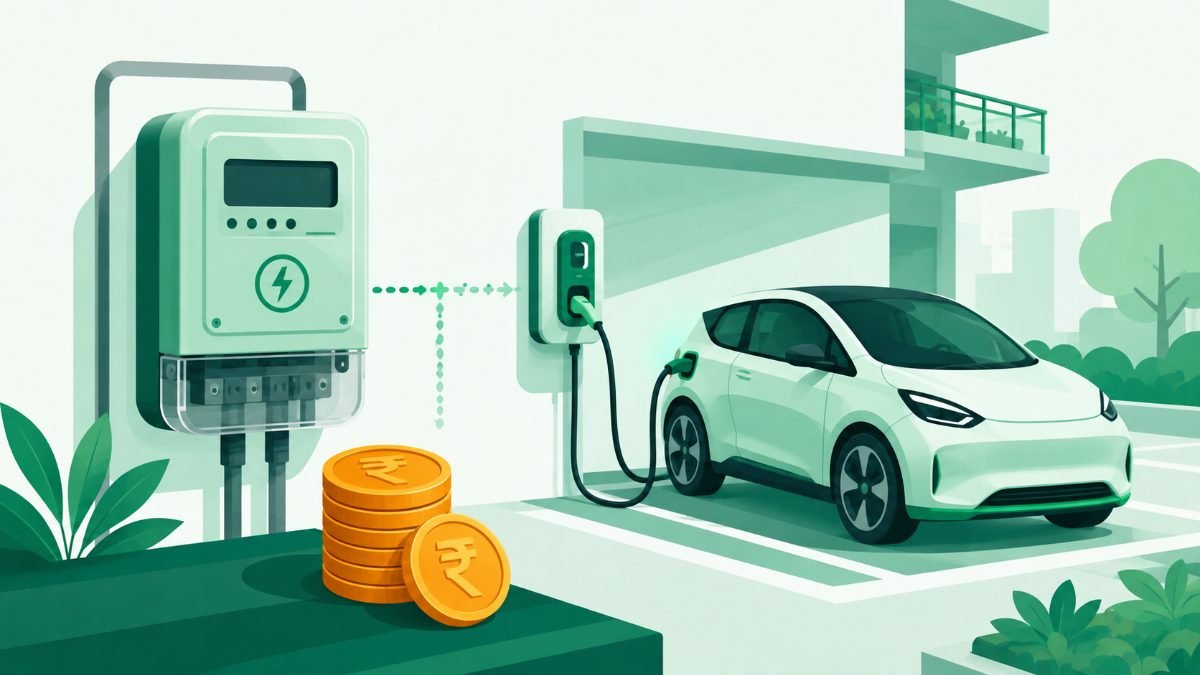
There are two dependable ways to measure the electricity an apartment EV charger uses. A sub-meter is a physical energy meter fitted on the charging circuit and read like any other meter. A smart charger measures consumption internally and reports it through an app, a display or a downloadable session log. Both can bill fairly. They differ in hardware cost, in who does the monthly admin, and in how a disagreement gets settled. The one model that reliably ends in arguments is no measurement at all — a flat amount added to maintenance dues — because nobody can prove it right or wrong.
How sub-meter billing works
An electrician fits an energy meter on the dedicated charging circuit, usually just after the isolator in the board feeding the parking point. From then on it counts only what the charger draws. Each month someone records the reading, subtracts last month's, and multiplies the difference by the agreed rate. The society collects that with maintenance dues — or, where the charger sits on the resident's own flat meter, nothing separate needs collecting, a choice compared in own meter, sub-meter or common meter.
- Strengths: cheap hardware, a number anyone can verify by looking, no vendor dependency, and it works with any charging equipment.
- Weaknesses: monthly manual reading and record-keeping; it measures a circuit, not a person, so a shared point needs one meter per user or a strict logbook.
How smart-charger billing works
The charger's built-in metering logs every session — start, end, units delivered, and, where the unit supports RFID cards or app sign-in, which resident authorised it. On a shared point used by several families, that automatic attribution is the difference between a workable system and a monthly argument.
- Strengths: per-user attribution without anyone policing the parking; session history showing when energy was drawn; scheduling, if your tariff rewards particular hours.
- Weaknesses: higher cost; dependence on a vendor for app, firmware and support; and if the unit is replaced or the account lapses, historical logs can go with it. Smart charger features for apartment use covers which features earn their price.
Comparison at a glance
| Sub-meter | Smart charger | |
|---|---|---|
| Hardware cost | Low | Moderate to high |
| What it measures | Total energy on the circuit | Energy per session, per user where sign-in is used |
| Monthly admin | Someone physically reads and records | Report or export from the app |
| Per-user attribution | Hard — one meter per user, or a logbook | Built in, via card or app login |
| Verifiability in a dispute | Anyone can walk down and look | Depends on trusting the device's log |
| Ongoing dependency | Almost none | Vendor, firmware, sometimes a subscription |
| Best fit | Private chargers, simple setups | Shared points, multi-user billing |
Read that as fit, not quality. For a private charger serving one flat, a sub-meter is usually enough. For a shared point, attribution is the whole problem, so built-in metering earns its cost quickly. Many societies fit both — a smart charger for attribution, a sub-meter upstream as an independent check.
How the readings actually get collected each month
This is the part that quietly decides whether a billing model survives its first year. Settle five things in writing before the first unit is drawn.
- A fixed reading date matching the society's billing cycle. Readings taken on drifting dates cannot be compared.
- A named role — resident, facility manager or security supervisor — not a named individual, so it survives staff changes.
- A photograph every time, of the meter display or app screen with the date visible. It settles almost every later dispute.
- One log: date, opening and closing readings, units, rate applied, amount, and who read it. A register or spreadsheet, not a WhatsApp thread.
- A reconciliation step for shared points: compare per-user sessions against the parent meter, so gaps surface in month one, not month twelve.
A worked example, with illustrative numbers — use your own bill for the rate that applies. The sub-meter reads 412 units on the 1st and 508 on the 1st of the next month: 96 units. At an assumed ₹8 per unit, ₹768. If ₹1 per unit has also been agreed towards shared equipment, add ₹96 and bill ₹864 as two visible lines, never one blended figure. The monthly charging cost calculator runs this on your numbers.
Expect reconciliation on a shared point to show a small gap. If the parent meter records 1,000 units while session logs total 960, the missing 40 are some mix of standby draw, sessions started without a card, and measurement tolerance. Agree in advance how a gap is handled — allocated in proportion to usage, or absorbed into common charges up to a set limit. Splitting shared charging costs covers the options.
When a device fails or a reading is disputed
Meters stop. Displays go blank. A firmware update wipes session history. A card gets lent to a neighbour. None of it is a crisis if the fallback was agreed in advance.
- Agree an estimation rule now: if a reading is unavailable, bill the average of the last three complete months, mark that bill as estimated, and true it up when the meter returns.
- Keep a second source where you can — a sub-meter upstream of a smart charger, or a logbook alongside the app — so one failure never leaves you with nothing.
- Record every device change: date, the old meter's final reading, the new meter's serial number and starting reading, signed by whoever did the work.
Write a dispute procedure into the policy: the resident raises the query within a stated number of days; both sides photograph the current reading immediately; log and session history are compared; and if that fails, an independent check by a licensed electrician decides. Never quietly adjust a past bill — issue a visible correction with the reason recorded.
The records that settle arguments
Billing records are society records. Keep them where the next committee can find them, not on one person's phone.
- The electrician's commissioning note: what was installed, the meter's serial number, and its reading on day one.
- Photographs of the installation, taken before the conduit was closed up.
- The signed billing agreement, or the billing clauses of the society's EV policy.
- The monthly reading log with its photographs, and every bill raised, including estimates and corrections.
- Any change of rate, with the date it took effect.
Hand the file over when a flat changes hands — the incoming resident inherits the equipment and the arrangement together. The shared charging billing agreement template and the RWA EV policy generator produce editable drafts containing these clauses; for the wider picture, start with how housing societies bill EV charging.
Common questions
Do I need an officially approved meter to bill EV charging in my society?
It depends on who is billing whom, so ask rather than assume. Meters a utility uses to bill its own customers must meet accuracy and approval standards, while metering built into a charger is generally sold as a monitoring feature, not an approved billing instrument. A society recovering its own costs from its members by written agreement is a different case from a utility billing a customer, or from selling charging to outsiders. Confirm your position with your DISCOM.
Can I skip the sub-meter and just use the charger's app?
For a private charger on your own flat's supply, often yes — the app is fine for budgeting, and your DISCOM meter is the number that bills you. But wherever money moves between residents, a physical meter is worth its small cost, because the point is a figure both sides can verify without depending on one person's login.
What rate per unit should the society charge?
The defensible default is the actual rate applying to the meter the charger draws from, passed through without markup, plus a separately shown maintenance contribution if one has been agreed. Some states and utilities publish a distinct tariff category for EV charging; whether one exists where you live, and whether it covers a society's shared point, is worth confirming with your DISCOM. Reading your electricity bill shows where to find the rate you pay.
Who pays for the sub-meter and its installation?
For a private point, the resident who benefits normally pays for the meter and its wiring, since it exists to measure their consumption. For a shared point, the meter is part of the shared installation and is funded the same way the rest of it is. Either way, put it in writing before the work starts.
Everything above concerns measurement and paperwork. The circuit feeding the meter — cable size, protection devices, earthing, and the load it adds to the building — is electrical work that must be designed and verified on site by a licensed electrician; what an electrician checks on site sets out what to expect. Anything touching your sanctioned load or an additional metered connection has to be settled with your DISCOM, whose procedures and fees differ by state and utility.