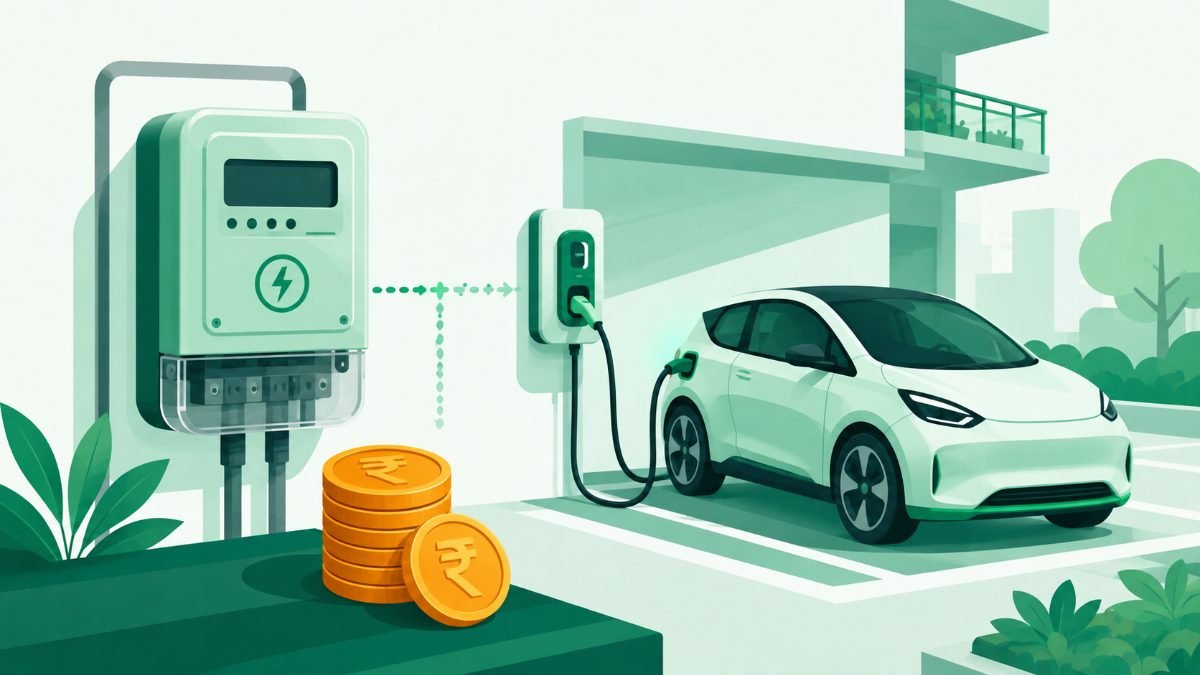
The fairest way to split shared EV-charging costs is to bill each resident for the units (kWh) they actually consume, at the rate the society actually pays, plus an equal contribution towards fixed costs such as maintenance and metering. Usage can be measured by a smart charger with per-user tracking, by RFID cards, by a dedicated sub-meter, or — for two or three trusted neighbours — by a simple logbook. Agree the method, the rate, the billing cycle, and what happens on non-payment in writing before anyone plugs in. Equal splits regardless of usage feel simple, but they collapse the moment one resident drives noticeably more than the others.
Start with the principle: pay for what you use
Electricity is the variable cost of a shared charger, and it varies a lot between residents. Someone commuting daily draws several times the energy of a neighbour who drives only on weekends. So the core of any fair split is simple: measure each resident's units and multiply by an agreed per-unit rate.
Everything else — the wiring, the charger, routine upkeep, any fixed charges on the connection — is a shared cost. These are best split equally among the registered users, or recovered through a small monthly access contribution, because everyone benefits from the charger existing whether or not they used it heavily that month.
Keep the two streams separate in your accounts. Mixing energy charges and maintenance money into one lump sum is the most common reason shared-charging arrangements turn into disputes: nobody can see what they are actually paying for. If your society has not installed a shared point yet, our guide on how to propose a common EV-charging station covers getting the project approved in the first place.
Four ways to measure who used what
How you attribute units depends on your budget, the size of the group, and how much you want to rely on trust. These are the approaches societies typically choose between:
| Method | How usage is measured | Best suited to | Watch out for |
|---|---|---|---|
| Smart charger with user accounts | The charger logs kWh per session against each user's app login or PIN | Larger groups, unattended use | Higher upfront cost; ask what happens to session data if the vendor's app stops working |
| RFID cards | Each resident taps a card; sessions are recorded per card | Societies that want access control without everyone installing an app | Cards can be lent or lost; someone must export and reconcile the reports |
| Sub-meter plus logbook | A dedicated sub-meter records total units; a shared logbook splits them between users | Small groups using a basic charger | Depends on honest, consistent entries; missed sessions cause disputes |
| Pure logbook | Residents note battery percentage before and after, and estimate units | Two or three trusted neighbours, temporary setups | Least accurate; charging losses make estimates drift from the real bill |
For a deeper look at the metering hardware itself, see our comparison of sub-meter versus smart-charger billing. Whichever method you pick, run it for one trial month and compare the attributed units against the actual meter reading. The gap — from standby draw and charging losses — tells you how much energy is going unattributed, and the group can decide upfront how to share it.
Budget for the costs electricity doesn't cover
A charger that only ever collects energy charges will eventually leave the society out of pocket. Build a small, equal monthly contribution from each registered user to cover:
- periodic inspection and servicing by a licensed electrician;
- repairs and replacement of worn parts, such as connectors and cables;
- any fixed or meter-related charges that appear on the bill feeding the charger;
- a modest replacement fund, since no charger lasts forever.
Route this money into a clearly named head in the society's accounts rather than someone's personal wallet. When users can see a separate line for "EV charger maintenance fund" alongside their unit charges, trust in the arrangement goes up sharply.
Deposits versus monthly billing
There are two workable payment models, and a sensible hybrid.
Prepaid deposits: each user pays an advance, usage is deducted against it, and they top up when the balance runs low. This protects the society completely from unpaid dues, but someone has to maintain a simple running ledger per user.
Postpaid monthly billing: units are billed at the end of each cycle, ideally as a line item on the regular maintenance invoice. This is the most convenient for residents and the easiest to audit, but the society carries the risk of late or missed payments.
The hybrid: a refundable security deposit from each user, combined with monthly billing. The deposit is only touched if a bill goes unpaid beyond the agreed deadline, and is returned when a user exits the arrangement. For most societies this balances convenience and protection well.
A worked example: three residents, one charger
All numbers here are illustrative — say the society's rate is ₹8 per unit (check your own electricity bill for the real figure), and the group has agreed a maintenance contribution of ₹300 per month, split equally. In one month the sub-meter shows 200 units, attributed as follows:
- Resident A used 60 units: 60 × ₹8 = ₹480, plus ₹100 maintenance = ₹580
- Resident B used 100 units: 100 × ₹8 = ₹800, plus ₹100 maintenance = ₹900
- Resident C used 40 units: 40 × ₹8 = ₹320, plus ₹100 maintenance = ₹420
The group collects ₹1,900 in total: ₹1,600 covers the electricity and ₹300 goes into the maintenance fund. If the main meter actually recorded slightly more than 200 units because of charging losses, the agreement should already say how that difference is shared — an equal split of the gap, or a small agreed percentage loading on each user's units, both work as long as they are written down. To sanity-check what your own monthly usage might look like, try the monthly charging cost calculator.
What to write into the agreement
A one-page written agreement prevents almost every dispute this arrangement can produce. It should record:
- the named users and the flat numbers they belong to;
- the metering method and who maintains the records;
- the per-unit rate, stated as following the society's actual bill so it updates automatically when the DISCOM revises tariffs;
- the fixed monthly contribution, what it covers, and where the money sits;
- the billing cycle, payment deadline, and any deposit with its refund conditions;
- how unattributed units and charging losses are shared;
- what happens on non-payment — typically a written reminder, then paused charging access until dues are cleared;
- how new users join, how existing users exit, and a yearly review date.
You do not need to draft this from scratch. Start from our shared charging billing agreement template, and if the society wants a broader framework covering permissions and safety as well, the RWA EV policy generator produces a discussion draft you can put before the managing committee.
Common questions
Can we just split the bill equally instead of metering?
Only if the group is tiny and everyone genuinely drives similar distances — and even then, driving patterns change. The heavy user ends up subsidised by the light user, resentment builds quietly, and the arrangement fails at exactly the moment the society most needs it to work. Even a basic logbook beats an equal split.
What per-unit rate should we charge?
Use the rate the society actually pays on the bill that feeds the charger — read it off the bill rather than guessing, since the applicable tariff can depend on how the connection is classified. Confirm with your DISCOM what applies to your setup. Never add a hidden markup; if the group agrees a small loading to cover losses or admin effort, write it into the agreement openly.
What if a resident stops paying?
Follow the process the agreement already lays out: a written reminder, then paused charging access after a notice period, with dues recovered through the society's normal collection process. Smart chargers and RFID systems make pausing access practical without confrontation. What you should not do is improvise penalties that were never agreed — that turns a billing issue into a legal and social one.
Do we need society permission before setting any of this up?
Yes — treat written approval from the managing committee as a prerequisite, not a formality, and remember that your society's bye-laws may differ from your neighbour's. The society should also confirm that the connection's sanctioned load can support the charger before billing arrangements are even discussed.
Finally, remember that a fair billing split sits on top of a safe electrical installation, never in place of one. Before any shared charger goes live, have a licensed electrician assess the wiring, load, and earthing, and confirm connection and metering requirements directly with your DISCOM — their answers, not any general guide, determine what your society can actually do.