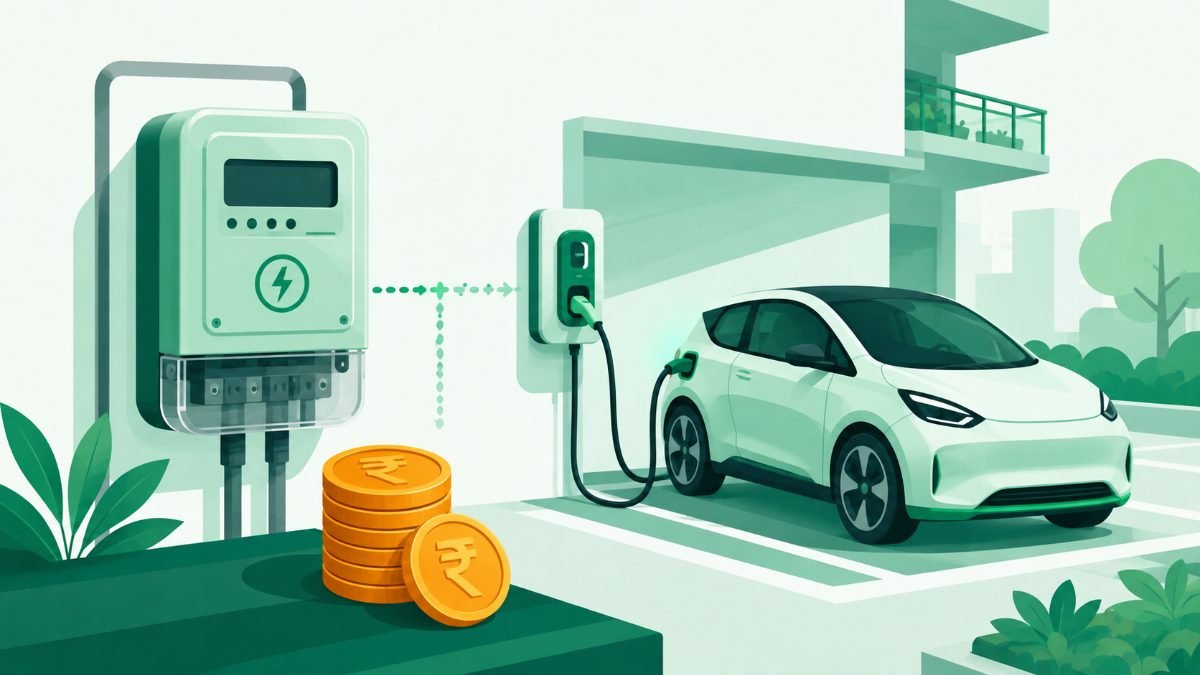
An operator offering to install a charger in your society at no upfront cost is not giving you equipment; it is financing it. The society trades capital cost for a higher price per unit, a multi-year term and, usually, control of the bay and the asset. Whether that is a good trade depends almost entirely on how many units your residents actually draw: at low volumes the funded route is usually the cheaper one, and at high volumes residents can repay the hardware many times over inside the unit price. The catch is rarely one hidden clause; it is spread across ownership, price revision, exclusivity and exit.
A free installation is financed, not donated
Three costs sit inside any charging point: hardware and civil work, electricity, and maintenance. A funded offer does not remove the first; it moves it into the per-unit price residents pay, over a term long enough to recover it and earn a return. For a society with no reserve fund that can be the right trade. The mistake is treating it as a gift and skipping the scrutiny a purchase would get.
Ask in writing for the per-unit price residents pay, the term in months, what it includes and excludes, and what the society must provide. Without those four on paper, you are not comparing anything.
The break-even sum you can run on your own two quotes
Break-even units = society capital cost ÷ (operator price per unit − your own all-in cost per unit)
Your all-in cost is not just the tariff: it is the rate your society pays at that connection, plus an allowance per unit for maintenance, spares and billing time. Take the rate from your bill and the capital figure from written quotes.
A worked example on assumed numbers
Every figure below is an assumption. Replace each with your own.
- Capital cost: suppose your quote for one shared point, including civil work, cable and meter, is ₹1,20,000, and the operator's written offer to residents is ₹18 per unit.
- Your own cost: suppose your bill shows ₹9 per unit, and the committee sets aside ₹2 per unit for maintenance.
All-in cost is ₹9 + ₹2 = ₹11, so the financing margin is ₹18 − ₹11 = ₹7 per unit. Break-even is ₹1,20,000 ÷ ₹7, about 17,100 units. Beyond that volume, buying outright would have been cheaper.
When two residents charge, and when twelve do
Convert volume into months, because the term is what you sign. Suppose each regular user draws about 100 units a month; test that with the monthly cost calculator.
Two users give about 200 units a month, so break-even arrives after roughly 86 months: on a five-year term that crossover never arrives, and the funded route stays cheaper. Twelve users give about 1,200 units a month, break-even arrives in about 14 months, and residents then pay a premium on hardware already repaid.
The shape of the sum is the point, not the figures: funded deals reward low and uncertain usage, ownership rewards high and growing usage. Run both lines in the cost calculator, on your own demand estimate.
Should your society buy its own charger or let an operator install it?
Compare what bites three years in.
| Question | Society-funded and run | Operator-funded revenue share | Hybrid: society funds cabling | Residents' private points |
|---|---|---|---|---|
| Upfront cost | Hardware, civil work, cable, meter | Usually nil | Civil work and cable | Nil |
| Owner at year five | The society | Operator, unless transfer is written in | Wiring society, box operator | The resident |
| Sets the unit price | General body resolution | Operator, within contract limits | Supply at cost, fee by operator | Each resident's own use |
| Repairs and downtime | Society sinking fund | Operator, as far as committed | Society cabling, operator unit | Resident's installer |
| Exit and make-good | None; asset stays | Key risk: who restores wall and bay | Box goes, wiring stays | Resident restores on move-out |
| Admin burden | Highest: metering, recovery | Lowest: operator bills users | Moderate: reconcile supply | Low; routes policed |
| If usage stays low | Capital stranded | Little lost; operator loses interest | Exposure only on civil work | Proportionate; no shared risk |
| If usage grows fast | Best value; society controls it | Premium for years; expansion on their terms | Second point is cheap | Load and cable congestion bind |
What to check in a revenue share agreement before you sign
Put each to the operator in writing and keep the answer; what is said at a sales visit will not help you later.
Ownership, exit and make-good
- Who owns the hardware during the term, and the day it ends: transfer, buy-out, or removal?
- If removed, who pays to make good the wall, conduit, cable run and civil work?
- Can either side terminate early, on what notice and at what cost? Does the agreement bind a successor if the operator is acquired or winds up?
Price, exclusivity and the electricity behind it
- How often is the price revised, and is it indexed to something you can verify, such as your bill?
- Is there exclusivity, or a right of first refusal, blocking a private point or a second operator?
- Whose connection feeds the unit, who is billed, and how is the society reimbursed?
- What uptime and response time are committed, and what is the remedy when missed?
- What happens to wallet balances, access cards and usage data on exit, and who carries insurance?
- What must the society guarantee: minimum usage, reserved bays, signage, power at cost?
Anything touching the feeder, protective devices, earthing or load belongs to a licensed electrician assessing your building; commission an electrician site assessment first.
The three ways these deals sour
Low utilisation and a bored operator. The operator's return depends on units flowing, so where two or three residents use the point, an engineer visit may not be a priority and downtime lengthens. A written response time with a stated remedy is the practical protection.
Price revisions you cannot contest. A clause allowing revision "in line with prevailing costs" gives the operator a free hand, and leaves the committee little to argue with. Tie revisions to a figure on the society's own bill.
Exclusivity the society outgrows. Suppose a society with two EVs signs a five-year exclusive and the count reaches eleven within three years: every route to more capacity then runs through that one operator. Read that clause before the price clause; plan queuing with access control and charging etiquette.
The hybrid many societies land on
A middle route can be easier to put to a general body than either extreme. The society funds what is permanent: cable route, conduit, feeder and meter. The operator funds and maintains the box and payment layer; the society supplies units at cost against a verified meter reading, and the operator adds a stated service fee disclosed to residents.
The society keeps the immovable half, so changing operator later is a swap of hardware, not fresh cabling. It also separates electricity, which the society can evidence, from service, which is a commercial charge, heading off billing disputes under any society billing structure.
A one-page brief to table before the AGM
Circulate this with the agenda so the general body debates numbers.
- The capital quote, itemised into hardware, cable, civil work and meter.
- The operator's price and term, with exclusivity and revision clauses verbatim.
- Your supply rate from the latest bill, and the break-even built on it for two scenarios: today's EV count and a three-year forecast.
- The exit position, and a recommendation with a named review date.
Frame it with how to propose a common charging station, or if the society would rather bill charging itself, the shared charging billing agreement.
Common questions
Is a free operator-installed charger actually cheaper than buying one for the society?
Only below a certain volume. Divide your capital quote by the gap between the operator's per-unit price and your own all-in cost per unit; that is the number of units at which buying overtakes the funded deal. On the worked example's assumptions, two or three regular users never reach that crossover inside five years; a dozen reach it in about fourteen months. Use your own figures.
Who owns the charger when the operator contract ends?
Whoever the contract says, so read that clause first. Do not assume the asset becomes the society's because it stood on your wall for years, or because residents repaid its cost through the unit price; neither transfers ownership by itself.
Ask for the end-of-term position in writing: transfer at nil value, at a stated price, renewal, or removal — and if removal, who restores the wall and bay.
Can the operator raise the per-unit price residents pay, and can the society stop it?
Assume the agreement permits revision until you have read the clause and found otherwise. Leverage exists only where the contract creates it, so negotiate before signature. Ask for a maximum frequency of revision, a verifiable basis, and written notice with a right to renegotiate or exit. A revision tied to a rate on your own bill is checkable; one tied to the operator's internal costs is not.
Does an operator agreement stop individual residents from installing their own points?
It can, where it contains exclusivity or a right of first refusal covering charging on the premises. A committee that signs such a clause without noticing may later be unable to approve a resident's private point.
To keep both open, ask for exclusivity limited to shared points. The trade-offs are in private versus shared charging.
What should our society put in writing before signing a charging operator agreement?
Every item in the checklist above: ownership during and after the term; exit, make-good and who pays; exclusivity; price revision and its basis; whose connection feeds the unit; uptime and remedy; balances and data on exit; insurance. Record in the resolution that written answers were obtained, and settle visitor use with the visitor guide.