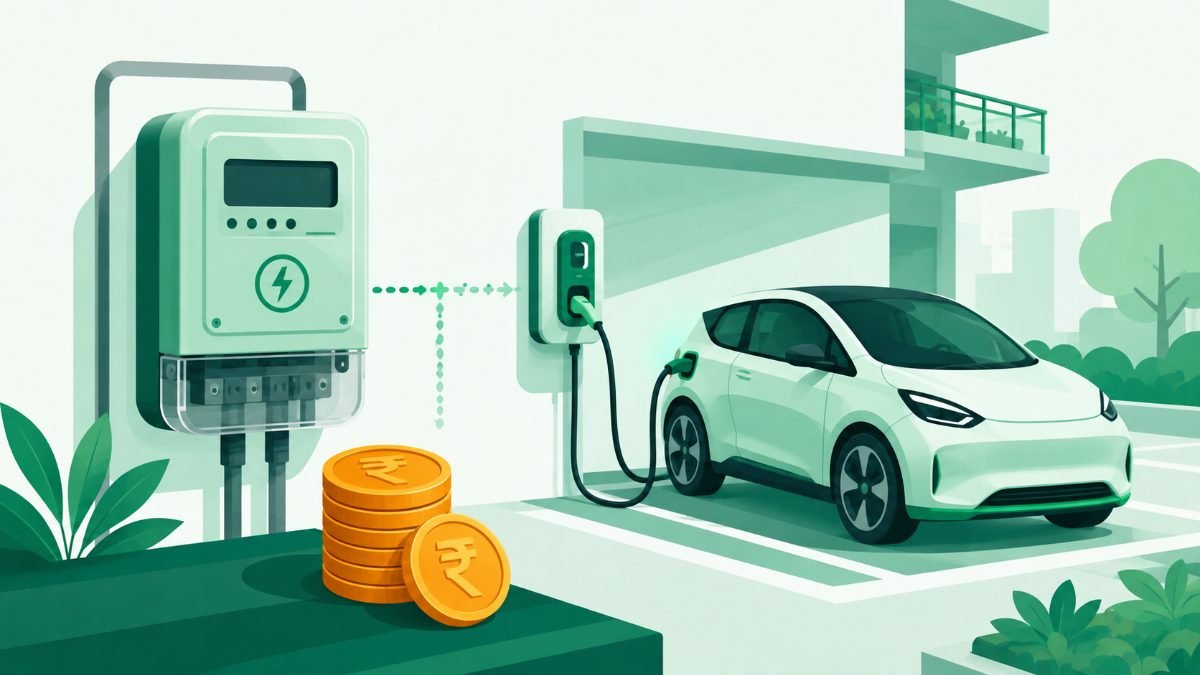
A society has three workable ways to handle visitor EV charging: not allowing it at all, allowing paid guest sessions at a metered shared charging point, or allowing guests to charge only when a resident sponsors the session and the cost lands on that resident's bill. Which one fits depends on whether your society already has a common charging point, how it is metered, and how much administration the committee can realistically manage. Whatever you choose, put it in writing as a short committee-approved rule, set a clear per-unit guest rate that covers electricity plus a small margin, and keep a simple session log. Most visitor-charging disputes come from unwritten assumptions, not from the electricity itself.
First, decide whether guests should charge at all
It is a legitimate choice for a society to say no. Common-area electricity is paid from maintenance collected from every flat, so a guest vehicle drawing power from the society's meter is, by default, subsidised by residents who never agreed to host it. The real question is how often the situation actually arises.
- Does the society have a shared charging point? If there is no common charger, there is usually nothing to offer guests anyway — visitor charging then reduces to whether a guest may use a resident's private point, which is largely between the resident and their own meter.
- How often do requests come in? One request a quarter can be handled case by case. Weekly requests — visiting parents with an EV, a car-pool friend, a regular driver — need a standing rule, or the committee will spend every meeting relitigating the same question.
- How much administration can the committee absorb? Paid sessions need someone to read meters, collect money, and keep a log. If nobody will do that reliably, choose a simpler option.
If your society is still weighing whether to build a common point at all, read our guide on how to propose a common EV-charging station first — visitor policy is much easier once the shared-infrastructure question is settled.
Three workable approaches, compared
Almost every workable visitor policy falls into one of three patterns.
1. No guest charging. Simple, defensible, zero admin. The society's points are for residents only. The trade-off is inflexibility: the visiting relative stuck at 8 percent has no option except a public charger outside the gate.
2. Paid guest sessions at the shared point. Guests may charge at the common charger at a published per-unit rate, paid before or immediately after the session. This is the fairest option when there is spare capacity, but it needs metering, a rate, and a collection process.
3. Resident-sponsored sessions. A guest may charge only if a specific flat hosts the session, and the units consumed are billed to that flat along with its regular charging dues. The society never chases an outsider for money — the host flat is responsible. This works especially well where billing already runs through sub-meters or a smart charger, as explained in our comparison of sub-meter versus smart-charger billing.
| Approach | Best suited to | How it is billed | Admin effort |
|---|---|---|---|
| No guest charging | Societies with no shared point, or points already at capacity | Nothing to bill | None |
| Paid guest sessions | Societies with a metered common charger and spare capacity | Published per-unit rate, collected per session | Moderate — readings, collection, session log |
| Resident-sponsored | Societies that already bill residents per unit | Units added to the host flat's regular bill | Low — rides on existing billing |
Many societies combine the second and third: sponsored sessions as the normal route, with committee-approved paid sessions for genuine one-off cases. The wider trade-offs between private and shared points matter here too — see private versus shared EV charging in apartment parking.
Metering guest sessions and setting a fair rate
Whatever you charge a guest must be grounded in a meter reading — never an eyeball estimate of "about an hour of charging". If the common point has an energy meter or a smart charger that logs units per session, you already have what you need: note the reading before and after, and bill the difference.
For the rate, a sensible structure is the society's own cost per unit plus a modest margin for wear, metering losses, and volunteer time. A worked example with illustrative numbers: say electricity on the society's common meter works out to ₹9 per unit (check your society's actual bill — common-area rates vary). If a guest session delivers 10 units, the raw electricity cost is about ₹90. A guest rate of, say, ₹12 per unit would recover ₹120 — the electricity plus roughly ₹30 towards upkeep. Those figures are examples, not recommendations; the principle is that the rate should be published, applied to everyone equally, and reviewed whenever the society's own tariff changes.
Collect payment before the session or immediately after, by UPI to the society's account, and record it — chasing a departed guest for money is a losing game. That is exactly why the resident-sponsored model, where the host flat carries the cost, is so much easier to run. If flats will be billed for sponsored sessions, a short signed understanding helps; our shared-charging billing agreement template covers the essentials.
Keeping visitor charging from being misused
The common failure modes are predictable, and each has a simple counter:
- Outsiders treating the society as a public station. Require every guest session to be linked to a host flat and logged at the gate with normal visitor entry. No host flat, no session.
- Residents routing their own charging through "guest" sessions. This only pays off if the guest rate is cheaper than the resident rate — so keep the guest rate equal to or higher than what residents pay, never lower.
- Guest vehicles occupying the point for hours. Set a session cap suited to your charger's speed and give residents priority during evening hours when demand peaks.
- Disputed or unpaid sessions. Prepayment or host-flat billing removes the problem. Without either, the committee becomes a collection agency, which nobody signed up for.
Five rules a society can adopt this month
A visitor-charging policy does not need ten pages. Five lines, adopted in a committee meeting and circulated, cover nearly everything:
- Guest vehicles may charge only at the designated common point, never from common-area sockets or unauthorised extensions.
- Every guest session must be sponsored by a resident flat, which is responsible for the units consumed.
- Units are measured by the point's meter and billed at the published guest rate, reviewed whenever the society's tariff changes.
- Guest sessions are capped at a stated duration — many societies pick two or three hours — and give way to resident bookings at peak times.
- The facility manager or a named committee member keeps the session log, which the committee reviews monthly.
If you would rather start from a fuller document, the RWA EV policy generator produces a discussion draft you can adapt, and the society EV charging policy draft shows visitor clauses in the context of a complete policy.
Common questions
Can a guest simply use a resident's private charger?
Generally yes, and it is the least complicated arrangement: the electricity flows through the resident's own meter, so the society has no billing role. The society's interest is limited to parking rules — the guest vehicle must stand where charging is permitted — and any safety conditions attached to the private point. Your society's bye-laws may add conditions, so check the approved policy.
Should guests pay more than residents?
A modest premium is reasonable — it covers wear and administration, and it removes any incentive to disguise resident charging as guest sessions. But visitor charging should not become a profit centre. A rate visibly anchored to the society's real cost per unit, published on the notice board, keeps the arrangement uncontroversial.
What if we have no shared charger at all?
Then the honest default is a no-guest policy, because there is nothing metered to offer. Occasional emergencies can be handled by a resident sponsoring a slow top-up from their own point where one exists. If guest demand keeps coming up, treat it as one more argument for building a common station.
Can the committee refuse guest charging outright?
Managing common electricity and parking is normally within a committee's remit, so a written no-guest rule is usually defensible — provided it is recorded in the minutes and applied consistently to every flat. Bye-laws differ between societies, so if the decision is contested, put it to the general body rather than leaving it as informal practice.
One final caution: anything touching the charging point's wiring, metering hardware, or the load on the society's connection should be checked by a licensed electrician, and your DISCOM is the authority on how the point may be connected, metered, and billed. Adopt the rules yourselves — but let the professionals confirm the electrical side.