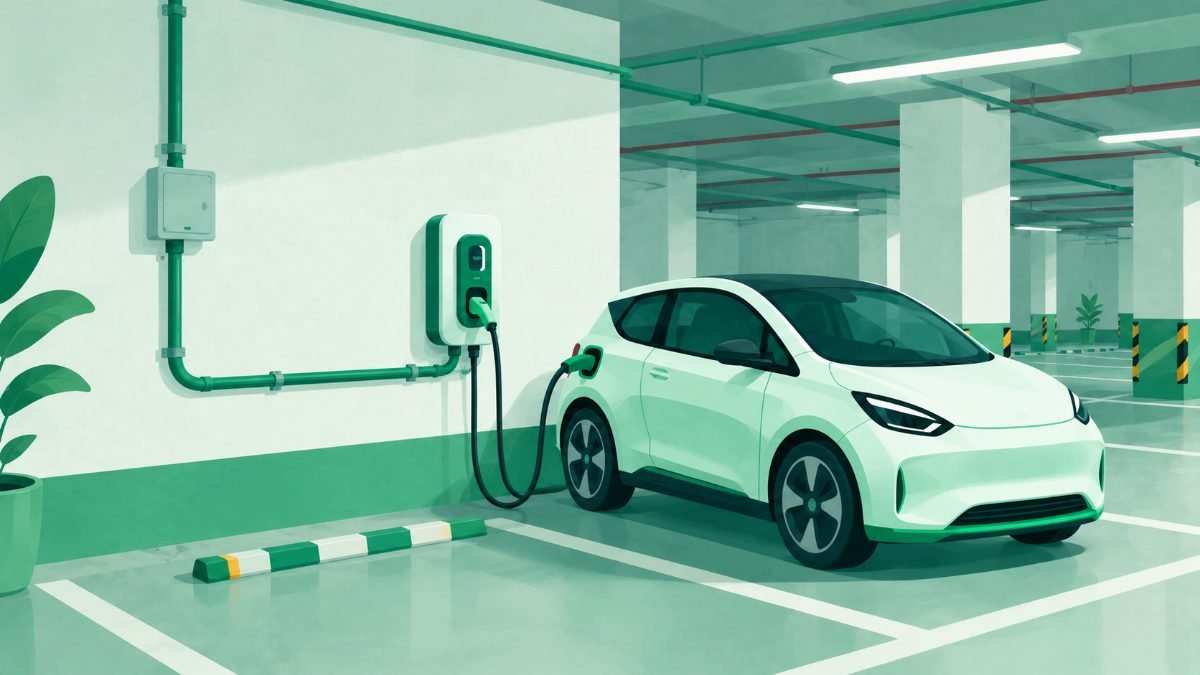
A charge point is bolted to a wall and wired to one bay, so when nobody owns a bay your job changes. You are not asking permission to fit a charger in your slot; you are asking the society to adopt a shared arrangement any resident could use. That is a committee decision before it is an electrical one. Four routes are realistic: designate one or two bays near the distribution board as EV bays; re-allot bays so EV owners sit nearest the electrical room and fund points there; fit a charge post serving a cluster of bays with per-user identification; or run a portable charger at a designated metered socket bay by appointment.
Why "no fixed slot" changes the job
A wall box, its protection and its earthing attach to one spot in the basement or stilt, and none of it follows a car around a rotational roster. The usual route — resident applies, pays, charges in their own bay — collapses at step one. If bays rotate, go by ballot or work first-come, you are proposing common infrastructure: less like permission for your own bay, more like proposing a common station.
Ask for the allotment basis in writing first
We will not tell you who owns stilt or open parking; that turns on your own documents. Ask the committee by letter or email, because the answer decides which arrangement is open to you, and file the reply with your charging records.
- On what basis are bays allotted — purchase, permanent allotment, rotation, ballot or first-come?
- For what term does an allotment hold, and who may change it?
The four arrangements compared
| Arrangement | Cost and who funds it | Ownership when bays rotate | User identified by | What breaks first |
|---|---|---|---|---|
| Designated EV bays near the board | Short run per bay; society or a pool of owners | Society owns it, tied to a reserved bay | Session log or token | The booking sheet |
| Re-allotment near the electrical room | Cheapest runs; each owner funds their own | Stays with the bay; later occupants inherit | Per-bay sub-meter | Goodwill, once nearby bays run out |
| Charge post serving a cluster | One larger run; society-funded | Society owns it; no outlet belongs to anyone | Token, card, code or app | Available load, before outlets do |
| Portable charger at a metered socket | Lowest: one socket; user owns the cable | Nothing permanent; the socket is the building's | Signed start and end readings | The diary |
How each arrangement works in practice
Designated EV bays on a booking basis
Take the one or two bays with the shortest, safest route from the distribution board, reserve them for charging, and let residents book a window, charge and move out. Have the route assessed on site first: see routing options.
Re-allotment so EV owners sit nearest the electrical room
If bays are re-allotted anyway, the committee can offer residents declaring an EV the bays nearest the electrical room and let them fund a point there, tied to the bay rather than the person. Settle in writing what happens when that resident moves out.
A charge post serving a cluster of bays
One post can be sited to reach several adjacent bays and identifies the user rather than the bay, which is why it survives rotation best. Settle who may unlock an outlet, in access control, and how capacity is shared, in load management.
A portable charger at a designated metered socket bay
A sub-metered socket point used by appointment gets people charging while the larger decision is taken; minute it as interim, with a review date, or it quietly becomes permanent. A domestic socket in a parking area was not put there for repeated multi-hour loads, and whether yours can serve as a charging point is a question for a licensed electrician inspecting that circuit. See portable against wall box.
Paying for a point on a bay that is not yours
Someone must fund hardware they may not be parked beside next year, so pick a recovery mechanism before anyone pays: a per-unit surcharge that lapses once the capital is repaid, or a joining contribution later users buy into. Every figure below is an assumption chosen to show the working. Replace each with the number from your own quote, sub-meter and bill.
- Suppose one point is quoted at ₹36,000 including cable, protection and sub-meter. Use your own figure from three written quotes: see comparing quotes.
- Suppose three residents draw 600 units a month between them. Take your own figure from the sub-meter.
- Suppose the society sets a surcharge of ₹3 per unit above its own supply rate. That collects 600 × ₹3 = ₹1,800 a month, so ₹36,000 ÷ ₹1,800 = 20 months to repay.
- Under the joining route the first three pay ₹36,000 ÷ 3 = ₹12,000 each. A fourth joiner pays ₹36,000 ÷ 4 = ₹9,000, refunding ₹3,000 to each of the first three.
- Record who contributed what, and that the society owns the point, so rotating parking never rotates ownership. Try your own numbers in the cost calculator.
Then identify the user, not the bay. A sub-meter shows how many units left the point, not who took them, so you need a per-user session log or signed readings per booking, reconciled monthly. See sub-meter against smart-charger billing and splitting costs.
The car that has finished charging but has not moved
An occupied charging bay blocks everyone behind it, and this ends more shared arrangements than any electrical fault. Settle the rules before the first session, not after the first argument, and pair them with the habits in shared charging etiquette.
- Fix a maximum session length rather than a charge percentage, so nobody argues over a dashboard reading.
- Agree a grace period after the session ends before a car counts as overstaying, and write your chosen figure into the rule.
- Require a reachable mobile number at the security desk, and agree in advance the consequence for repeat overstaying.
Going from two EV owners to twelve
One bay and a paper diary suit two owners. Add a few more and the diary starts producing arguments, and the first serious question about total load arrives with them. At ten or twelve you need several points and an honest count of outlets: see how many points a society needs. Ask your electrician to price conduit sized for expansion against opening the same trench twice, and remember that only a licensed electrician assessing your building can say what spare capacity exists and what protection each point needs: see the site assessment. If you are refused outright, read next steps after a no.
What a renter can ask for, and how to record it all
As a tenant you cannot ask the society to alter the building on your account, and you will not want to fund hardware you leave behind. Ask for access instead.
- Ask your landlord in writing to confirm you may use any resident charging facility, and to raise it with the society.
- Ask the committee to register you as an authorised user of an existing point and to bill you directly.
More detail sits in the renter's guide. Whatever is agreed, get it into a resolution naming the bays, the owner of the point, the billing method, the recovery mechanism and the move-off rules, and keep the user register in the society's records. Bring a draft so the meeting edits rather than invents: see the AGM guide and the policy draft.
Common questions
Can I install an EV charger if my society does not give me a fixed parking slot?
Not as a private installation in "your" bay, because you have no bay to attach it to. Ask the society instead to adopt a shared arrangement — designated EV bays, re-allotment near the electrical room, a cluster charge post, or an interim metered socket — and to record the choice in a resolution.
Begin by asking the committee, in writing, for the basis and term of allotment; that answer rules out at least one route.
What happens to the charger I paid for if my parking slot is reallocated next year?
This is why the point should belong to the society and stay with the bay, with your money recorded as a contribution rather than ownership of equipment. Fix the recovery mechanism before installation: a surcharge that lapses once the capital is repaid, or a joining fee later users buy into, refunded pro rata.
If nothing was written down and you have paid for hardware now sitting beside someone else's car, you are relying on goodwill; ask for the contribution and refund basis to be minuted, even late.
How does a society bill EV charging when several people use the same point?
By identifying the user rather than the bay. A sub-meter gives the total units drawn but not who drew them, so you need a per-user session log, or signed start-and-end readings per booking, reconciled monthly against that total. Publish the rate build-up too: supply rate, any recovery surcharge, any maintenance share, each shown separately.
Is a portable charger a reasonable stopgap when parking is rotational?
As a deliberately temporary measure at one properly installed, sub-metered socket point used by appointment, yes. Minute it as interim and set a review date when you adopt it.
It is not a substitute for a proper point: sessions are long, the diary jams once a few residents rely on it, and only a licensed electrician inspecting that socket and circuit can say whether it suits repeated long loads.
How do we handle a car that is fully charged but still occupying the charging bay?
Use a maximum session length rather than a charge percentage, add a written grace period after it ends, and require a reachable number at the security desk. Name one person on duty, normally the security supervisor, as the only one who asks a car to move, so it never becomes resident against resident.
Log overstays for a couple of months before proposing penalties, then read the log: a handful of repeat offenders is a conduct problem, while overstays spread across everyone means the bay is oversubscribed, and the answer is another point, not a stricter rule.