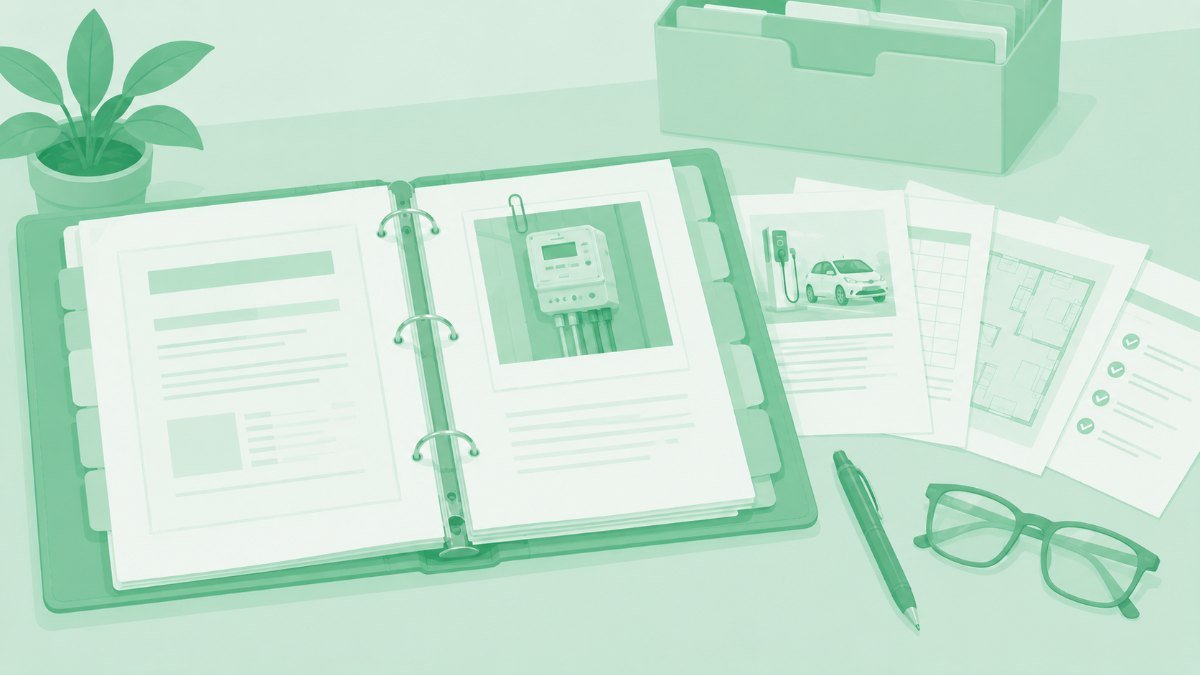
Keep one folder, physical or digital, holding nine things: your society's written permission, the installer's scope and quote, the electrician's test and inspection record, the earthing and protection-device details, any connection or load paperwork from your DISCOM, the sub-meter serial number with its opening reading, the warranty terms, photographs of the cable route before it was concealed, and a maintenance log. That file takes an hour to assemble and settles almost every argument that comes later: what tripped and why, who agreed to what, and what the next resident inherits.
The three moments the file earns its keep
The day something faults
The charge point trips at eleven at night and will not reset, and the electrician who arrives may not be the one who installed it. The first questions will be what protection device is fitted and at what rating, how the cable was run and in what size, and where the isolation point is. Answer from a folder and the visit stays diagnostic; fail to, and it begins with an hour of opening up trunking that you pay for. Our guide to RCCB, MCB and RCBO explains those ratings.
The day it becomes a dispute
Managing committees turn over. The secretary who walked the basement with you may be gone within a year, leaving the next committee with only a rumour that someone drilled a wall. Written permission with a meeting reference behind it turns a personality question into a records question. The same applies to money: if the society agreed the wiring was your cost and the supply point theirs, that split must exist somewhere other than in two memories.
The day you sell or vacate
A buyer looking at a fitted charge point will want to know whether it is authorised and transferable. A tenant leaving asks the mirror image: does the equipment come off the wall, and who is owed what. Both are painless if the permission letter said what happens on transfer, so if you rent a flat, read our note on charging in a rented flat before installing.
The society permission letter
A one-line approval in a group chat is not a record. Ask for something on society letterhead, signed, that a stranger could read in five years and understand. It must be specific about the following.
- Your name, flat number and the parking bay, identified the way the society's own records identify it.
- The date of approval and the meeting or resolution reference behind it.
- The supply point the charger draws from, and who owns the cable from there to your bay.
- The metering and billing basis agreed, and who takes readings, how often.
- Who owns the equipment, and who pays for repair, replacement and eventual removal.
- What happens if you sell the flat, sublet it or move out.
- Any conditions attached: charging hours, load limits, or use of a licensed electrician.
- Signatures of the office bearers, with their designations.
If approval is still pending, the structure of the request matters as much as the answer; our walkthrough on requesting charger permission from your RWA covers what to put to the committee.
The installer's scope and the electrician's test record
Keep the quote you accepted and the invoice you paid together, because the useful information often sits in the gap between them. A scope worth filing names the cable type and cross-section, the measured run length, the route, the isolation arrangement, the protection device, how the unit is mounted, and what is excluded. Installations change on site, so if the route or run length changed, ask for the scope to be reissued as built: a quote describing work never done will confidently mislead the next electrician.
The test record is the part most easily overlooked, and the part that matters most. Everything to do with wiring, load, earthing, protection devices and fire risk depends on the specific building, run and supply, and must be assessed on site by a licensed electrician. No folder substitutes for that. Ask, before the final payment, for a signed record giving the date of work, the electrician's name and licence or registration details, the tests performed on completion, the readings obtained, and their conclusion. Interpreting those readings is their professional judgement, not yours; you hold the paper so a future electrician can compare against it. Our explainer on what an electrician checks in a site assessment covers the ground, and why earthing deserves its own page in the file.
Meter, supply and DISCOM paperwork
If the charger runs from your own flat connection, keep whatever your DISCOM issued about it, including any application, approval or revised demand note if the sanctioned load was changed. If nothing changed, write a dated line saying so: a later capacity question is easier to answer with a note than silence. The background is in our guide to sanctioned load and EV charging.
If a sub-meter was installed, record the serial number and the make and model exactly as printed on the body, the installation date, the reading on the day it went live, its location and any seal reference. That opening reading is the most valuable number in the file: without it, the first billing cycle is a negotiation instead of a subtraction.
The arithmetic is then trivial. Suppose your society bills EV units at ₹9 per unit — substitute your own figure, taken from your society's accounts or the bill it pays, because rates differ everywhere. If your meter read 000012 at installation and 000212 at the first reading, that is 200 units, and 200 × ₹9 is ₹1,800 for the period. If the billing basis is unsettled, compare the approaches in sub-meter versus smart-charger billing.
What to keep, why, and who gives it to you
| Document | Why it matters | Who issues it |
|---|---|---|
| Permission letter, with meeting reference | Shows the work is authorised, and on what terms, after the committee changes | Your society or RWA |
| Quote, as-built scope and invoice | What was installed, in what size, along what route, and who paid | Your installer |
| Test and inspection record | Shows the work was checked on completion, and by whom | Your electrician |
| Connection or load paperwork | Answers capacity questions without guesswork | Your DISCOM |
| Sub-meter details and opening reading | Makes every later bill a subtraction, not an argument | Whoever fitted it, countersigned by the society |
| Warranty and service terms | Who to call, for how long, and what voids the cover | The supplier, through your installer |
| Route photographs before concealment | Shows where the cable runs behind finished surfaces | You, on the day |
| Maintenance log | Turns intermittent faults into a diagnosable pattern | You, one line at a time |
Warranty terms, photographs and a maintenance log
Read the warranty on the day it is handed over, not on the day the unit fails. Note the start date, the duration, what is covered as against what counts as a consumable or installation work, who you contact, what voids the cover, and whether a site visit is included or billed.
Then take photographs, at the right moment. Once a chase is plastered or a conduit boxed in, the route exists only in someone's memory. Photograph the open run end to end, the connection at each end, and the meter face showing its serial number and reading. Our overview of cable routing options explains why; if any of it sits outdoors, photograph the sealing and drainage too.
A log is only useful if it is short enough that you keep it. One line per event is enough; the dates give it its value: an electrician can work with "tripped three times in the week after the first heavy rain" and nothing with "it trips sometimes".
- Date and outcome of any inspection or servicing, and who attended.
- Every nuisance trip: date, time, what was charging, and the weather.
- Any replacement of a protection device, cable, socket or the unit.
- Meter readings at each billing cycle, kept as a simple running list.
Log any change in society rules, charging hours or billing rate. Set an annual reminder to walk the installation and log that even when nothing is wrong; the routine checks are in our guide to maintaining an apartment charging point. Keep a scan somewhere that survives a lost phone, and give the society a copy of the permission letter and meter details.
Common questions
Is a message from the society secretary enough approval?
A message in a group chat is better than nothing and weaker than a letter. It shows intent at a moment in time, but it rarely records the bay, the supply point, the billing basis or what happens when you move out, and it survives only as long as the handset it sits on.
Treat it as a first step: ask for confirmation on letterhead with the meeting reference, and keep the chat thread as evidence. What your society's by-laws require is a question for the committee and an appropriate local professional.
How long should I keep EV charger paperwork?
For as long as the installation exists, plus the period you might reasonably be asked about it after you leave. Permission letters, test records and the opening meter reading have no natural expiry: their value is that someone can look them up years later.
My installer will not give me a test record. What now?
Ask once in writing, naming what you want: date, licence or registration details, the tests performed, the readings obtained and a signed conclusion. An electrician who has done the work properly has no reason to refuse. A continued refusal is itself information: pay a different licensed electrician to inspect and record the installation, which also gives you a baseline.
Does the paperwork transfer when I sell the flat?
The documents are simply handed over, which is one of the easier ways to make a fitted charge point look like an asset. Whether the society's permission transfers with the flat is separate, and depends on the letter and on your society's own by-laws. That is why the letter should address transfer when it is issued; if yours does not, ask the committee to confirm in writing before you sell.
What if I only use a portable charger from a socket?
You need less, but not none: keep the permission covering that socket, the electrician's note on what it and its protection are rated for, and your meter readings. A socket that suited a drill may not suit hours of sustained draw, as our comparison of a portable charger against a wall-box explains.