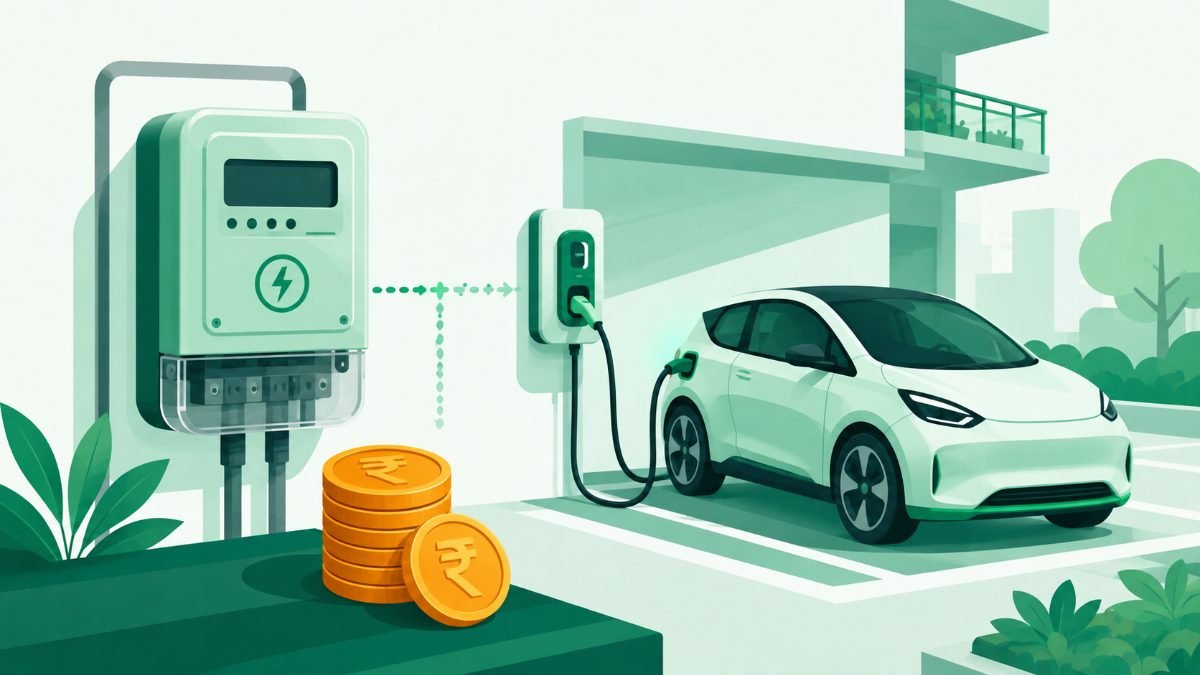
The fair default is beneficiary pays: you pay for everything that exists only because you charge a vehicle — the charger, the dedicated cable run from your meter, the protection devices, the sub-meter — and the society pays for what serves the whole building, including common electrical work it needed anyway. Costs that genuinely serve both sit in the middle, and should be split by a rule written down before work starts, usually with the first mover partly reimbursed as later residents connect. Below is how that line gets drawn item by item, and what to record so it holds.
Why beneficiary-pays survives a committee meeting
Committees are rarely arguing about cable. They are arguing about cross-subsidy: maintenance dues come from every flat, so any rupee of charger cost paid from that pool is paid partly by residents who will never own an EV. Beneficiary-pays removes that objection entirely.
It cuts the other way too. Asking for a charging point is not volunteering to fund an upgrade the building has deferred for years: if the site check turns up an ageing common panel or a neglected earth pit, your request revealed the problem — it did not cause it.
Which costs sit on which side of the line
Costs that follow the resident
- The charger unit and its mounting.
- The dedicated circuit from your meter to your parking spot: cable, conduit, labour, and making the wall good afterwards.
- Protection devices for that circuit — the MCB, and the RCCB or RCBO your electrician specifies.
- A sub-meter, if your metering plan uses one; the routes are compared in own meter, sub-meter or common meter.
- Anything on the utility side of your own connection. If the charger takes your flat past its sanctioned load, the application, any revised deposit and the utility's charges are yours. Those charges, and whether a test report is required, differ by state and utility — ask your DISCOM for its current schedule before you budget, and see our load-enhancement walkthrough.
- Ongoing electricity at the agreed rate, plus repair and replacement of your own equipment.
Costs that follow the society
- Shared charging points the society installs — wiring, metering, enclosure and signage.
- Common electrical repairs or upgrades made for general benefit, including defects an EV site check happens to reveal.
- Routine testing of the common system every flat's supply depends on.
- Reinstatement of common areas after society-initiated work.
The grey zone: upgrades one resident triggers and everyone later uses
The contested items are those built bigger than one charger needs: a heavier riser cable, a parking-level distribution board, an oversized conduit laid while the trench is open. One test settles most cases — if the next resident can connect by running only their own cable into what already exists and adding a breaker, everything they did not have to redo was shared benefit.
- First mover pays, later users reimburse. Say the shared portion is quoted at ₹40,000 (illustrative; use your own quotes). Built for four connections, each later user pays ₹10,000 to the society, which credits the first mover. Failure mode: nobody else connects, and the first mover has funded idle capacity. Cap the window at an agreed number of years, after which nothing is owed.
- Society funds, recovers a connection fee. The society owns the shared asset and sets a one-time fee recovering its cost over an expected number of chargers, plus a small annual contribution towards testing. Administratively the cleanest. Failure mode: common money goes out before anyone connects, so it needs a properly minuted general-body decision.
- Cost-share group up front. Best when three or four residents want chargers in the same season. Split the shared portion equally per connection, never by cable length or car size — distance from the meter is a private cost, and letting it into the shared pot re-imports the arguments you were avoiding.
A worked split for one installation
Take a resident installing a wall box about 25 m from their meter, on a route through a common shaft where the electrician suggests a larger conduit so two neighbours can follow later without reopening the wall.
| Item | Paid by | Why |
|---|---|---|
| Charger unit and mounting | Resident | Serves one flat |
| Cable from meter to parking spot | Resident | Serves one flat |
| MCB and RCCB/RCBO on the circuit | Resident | Protects that circuit only |
| Sub-meter and enclosure | Resident | Measures one resident's use |
| Oversized conduit and trenching | Resident up front; one-third refunded per later connection | Capacity built for three |
| Earthing defect found at the site check | Society | Pre-existing building issue |
| DISCOM charges to raise sanctioned load | Resident | That flat's own connection |
| Making good and repainting the shaft | Resident's contractor | Resident-initiated work |
Numbers help a committee decide, even illustrative ones: if the shared conduit line is ₹36,000, each later user repays ₹12,000. Treat that as a stand-in for your own quotes, not price guidance — cable size and route length move the total enormously. The charger cost calculator gives a range with every assumption labelled.
What to put in writing before the first drill hole
Most wiring-cost disputes trace back to something everyone assumed was obvious. A one-page annexure to the permission letter prevents them. Record:
- An itemised scope, each line marked private or shared with its amount. Ask the contractor to itemise before approval — a lump sum cannot be split fairly afterwards.
- Ownership: whether the shared conduit becomes society property once reimbursed, or stays yours.
- The reimbursement rule — amount per later connection, who collects it, who is paid, and the deadline after which nothing is owed.
- Who may connect to the shared portion, so nobody taps in without the electrician confirming there is capacity.
- Maintenance and testing responsibility for each item, at an interval your electrician recommends.
- Reinstatement standard and timeline for common areas.
The RWA policy generator drafts these clauses, and the society EV charging policy draft shows where they sit in a full policy. If your society has not settled how charging is billed at all, start with how housing societies bill EV charging.
Resale, tenancy and transfer: who owns the wiring later
Fixed wiring is generally treated as a fixture of the flat: conduit, cable, sub-meter and usually the wall box pass to a buyer, along with the conditions attached to the original permission. Two lines in that letter save real trouble later.
State that permission runs with the flat on the same conditions — without it, a buyer can find they own a charger they may not use until they re-apply. Then deal with the reimbursement right: say whether money still owed from future connections transfers to the buyer or is settled at the sale. Otherwise the society faces a claim two years later from someone who has moved out.
A departing owner may take the charger unit if the letter allows it, provided an electrician caps the circuit safely and the society records the change. In rented flats the tenant usually funds the charger and the electricity, but the owner must consent because the work attaches to their property; agree upfront whether it is removed or compensated for, as our guide for renters sets out.
Common questions
Can a society charge EV owners a one-time fee for using common wiring?
Societies commonly do, and a fee that recovers actual shared-infrastructure cost is easier to defend than a round number picked in a meeting. Adopt it through your society's normal decision-making, record the basis for the amount, and apply it equally to everyone who connects. What your bye-laws permit varies, so have the arrangement reviewed first.
Should the society pay if the electrician finds the building's panel is unsafe?
Generally yes — a pre-existing defect is a building cost, revealed by the EV request rather than caused by it. Ask the electrician to quote in two clearly separated parts: work the building needs regardless, and work needed only for the charger. That one request settles most of these arguments before they start.
Who pays if a resident's charger trips the common supply?
Investigate before assigning blame. If the fault sits in the resident's own circuit or equipment, it is theirs; if the charger merely exposed an undersized or already-faulty common element, that is the building's. A properly protected dedicated circuit should isolate its own faults, which is why societies are right to insist on one.
Three of us are installing together — how do we split the shared cost?
Split the shared portion equally per connection, not by cable length, car size or expected mileage. Distance from the meter is a private cost and belongs to whoever is far from theirs. Write down what a fourth resident pays to join later, and how that money is shared among the original three.
Everything above is about money, not about wires. Cable sizing, protection ratings, earthing adequacy and whether your building can carry the extra load are site-specific judgements for a licensed electrician, and the load, metering and connection rules for your supply are for your DISCOM to confirm. Get both before committing to a quote. This describes common practice, not a legal requirement, so have your final arrangement reviewed before your society adopts it.