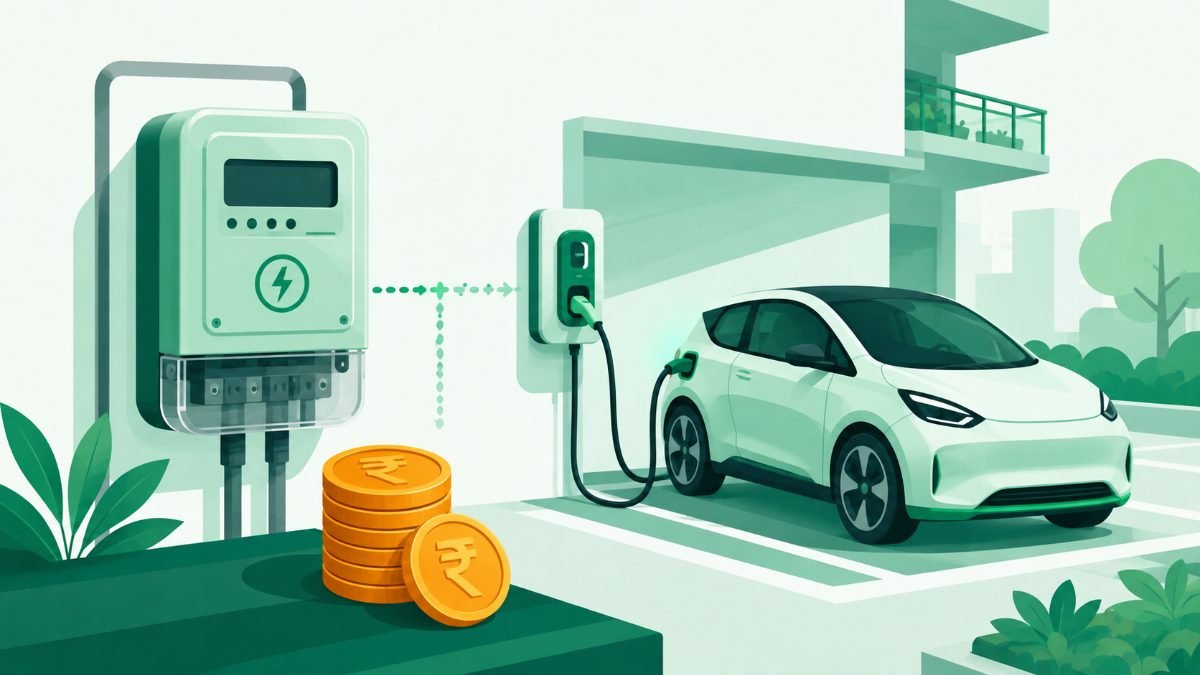
The fairest way for a housing society to bill EV charging is to measure the electricity each vehicle actually uses and charge for it at a clearly agreed per-unit rate — through a separate DISCOM connection, a society-installed sub-meter, or a smart charger that records consumption. Where measurement is not yet possible, a written reimbursement formula based on recorded readings works as a stopgap. The one model that reliably causes disputes is the flat monthly fee, because light users end up subsidising heavy users. Whichever route your society chooses, put it in writing before the first charger goes in: who pays for the wiring, what rate applies, how readings are taken, and how disagreements are settled.
Start with the principle: pay for what you use
Almost every EV billing dispute in a society traces back to one root cause: somebody is paying for electricity somebody else consumed. Petrol never had this problem — you filled your own tank at your own cost. The moment charging happens through society infrastructure or a common meter, that clean separation disappears, and the managing committee has to recreate it.
So before comparing hardware, agree on three principles. First, consumption should be measured, not assumed, wherever practical. Second, the rate should be transparent — any resident should be able to see how it was derived from the society's actual electricity bill. Third, infrastructure costs and energy costs are separate questions: who funds the wiring is a one-time decision, while who pays for units consumed is a monthly one. Societies that blur these two end up arguing about both at once.
The five billing models at a glance
Nearly every arrangement a society can adopt falls into one of five models. Here is how they compare; the sections that follow go deeper into each.
| Billing model | How energy is measured | Best suited for | Main risk |
|---|---|---|---|
| Separate DISCOM meter | DISCOM bills the resident directly | Long-term private chargers; residents who want full independence from society billing | Feasibility depends on meter-room space and your DISCOM's process |
| Society sub-meter | Society reads a dedicated sub-meter and adds the cost to the maintenance bill | Private charge points fed from a common supply | Needs reading discipline and a fairly derived rate |
| Smart charger | Charger logs units per session or per user automatically | Shared charging stations; societies that want automated billing | Higher upfront device cost; dependence on an app or platform |
| Common-meter reimbursement | Usage estimated or logged manually, reimbursed to the society | Temporary or very small setups | Estimates drift from reality; weak audit trail |
| Flat monthly fee | Not measured at all | Almost nothing beyond a short, explicitly temporary trial | Light users subsidise heavy users; disputes are near-guaranteed |
The metered routes: separate meter, sub-meter, smart charger
A separate DISCOM meter is the cleanest arrangement on paper. The resident applies for a new connection for their charging point, the DISCOM bills them directly, and the society stays out of the money flow entirely. Whether it is practical depends on your building — spare space in the meter room, a workable cable route to the parking spot, and your DISCOM's own procedure for additional connections, which you should confirm before assuming anything.
A society sub-meter keeps the supply on the society's connection but places a calibrated sub-meter on the line feeding the charge point. Someone reads it monthly, multiplies the units by the agreed rate, and adds the amount to that flat's maintenance bill. It is simple, cheap, and auditable — provided readings actually happen on schedule and the rate is set honestly.
A smart charger builds the metering into the device itself, logging consumption per session and often per user via an app or RFID card. This shines for shared stations, where one machine must bill many households. The trade-offs between these two approaches — accuracy, cost, failure modes — are covered in detail in our guide to sub-meter versus smart-charger billing. And whichever you pick, settle the infrastructure question separately: our guide on who pays for apartment EV-charger wiring walks through the usual cost-sharing patterns.
Why flat fees go wrong: a worked example
Flat fees feel easy — one number, no meters, no monthly arithmetic. Here is why they collapse, using deliberately round illustrative numbers. Say your society's cost works out to ₹8 per unit (check your own bill — yours will differ) and a typical car manages about 6 km per unit.
Resident A drives 300 km a month: roughly 50 units, about ₹400 of electricity. Resident B drives 1,500 km: roughly 250 units, about ₹2,000. Now impose a flat fee of ₹1,200 on both. Resident A is paying triple their actual cost; Resident B is paying barely more than half. Within a few months, A wants the fee cut, B wants it left alone, and the committee has no data to settle the argument — because nothing was ever measured.
Flat fees also remove any reason to charge sensibly. When the marginal unit is free, heavy use grows, the society's common bill rises, and the shortfall lands on every member's maintenance dues — including residents who don't own an EV at all.
Setting the rate: what number goes on the bill
For any society-billed model, the rate should come from the society's own electricity bill, not from guesswork. A practical starting point is the landed cost per unit: take the total amount of the relevant bill and divide by the units consumed, so that fixed charges and other line items are captured, not just the headline energy charge. Note that societies are often billed under a different tariff category than individual homes, so don't assume a resident's domestic rate applies — read the actual bill and confirm the category with your DISCOM.
Some societies add a small, disclosed component on top for wear on common infrastructure. That can be reasonable if it is agreed in a general body meeting and shown separately, never buried. Review the rate once a year or whenever tariffs change. Residents who want to sanity-check their own numbers can use our monthly charging cost calculator, and our guide on how to calculate monthly EV charging cost shows the arithmetic step by step.
Governance: put the model in writing before the first charger
Fair billing survives committee changes only if it is documented. Get a general body resolution that records, at minimum: the billing model chosen, how the per-unit rate is derived, who takes readings and when, how the amount appears on the maintenance bill, what happens on non-payment, how a resident disputes a reading, and when the arrangement is reviewed. Keep a simple register of readings — dated photos of the meter work well as evidence.
You do not have to draft this from scratch. Our RWA EV policy generator produces a discussion draft covering billing, metering, and safety clauses, and the shared charging billing agreement template is useful where several households split one station. Treat both as starting points for your society's own review — your bye-laws may differ, and the final wording should be yours.
Common questions
Can the society charge more than its own electricity cost?
Most societies keep the rate at cost recovery, sometimes plus a small disclosed maintenance component agreed by the general body. Marking up electricity to generate a profit is a different matter — it can raise questions under electricity rules and your society's bye-laws — so treat any surplus cautiously, disclose it fully, and confirm the position with your DISCOM before building it into the rate.
What about residents charging from common-area plug points?
Unmetered charging from corridor or basement sockets is the fastest way to poison goodwill, because every member funds it through maintenance dues. The fix is a clear rule that all EV charging must go through an approved, metered point — paired with a genuine, affordable route to get one, so the rule is easy to follow rather than easy to resent.
How often should the society read meters and bill?
Monthly, aligned with the regular maintenance billing cycle, is the sweet spot: frequent enough that amounts stay small and disputes stay fresh, infrequent enough that the workload is trivial. A dated photo of each reading, saved to a shared folder or register, gives everyone the same evidence if a figure is ever questioned.
Is a flat fee ever acceptable?
Only as a short, explicitly temporary bridge — for example, while a sub-meter or smart charger is being installed — with a stated end date and a review in the minutes. A flat fee that becomes permanent almost always ends in an argument that measured billing would have prevented.
One last thing: billing is only half of a society's EV decision. The wiring, sanctioned load, earthing, and cable routing behind any charge point must be assessed on site by a licensed electrician, and metering or new-connection questions should be confirmed directly with your DISCOM. Every figure in this guide is illustrative — your bill, your building, and your society's rules are the numbers that actually count.