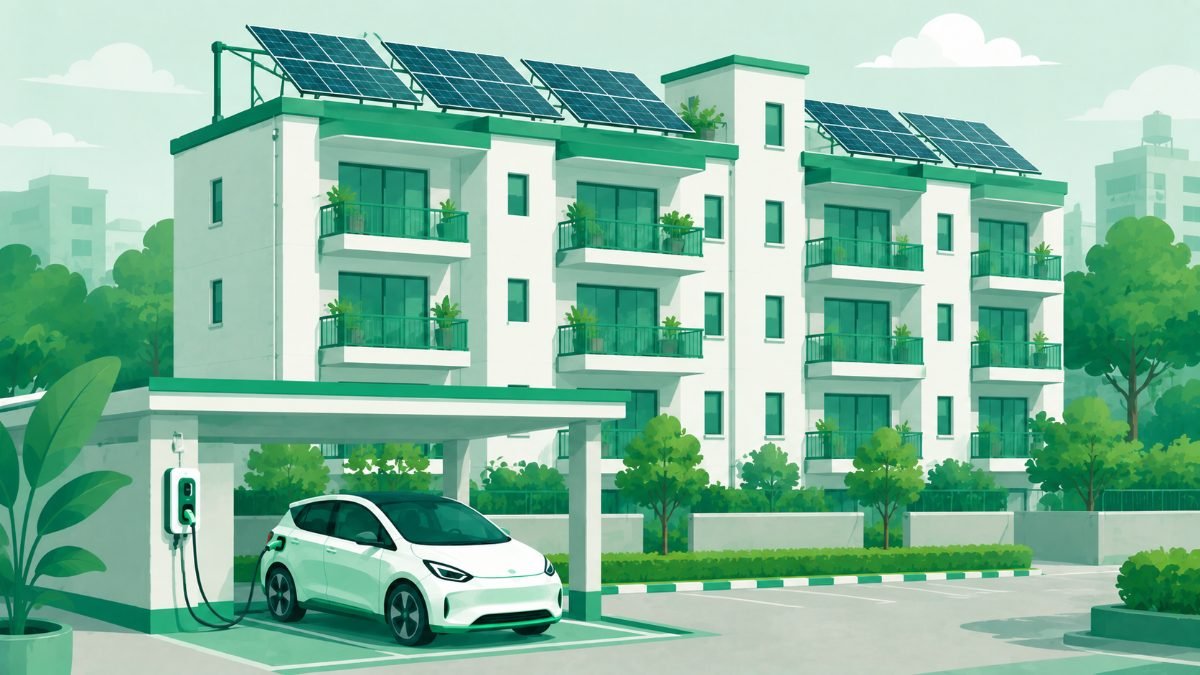
Rooftop solar can genuinely cut a housing society's electricity bills, but it rarely powers EV charging directly. Panels generate at midday; most residents plug in overnight, when panels produce nothing. In practice, society solar offsets daytime common-area load — lifts, pumps, lobby lighting — while EVs draw from the grid. Whether surplus daytime generation can be credited against night-time consumption depends on your state's net-metering rules, which vary and keep changing, so confirm the current position with your DISCOM. Solar and EV charging pair best when cars are parked and plugged in during daylight hours. Treat them as two worthwhile projects that sometimes overlap — not one packaged product.
The timing mismatch nobody mentions in the brochure
A solar panel produces most of its energy between late morning and mid-afternoon. A typical apartment resident drives home in the evening and plugs in overnight. Those two curves barely touch. Without a battery, electricity cannot wait on the roof until you need it — whatever the panels generate at 1 pm is either consumed at 1 pm or exported to the grid.
Net metering is the accounting bridge: exported units earn credits that offset units the society imports later. Where it is available on reasonable terms, "solar-powered charging" can be true on paper even though your car physically charges on grid electricity at night. But eligibility, capacity limits, and how exports are compensated differ from state to state and are revised from time to time. Do not size a project around banking assumptions until your DISCOM confirms, in writing, what applies to your society's connection today.
This is why the honest starting question is not "can solar charge our cars?" but "when are our cars actually parked and plugged in?"
What rooftop solar realistically does for a society
For most societies, rooftop solar is a common-area project. Lifts, water pumps, common lighting, the clubhouse, the sewage treatment plant — these run through the day and line up reasonably well with solar generation. Reducing that bill lowers the electricity component of everyone's maintenance dues, which is a perfectly good outcome on its own.
EV charging, by contrast, is usually billed to the individual owner — through a sub-meter or a smart charger that records each flat's consumption. So in the typical setup, solar savings land in the common-area bucket while charging costs sit in a private bucket, and the two never actually meet. If your society recovers charging through metered billing (see our comparison of sub-meter versus smart-charger billing), a rooftop plant will not change what an EV owner pays per unit unless the general body deliberately decides to subsidise charging from common funds.
None of this is an argument against solar. It is an argument for being clear-eyed about which bill it reduces before anyone promises "free charging" at the AGM.
When solar and EV charging genuinely pair well
There are real situations where the two projects reinforce each other:
- Cars that sit at home in the daytime. Retired residents, people working from home, second cars, and society-owned vehicles can charge at midday, drawing solar power as it is generated. This is the cleanest match — no storage, no accounting gymnastics.
- Shared daytime bays. A common charging point used on a roster or by visitors during working hours consumes solar when it is most plentiful. If your society is considering this route, start with our guide on how to propose a common EV-charging station.
- A large roof relative to a modest common load. If generation regularly exceeds daytime common-area demand, the surplus needs somewhere to go — either export under net metering or productive use such as daytime charging.
- Net-metering credits, where your state allows them. If exported units can offset night-time imports on your society's bill, overnight charging can be indirectly "solar" in the accounting sense. Verify the current rules with your DISCOM before counting on this.
- Battery storage, with eyes open. A battery physically closes the day-night gap, but it adds significant cost, space, maintenance, and a replacement cycle of its own. It is worth evaluating, not assuming.
A quick illustrative sketch: suppose a hatchback needs about 15 units for its weekly top-up, and a small society rooftop plant produces, say, 30 to 40 units on a clear day — both round example numbers; real figures depend on your car, system size, season, and shading. If that car is plugged into a daytime bay, the roof can plausibly cover the session with room left for the lifts and pumps. If the same car only ever charges at 10 pm with no storage and no export credits, the panels contribute nothing to that session. Same hardware, completely different outcome — timing is everything. Our monthly charging cost calculator can help you estimate your actual charging demand from kilometres driven.
| Charging pattern | How much solar helps | What to watch |
|---|---|---|
| Overnight charging, no storage or export credits | Almost none, directly | Solar still cuts common-area bills; keep the two benefits separate in your proposal |
| Overnight charging with net-metering credits | Possible on paper | Depends entirely on your state's current rules — confirm with your DISCOM in writing |
| Daytime charging (work-from-home, retirees, second cars) | Strong match | Needs bays and billing arrangements that suit daytime use |
| Shared daytime bays on a roster | Good match | Requires coordination, fair booking, and metered billing per user |
| Solar plus battery storage | Works even at night | Higher upfront cost, space, maintenance, and battery replacement over time |
Questions to ask a solar vendor before you sign
Vendors quote quickly; committees should slow the conversation down. Reasonable questions include:
- What is the sizing based on? Ask them to work from your last twelve months of common-area bills, not a brochure assumption. Oversized systems export more than they save.
- What net-metering arrangement are you assuming? Ask for the assumption in writing, then verify it yourself with your DISCOM. If the payback story collapses without export credits, you need to know that now.
- Has anyone assessed the roof? Structural condition, waterproofing, panel weight, wind loading, and shading from tanks or neighbouring towers all matter. A site survey should come before a final quote.
- Who owns and maintains the system? Outright purchase, financed purchase, and third-party-owned models distribute cost, risk, and savings very differently. Get the model named and the responsibilities listed.
- What exactly is under warranty? Panels, inverters, and workmanship usually carry separate terms. Ask for each in writing.
- What are the payback assumptions? Any payback estimate rests on an assumed tariff, generation figure, and degradation rate. Ask for all three. Treat a "guaranteed" payback period as a red flag — generation and tariffs are not guaranteed.
- Does the design leave room for future charging bays? Cable routes, distribution-board capacity, and earthing arrangements should anticipate EV load, and the electrical work should be checked against a proper apartment EV charging safety checklist.
How to take this to your RWA
The proposals that pass are the ones that separate facts from hopes. A workable sequence:
- Collect twelve months of common-area electricity bills so the committee sees the real daytime load and what it costs.
- Survey the roof honestly — usable area after tanks, lift rooms, and shading, plus its structural state.
- Decide the primary goal: cutting the common bill, enabling daytime charging, or both. Write it down; it disciplines every later decision.
- Get two or three comparable quotes using the vendor questions above.
- Estimate charging demand and infrastructure separately, using the monthly charging cost calculator and the charger and installation cost estimator, so solar economics and charging economics are never blended into one blurry number.
- Present solar and EV charging as two linked resolutions. Our RWA EV policy generator can help you draft the charging side as a discussion document for the committee.
Common questions
Can solar make our EV charging free?
No. The panels cost money upfront, and their output has value whether it offsets the common bill or a charging session. A society can choose to offer solar-subsidised daytime charging, but that is a billing decision the general body makes consciously — it is not something the physics delivers automatically, and "free" claims usually just hide the capital cost.
Do we need a battery to combine solar with EV charging?
Not necessarily. Daytime charging uses solar directly, and export credits — where your state's rules allow them — can offset night-time consumption on paper. A battery is only essential if you specifically want stored solar energy at night, and it brings its own cost, space, and replacement questions. Ask for a full lifetime cost, not just the installation price.
Will adding solar and chargers together overload our connection?
They push in opposite directions — solar reduces what you draw at midday, while chargers add load whenever they run. But sanctioned load, cable sizing, protection devices, and earthing all still need professional review, especially if several chargers arrive over a few years. This is a design exercise for a licensed professional, not a committee estimate.
Is a solar carport over the parking area a good idea?
Sometimes. It places generation right next to daytime charging bays, which is elegant. But a carport is a structure — it needs proper design, drainage, and society approval, and it typically costs more per unit of capacity than plain rooftop panels. Compare it against a simple rooftop system before falling for the aesthetics.
A final word of caution: everything above is planning guidance, not an electrical design or a regulatory opinion. Before your society commits to panels, chargers, or both, have a licensed electrician or electrical consultant assess the installation, and confirm net-metering terms, load enhancement requirements, and approval procedures directly with your DISCOM — their current rules, not last year's summary, are what your project will actually live under.