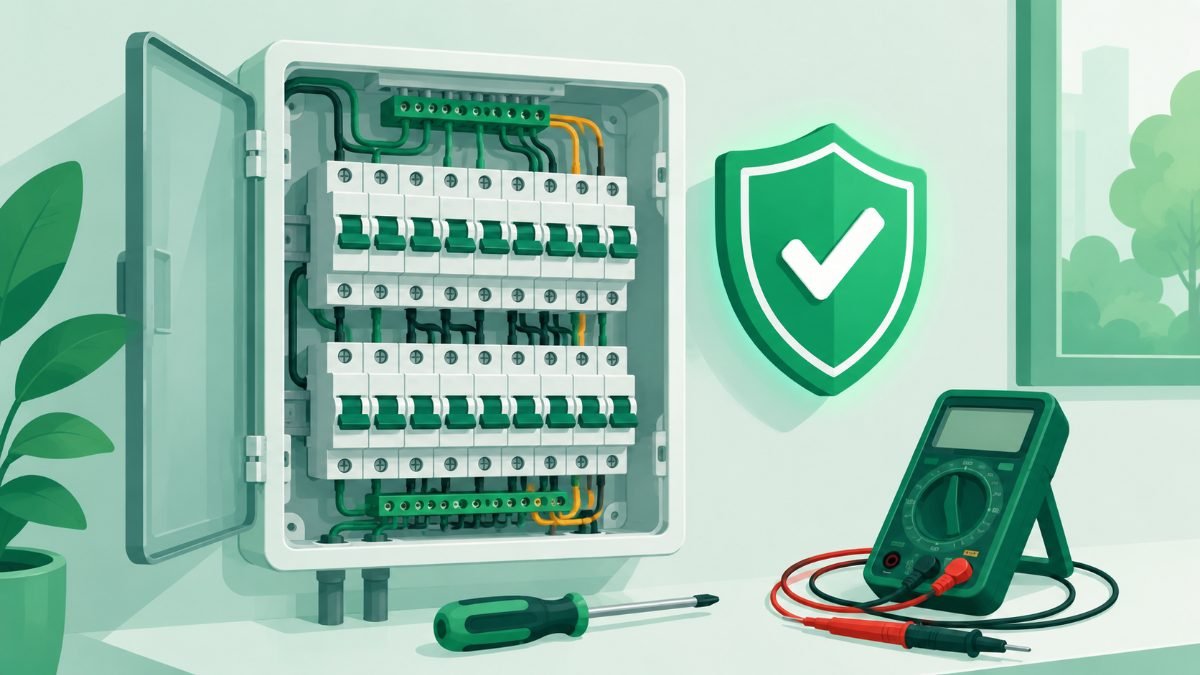
Before an apartment EV charger is used for the first time, six things need verification by a licensed electrician, on site: a dedicated circuit from the distribution board, overcurrent protection sized to that cable, earth-leakage protection of the type the charger's own manual specifies, earthing measured at the charging point rather than assumed, a cable route that is mechanically protected and approved in writing by your society, and enough load headroom on your connection to carry the extra draw. This guide explains what each item means, what verified actually looks like on the day, and the questions to put to your installer. It prepares you for that conversation; it does not replace it.
The six checks at a glance
The right-hand column matters as much as the first. Several of these are not one person's job.
| Check | Why it matters | Who verifies it |
|---|---|---|
| Dedicated circuit | Charging draws steadily for hours; shared circuits and old socket wiring overheat | Licensed electrician, at the distribution board |
| MCB sized to the cable | Stops the cable carrying more current than it safely can | Licensed electrician, matched to cable size and charger rating |
| RCCB or RCBO | Cuts the supply when current leaks to earth — the fault that injures people | Licensed electrician, working from the charger's installation manual |
| Earthing at the point | Every protection device above depends on a working earth path | Licensed electrician, by measurement on site |
| Cable route | Impact damage, trip hazards and blocked exits are the everyday risks | Electrician for the route; society for written common-area approval |
| Load headroom | An overloaded connection trips, and repeated trips stress wiring | Electrician measures; DISCOM confirms sanctioned load and any enhancement |
Checks 1 and 2: a dedicated circuit, with an MCB sized to it
EV charging is a sustained load — two, six, sometimes ten hours at a steady current. Almost nothing else in a flat behaves that way. Household circuits, and the ordinary sockets already sitting in most parking areas, were wired for lights, a pump or the occasional power tool. Loose terminations that survive intermittent use heat up under continuous load, and heat is how these installations fail.
So the charger gets its own cable from the distribution board, its own way on the board, and nothing else on it. The MCB on that way protects the cable, not the charger: it is chosen to match the cable's capacity and the charger's rated draw, and a mismatch in either direction is a defect, not a preference. Verified looks like a labelled way that, switched off, kills the charger and nothing else — plus a written record of the cable size and MCB rating actually fitted.
Ask your electrician: what cable size did you run and what MCB did you pair with it; can you switch that way off and show me only the charger loses power; does my board have a spare way, or does it need extending first?
Check 3: earth-leakage protection, the item most often skipped
An MCB reacts to too much current flowing in a circuit. It does not react to current leaking out of one — through damaged insulation, through moisture, through a person. That is what an RCCB, or a combined RCBO, does, and it is the device that protects people rather than cables. Around vehicles, in parking areas where water, dust and knocks are routine, it is not optional.
The type matters as much as its presence. EV charging equipment can, in certain fault conditions, produce leakage that behaves differently from ordinary household leakage, and not every residual-current device is built to detect it. Some chargers handle part of that detection internally; others expect a particular type of device upstream. Which applies to your unit is stated in its installation manual — and that manual, not habit, is what your electrician should be working from. Ask to see the page.
Worth asking: does the fitted device match what the manual calls for, and is it dedicated to the charger or shared with the whole flat? A shared device means a charger fault takes the flat down with it. MCBs, RCCBs and RCBOs explained covers the differences.
Check 4: earthing that was measured, not assumed
Every protection device above depends on a working earth path, and buildings quietly lose theirs — electrodes corrode, continuity breaks during renovations, extensions get added over decades by different hands. An installer who says earthing is fine without measuring is guessing about the one thing the whole system rests on. Verified is a number, written down, with the date and the point it was taken at. If that reading is not what your electrician expects for your installation, it is a building problem to fix before charging, not a reason to proceed carefully. Tingles on metal railings, frequent unexplained trips, or a past shock anywhere in the block all point the same way. Earthing basics for apartment EV charging explains what is actually being tested.
Check 5: a cable route that survives a car park
Parking areas are hostile to cable: cars clip walls, trolleys scrape, floors flood during cleaning, and anything at knee height gets hit eventually. A route that will still be safe in three years is:
- Mechanically protected in conduit or tray for its whole run, with real guarding where vehicles can reach it.
- Carried high rather than along the floor, and never across a driving lane or walkway — not even while charging.
- Clear of fire exits, hose points and escape widths, measured rather than eyeballed.
- Free of extension cords and temporary arrangements, which have a habit of becoming permanent.
- Approved by your society in writing where it crosses common areas, naming the route, so a change of committee does not reopen the argument.
Open parking adds water: fittings suited to the location, glands facing downward, the unit sited out of the splash zone. See cable routing options and, for exposed spots, outdoor charging points in the monsoon.
Check 6: load headroom you can point to
Your sanctioned load is printed on your electricity bill. Your real headroom is the gap between that figure and everything you already run at once — and the honest test is a summer evening, not an average day.
Work it through with illustrative numbers. Say your bill shows a sanctioned load of 3 kW (check your own), and on a hot evening the air conditioner and geyser are already running. Adding even a 3.3 kW charging point to that is planning to exceed your connection. Three ways out: charge when the heavy loads are off, set the charger to a lower current if it supports that, or enhance the sanctioned load. The enhancement procedure, paperwork and fees differ by state, by utility, and by whether the connection is in your name or the society's — confirm the current process with your DISCOM rather than copying what a neighbour did last year.
More on both in sanctioned load and apartment charging and the load-enhancement process. The readiness checklist will tell you which of these conversations you are likely to need.
After installation: the habits that keep it safe
- Look at the cable and connector before each session. Damaged equipment gets retired, not taped.
- Feel the plug and enclosure after a long session — warm is normal, hot is worth a call.
- Press the RCCB test button on whatever schedule your electrician gives you.
- Treat trips as information. Repeated tripping means something is wrong; ring the electrician instead of resetting again.
- Keep the area clear — cartons, paint tins and old furniture stacked against a charging point are a fire load, not storage.
- Keep the paperwork together: installation record, device ratings, earth reading, manual, society approval. It matters for insurance, for the next electrician, and when you sell or let the flat.
Maintaining an apartment charging point covers the annual check. Basement spots add enclosed-parking questions on top — see what to check before installing in basement parking.
Common questions
Can I just use the existing 15A socket in my parking spot?
Only if an electrician confirms that specific socket and the circuit behind it are suitable for hours of continuous draw — and often they are not, because that point was put in for a light, a pump or occasional use, on a circuit shared with other things. It is a question about the wiring behind the socket, not about the rating printed on it.
Does the RCCB already in my flat's board cover the charger?
Not automatically. It depends on whether the charger actually sits on that device, and whether the device is the type the charger's manual calls for. A shared one also means a charger fault darkens the whole flat, and nuisance trips become everyone's problem. Ask your electrician to check it against the manual rather than assume it is covered.
Who pays for the safety work — me or the society?
In most societies the resident pays for their own charging point and the wiring to it, while shared infrastructure and common-area work are handled collectively. There is no universal rule, so the useful step is getting the split written down before anyone starts. The society EV charging policy draft gives you language to begin from.
How do I know my electrician is qualified for this?
Ask whether they hold a current licence, whether they have installed EV charging points before, and whether they will hand over a written record with cable size, device ratings and the measured earth reading. Someone who works this way answers all three without hesitation. What a good site assessment covers sets out what to expect.
This checklist is a conversation, not a certification. Its job is to make you a useful participant in your own installation — able to ask the right question and recognise a vague answer. The verification itself belongs to a licensed electrician working on your site with your charger's manual in hand, and anything touching your sanctioned load, meter or connection belongs to your DISCOM. If even one item on the list cannot be verified, the right decision is to wait until it can.