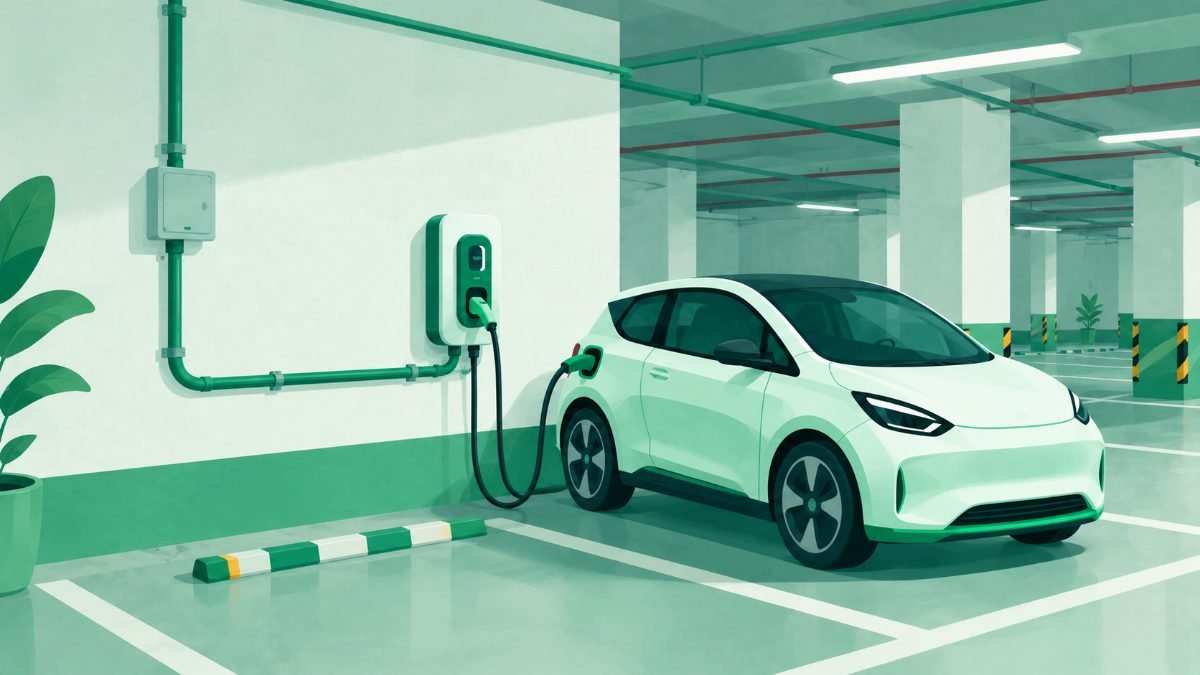
Yes, you can charge an EV through the Indian monsoon — provided the charging point was designed and installed for outdoor or semi-outdoor use, sits above splash and waterlogging level, and is protected by proper earthing and a working RCCB or similar protective device. Rain itself is rarely the problem: chargers and vehicle charging inlets are engineered with weather sealing in mind. The genuine monsoon risks in apartment stilt and open parking are pooled water under the charger, wind-driven spray, connectors left lying on wet floors, damaged cable insulation, and improvised extension cords. Fix those, build a few wet-weather habits, and know when to simply pause — that is what this guide covers.
Why stilt and open parking need a monsoon plan
Most apartment charging points in India sit in stilt parking — roofed, but open on the sides — or in fully open surface parking. In a heavy shower, "covered" parking behaves differently from how it looks in dry weather: wind pushes rain several metres in from the edges, water sheets down columns, passing two-wheelers throw up spray, and one blocked drain can turn a corner of the parking into a shallow pond within minutes. None of this is visible when an installer surveys the site on a sunny day.
The most useful thing you can do costs nothing: walk your parking area during the first serious downpour of the season. Note where water enters, where it pools, how close it gets to your charging point and cable route, and whether the drainage keeps up. Share what you find with your society — drainage and seepage in common areas are usually the RWA's responsibility to fix.
IP ratings: the weather label worth asking about
Electrical equipment made for wet or dusty locations carries an ingress protection rating — "IP" followed by two digits. Broadly, the first digit describes protection against solid objects and dust, and the second describes protection against water; a higher second digit means the enclosure has been tested against more demanding water exposure. You do not need to memorise the scale. You need to ask your installer two questions: what is the IP rating of each component — charger body, connector, junction boxes, isolator, and the distribution-board enclosure — and is that rating suitable for this exact spot, given how exposed it is?
The chain matters more than any single number. A well-sealed charger fed through a cheap indoor-grade junction box has the weather resistance of the junction box. There is no single rating we can tell you is "required" — suitability depends on your location — so get your installer's recommendation in writing and keep the component ratings in your installation paperwork. It is useful evidence for society approval and any future warranty conversation.
Mounting height and placement: decide before the first rain
Three placement questions prevent most monsoon trouble. First, how high has water ever risen here? Ask long-term residents or the security and housekeeping staff — they remember the worst waterlogging years. Mount the charger, its isolator, and junction boxes comfortably above that line, not at whatever height looks convenient. Second, is the spot in a splash zone? A charger at bumper height beside a driveway lane collects tyre spray all season; a little separation or a simple deflector changes that. Third, can water reach it from above — a leaking slab joint, a drip line from the floor overhead, an overflowing rainwater pipe?
Where a fully sheltered wall is not available, a small canopy or hood over the charging point is a modest addition your installer can include in the job. If you are still choosing a location, run through the apartment EV readiness checklist first, and see our guide to installing a charger in an Indian apartment for the full sequence from permission to commissioning.
Wet-weather cable habits
The cable and connector are the parts you handle every day, and the parts that suffer most in the wet. A few habits go a long way:
- Never leave the connector on the floor. Use the holster or dock — water pools exactly where a dangling connector comes to rest.
- Give the cable a drip loop. Let it dip below the connector before rising to the vehicle inlet, so water runs to the low point of the cable instead of into the connection.
- Look before you plug. Glance at the connector face for droplets, grit, or damage, and wipe a wet connector dry with a clean cloth before use.
- Retire damaged cables immediately. Nicked insulation, a cracked connector shell, or a cable that has been run over is a monsoon hazard, not a to-do item.
- No household extension boards. Domestic multi-plugs and extension reels are not built for sustained charging loads, and certainly not while lying on a damp floor. If the cable does not reach, the fix is proper wiring, not an extension.
When to pause charging — and when it is fine
Properly installed charging equipment is meant to be used in wet weather, and the protective devices in the circuit exist precisely to cut power when something goes wrong. Even so, there are moments in an Indian monsoon when the sensible move is to wait. Use this as a rough decision guide:
| Situation | Sensible response | Why |
|---|---|---|
| Steady rain; charger, connector and vehicle inlet all under cover | Charging can usually continue | Outdoor-rated equipment is designed for wet weather when connections stay sound |
| Wind-driven rain hitting the charging point directly | Pause, or wait for the squall to pass | Sideways spray stresses seals far more than falling rain, and waiting costs nothing |
| Water pooling under or around the charger or cable route | Pause until it drains | Standing water plus electricity is never worth the risk, whatever the rating |
| Connector or cable has been lying in water, or insulation looks damaged | Do not use it; get it inspected | Seals and insulation may be compromised in ways you cannot see |
| RCCB or breaker trips during rain | Stop charging and call an electrician | A trip is a warning, not an inconvenience to reset repeatedly |
| Lightning directly overhead | Many owners prefer to pause | Ask your electrician whether surge protection suits your circuit |
Pausing for an evening costs very little — most apartment EVs need only a few charging sessions a week anyway.
A pre-monsoon check for residents and RWAs
Every year, before the rains arrive, spend thirty minutes on the basics: press the test button on the RCCB, inspect visible wiring and conduits along the cable route, clear the drains near charging points, and confirm canopies and seals are intact. Our apartment EV charging safety checklist covers the full list, and if your chargers sit in basement parking, the basement parking charger checks matter even more — basements collect water from everywhere. Where remedial work is needed on shared infrastructure, settle early who pays for the wiring and civil work, so the fix is not stuck in society meetings while the clouds gather.
Common questions
Is it safe to charge an EV in the rain?
Generally yes, when the charging point was installed for outdoor use and is in good condition. Charging connectors are designed so that live parts are not exposed, and the vehicle and charger verify the connection before power flows. The caution belongs to the surroundings — standing water, damaged cables, makeshift extensions — rather than to rain falling on properly rated equipment.
What if my parking gets waterlogged every monsoon?
Treat waterlogging as a site problem to fix before it becomes a charging problem. Raise the mounting height of equipment, route cables above the waterline, and push the society to improve drainage — that benefits every resident, not just EV owners. On days when water is actually standing around the charger or cable route, do not charge until it drains.
Should I unplug during a thunderstorm?
Opinions differ, and we will not pretend there is one universal rule. A nearby strike can send a surge through building wiring, and some owners prefer to pause charging while a storm is directly overhead. The more durable answer is to ask your electrician whether surge protection makes sense for your charging circuit, and follow their advice for your building.
Do I need a canopy over the charging point?
Not always. A well-sheltered wall with suitably rated equipment may not need one. A canopy earns its keep when the point faces wind-driven rain, sits near an open edge of stilt parking, or when you simply want extra margin over the equipment's ratings. Ask your installer to assess the exposure of your specific spot rather than buying a cover by default.
A final word: everything above is planning guidance, not an inspection. Before the monsoon — and before any new installation — have a licensed electrician verify the earthing, protective devices, ratings, and mounting of your setup, and confirm any supply or metering questions with your DISCOM. Rain rewards preparation and punishes assumptions.