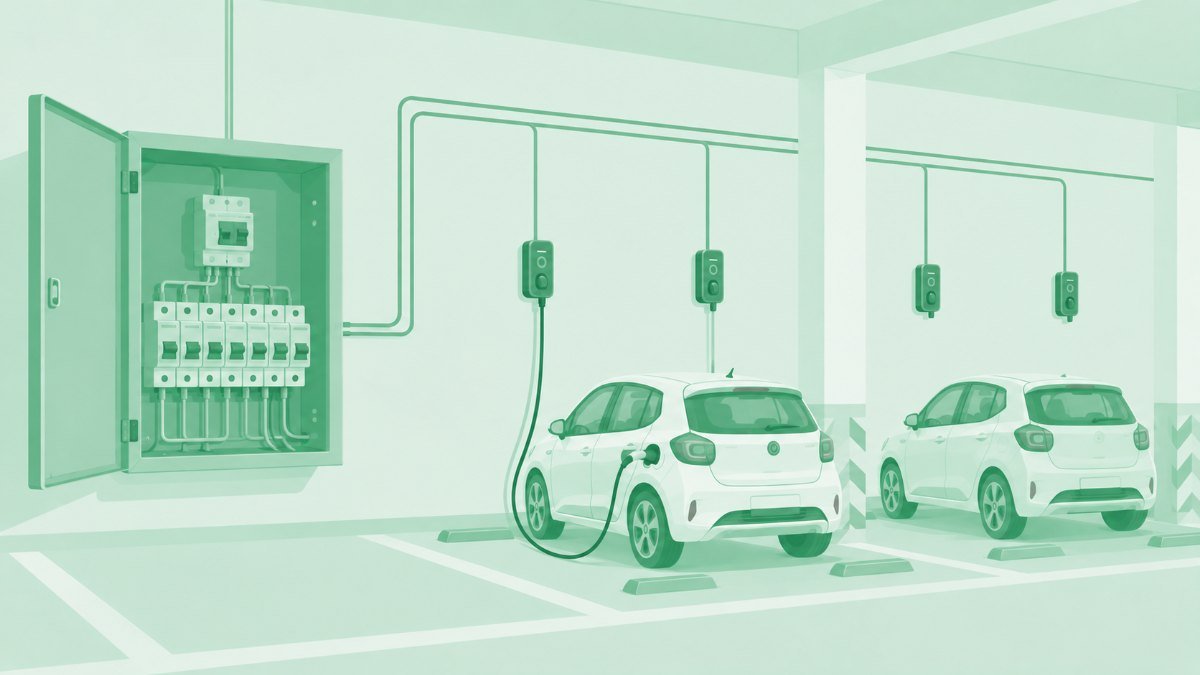
When the grid fails, your EV charger stops — unless the circuit feeding it is also carried by the society's diesel generator, in which case your charging load lands on the DG set alongside the lifts and the pumps. Which of those two things happens is decided by one thing only: where the charger circuit is tapped, relative to the changeover that switches your building to backup. You can settle it in an afternoon. Ask your licensed electrician which side of the changeover your charger sits on, pick one of the three isolation methods below, and have the drop-out demonstrated in front of you before you pay the installer.
What happens when the mains drops mid-session
Take the supply away and the session ends. Nothing in a wall box stores energy to finish the job, so the question is not what the charger does. It is whether the supply actually went away.
- The charger circuit is not carried by the generator. The charging point goes dead the moment the grid drops and stays cold until it returns, even while your flat takes light from backup.
- The charger circuit is carried by the generator. The session continues, and the set now carries your charging load on top of everything it was bought for. Nobody chose that. The wiring chose it.
What your car does when supply comes back varies by vehicle and charger, so find out once, deliberately, during the test below.
Why the generator is the constraint, not the charger
A DG set is one engine with a fixed output, sized against a list of loads somebody wrote down when it was bought. Ask the manager for the generator's nameplate rating and that load schedule; both sit in your society's own records.
Then hold your charger up against them. Every figure here is an assumption written in to show the working — substitute your own label, your own board and your society's own records. Suppose four residents' wall boxes each carry a label reading 7.2 kW: four cars charging through one cut is 4 × 7.2 = 28.8 kW arriving as one step on top of that schedule. Whether your set holds a step that size is a question for the DG contractor in writing, against your own nameplate rating.
If you want amperes rather than kilowatts, divide the watts on your own charger label by the voltage your electrician measures at the board: 7,200 W at a measured 230 V is 7,200 ÷ 230 = about 31 A.
Ask the DG contractor in writing what the set holds when a large load steps on, and give the reply to your electrician. The grid side of the same sum is covered in sanctioned load and apartment EV charging and load management with several chargers in one building.
Three ways to isolate a charger from the backup supply
Isolation means the charging circuit cannot be energised from the generator, whatever anyone forgets — never rely on a resident remembering to unplug. Three arrangements are in common use, and your wiring decides which applies. Which device and rating gets fitted is for your licensed electrician to specify in writing.
Tap on the grid side of the changeover. The charger circuit comes off the incomer ahead of the flat's changeover, so the flat switches to backup and the charging point does not.
A contactor held closed by the grid incomer. The contactor sits in the charger supply with its coil fed from the grid incomer; lose the grid and the contacts open on their own.
A charging busbar with no DG connection. The points are fed from a section with no physical link to the backed part of the installation.
| Method | Suits this wiring | Who must be involved | Watch at handover | When mains returns | On the completion note |
|---|---|---|---|---|---|
| Grid-side tap | Charger fed from your own flat's meter, flat has a changeover | Your electrician; society's electrician confirms nothing common changed | Mains removed: charger dies, flat's lights stay on backup | Live again as soon as the grid is back | Board, side of the changeover, drop-out witnessed |
| Contactor held in by the grid | Charger branches off a common panel the generator backs | Your electrician, the society's electrician, the DG contractor | Mains removed: contactor opens, charger dies, panel stays live | Coil is fed again and the contactor closes; watch the re-close | Device fitted, where the coil supply came from, both tests witnessed |
| Busbar with no DG link | New shared installation, several points at once | Society's electrician and DG contractor together | Changeover operated with points live: nothing on the busbar carries on | Nothing changes; the points were never on backup | Single-line diagram showing the busbar origin and no DG link |
Choose by your wiring:
- Own flat's meter, flat has a changeover — first method.
- Common panel the generator backs — second.
- Nothing installed yet, several points planned — third.
- Cannot tell? That is the first item for the site visit: what an electrician checks in a site assessment.
The witnessed drop-out test, before you pay
An isolation nobody has watched work is a claim on a bill. The test takes ten minutes at handover, which is when you still hold the final payment.
- Write it into the job when you accept the quote: the isolation is demonstrated at handover, vehicle connected and drawing, before the completion note goes to the society office.
- Ask the society for a witness; a facility manager's or committee member's signature makes the note useful later.
- Watch the sequence: car drawing, mains removed at the board, charging point dead, flat or panel on backup, mains restored, charging point live again.
- Note what the car did when supply returned, and whether it needed unplugging.
- Write it down on the spot: date, who removed what, what went dead, what came back, and signatures.
If the charger keeps delivering with the mains removed, the isolation is not doing its job and the note is not ready to sign. Say so in writing, then and there. File the signed note with the paperwork to keep for your charger.
Putting one backup session into rupees for the common pool
Backup power is not free electricity that arrives during a cut; somebody bought the fuel out of the maintenance account. Every input below comes from a document your society already holds. Each number is an assumption chosen to show the sum — substitute your society's own figures.
- Units per litre, from your own fuel log. Take the litres burned over a run of hours and the units the DG meter recorded across the same hours. Suppose the log shows 40 litres and 120 units: 120 ÷ 40 = 3 units a litre.
- Fuel per unit, from your own invoice. Suppose the invoice reads ₹92 a litre: ₹92 ÷ 3 = about ₹30.67 a unit for fuel alone.
- Servicing per unit, from your own ledger. Take a year of servicing, oil and filters and divide by the units the set produced. Suppose it lands at ₹4 a unit: ₹30.67 + ₹4 = about ₹34.67 a unit.
- The grid comparison, from your own bill. Suppose the per-unit energy charge reads ₹8.50.
- Size one session. Suppose a charger delivered 12 units across a four-hour cut: 12 × ₹34.67 = about ₹416 out of the common pool, against 12 × ₹8.50 = ₹102 had the grid been up. On these assumed figures, ₹314 moved from one resident's bill onto everyone's maintenance.
Run that with real documents and the committee conversation changes shape: a line item rather than an argument about EVs. That is also how splitting shared charging costs between residents gets settled.
What a committee could choose to write into its own policy
This site does not tell you what your bye-laws say, and you should distrust any page that does. A committee can decide in advance, in writing, and publish the decision. Absent a written rule, treat backup charging as not permitted and ask the committee; silence is not permission.
Put three questions to the secretary in writing before any work starts: is there a written rule on energising charging points from backup, and may I have a copy; which boards in my parking area are carried by the generator; and who from the society will witness the isolation test and sign the note? Ask for each reply in writing. Send the insurance broker one question too: how does the policy treat a charging point on the backed common supply, and what does the insurer want from the installer?
- A clause naming which boards the generator carries.
- A clause making a witnessed drop-out test a condition of any completion note.
- A clause settling who bears a generator reset callout attributable to a charging load, before anyone installs.
- A review date, so the policy is revisited as vehicle numbers change.
The RWA EV policy generator produces a discussion draft to amend, and the draft society charging policy shows where clauses like these sit. Both are starting points, not rules.
Common questions
What actually happens to my car mid-session when the mains fails?
If the circuit is not carried by the generator, the supply goes and the session ends there. If it is carried, the session continues and your load is added to the set. What the car does when supply returns varies by vehicle and charger, so establish which yours does during a deliberate test rather than an unplanned cut.
How do I get the isolation demonstrated before I pay the installer?
Write it into the job when you accept the quote: the isolation is demonstrated at handover, vehicle connected and drawing, before the completion note is submitted. Ask the society to send a witness. Watch the mains removed, the point go dead, then come back. Record the date, names and sequence, and have everyone sign.
How do I work out what one backup charging session costs the common pool?
Three of your society's own documents give every input. From the fuel log, suppose litres and units come out at 40 and 120: 120 ÷ 40 = 3 units a litre. From the invoice, suppose the rate paid reads ₹92 a litre: ₹92 ÷ 3 = about ₹30.67 a unit before servicing. Add your own servicing figure, then multiply by the units one session delivered.
My two-wheeler charger is small — does the same reasoning apply?
Yes, because the question is which side of the changeover the socket sits on, not how many watts pass through it. Read the wattage printed on your own charger label and divide it by the voltage your electrician measures at that socket. A smaller load is still either isolated or not. Charging an electric two-wheeler in an apartment covers the rest.
What could a committee write into its own policy about charging on backup power?
Whatever it decides in writing, once it knows which boards the generator carries and what its insurer expects. Clauses committees debate include naming the backed boards, making a witnessed isolation test a condition of any completion note, and settling who bears a generator reset callout attributable to a charging load. None of that is a rule that already exists; the society decides and publishes it.