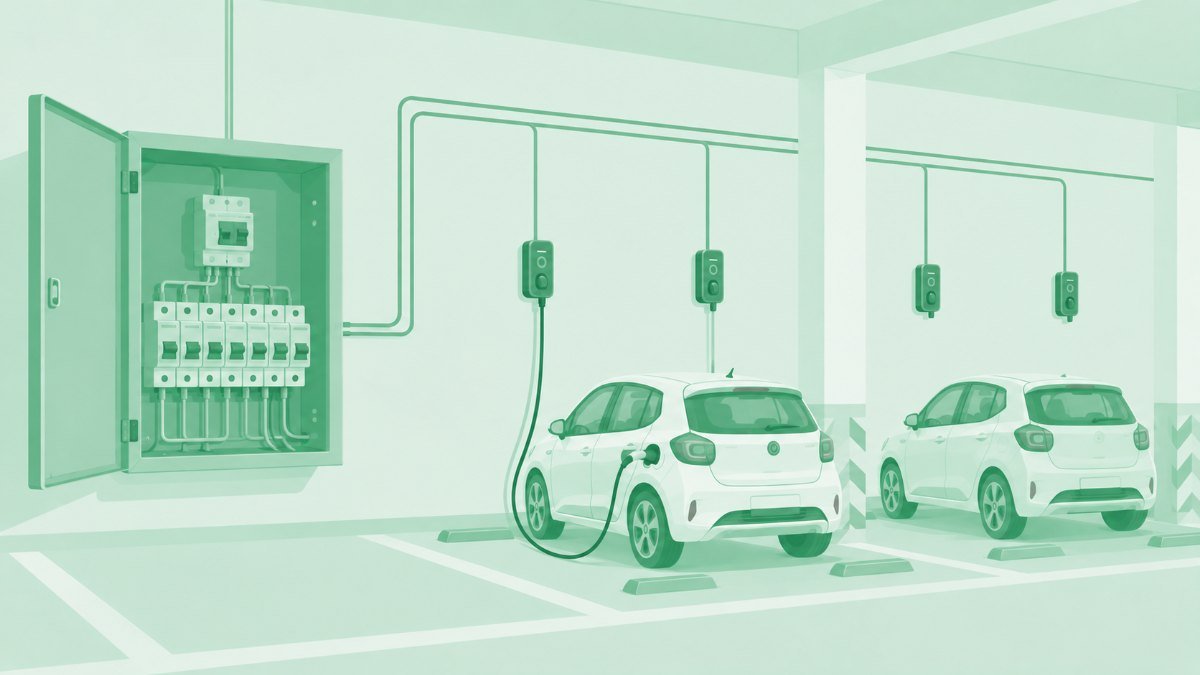
When one flat installs a charger, the building barely notices. When six do, the question stops being about chargers and becomes a question about the supply feeding them. The limit is rarely the charger's rating; it is the sanctioned load, the transformer and feeder capacity, the cable sizes in the shafts and the protection devices already fitted. You have three practical levers: cap each point at a lower power, let a controller share a live budget between points, or stagger charging by time. Which combination suits your building is an engineering decision only a licensed electrician can make, from your drawings and your measured demand.
Why the supply, not the charger, is the binding constraint
A charger is a controlled tap on an existing system. It can only deliver what the wiring behind it can carry, and that wiring was sized long before anyone in your society owned an EV. Three things sit between a car and the grid, and any one can be the ceiling:
- Sanctioned load. The contracted maximum your connection may draw. Exceeding it is a contractual problem as well as a technical one.
- Physical capacity. Transformer rating, incoming cable, busbar, risers and board ratings. No software setting raises the current an undersized cable can safely carry.
- Protection coordination. Breakers and residual current devices must be graded so a fault trips the nearest device, not the whole building. Adding load changes those calculations.
Your own sanctioned figure is on your bill; our guide to sanctioned load and EV charging explains where to look. This is why "the charger is only 7.2 kW" is a weak argument in a committee meeting: one point may be nothing, but six switched on as residents return from work are a different load profile, as our piece on whether EVs will overload your building explains.
Diversity: why six chargers are not six times one charger
Designers rarely assume every device runs at full power at once; lifts, pumps, geysers and air conditioners are sized on the basis that they do not peak together. That allowance is called diversity.
EV charging both helps and hurts. Cars are not all at low charge on the same evening, and one that finishes stops drawing power. But routines cluster: many people plug in when they get home, around the hours when cooking and cooling demand rises.
Suppose your society is considering six points rated 7.2 kW each: the arithmetic worst case is 43.2 kW. Suppose your consultant then judges, from logged data for your building, that no more than three ever draw together, so the design figure becomes 21.6 kW. That judgement alone can decide whether you need a supply upgrade. Both numbers are illustrative arithmetic; substitute the rating you are considering and take the diversity figure from your consultant's measurements. Diversity is only an assumption about behaviour, and load management is what turns it into something equipment enforces.
What must be measured before anyone chooses
Any proposal that arrives before measurement is a guess. Ask your electrician or consultant to establish these in writing:
- Existing peak demand, logged over a representative period including a summer evening and a monsoon week, not one spot reading.
- Headroom, the gap between that measured peak and what your connection is contracted to supply.
- Transformer and feeder ratings, including the incoming cable and the risers.
- Condition, not just rating, since ageing cable and loose joints cut real capacity below the drawing figure.
- Earthing integrity, confirmed by test, because every point you add depends on it.
- A future count: how many points the building intends to support in five years, agreed by the committee rather than assumed by a supplier.
Our explanation of why earthing matters in apartments covers what that test should show, and our walkthrough of what an electrician checks in a site assessment covers the survey. The last item matters most: designing for two points and retrofitting later for eight commonly costs more than sizing the backbone for eight and filling it gradually, so ask your consultant to price both.
The three levers, and the baseline of doing nothing
Every building ends up in one of these positions, by design or by accident. The first row is the baseline you get when nobody decides anything.
| Approach | How it works | Relative cost | Main strength | Main weakness |
|---|---|---|---|---|
| No management | Each point runs at full rating whenever plugged in | Lowest upfront, highest risk | Nothing to configure or maintain | Coincident demand can exceed the supply and trip the building |
| Static limit per point | Each charger commissioned at a permanently reduced current | Low; a commissioning setting | Predictable worst case, calculable on paper | Wastes capacity: a lone car charges slowly while the building idles |
| Scheduling and staggering | Residents agree charging windows, or timers enforce them | Low; rules plus timer settings | Cheap, quick and reversible; buys planning time | Depends on compliance; fails on an unplanned charge |
| Dynamic load management | A controller shares a live budget between active points | Highest; hardware, metering and commissioning | Uses spare capacity whenever it exists | More equipment to specify, maintain and replace |
Static limits in practice
If several points are each held to a lower current, the total stays inside the headroom your consultant identified, permanently and without electronics. It is robust, because nothing can fail, and inefficient, because the limit applies at three in the morning exactly as at eight in the evening. For two-wheelers the penalty may not matter; the trade-off resembles the one in 3.3 kW versus 7.2 kW charging.
Dynamic load management in practice
Dynamic systems measure current at the incomer, subtract the rest of the building's demand, and share what remains among the cars plugged in. When lifts and pumps quieten overnight the cars get more; when demand rises, the controller throttles the chargers instead of leaving the main breaker to decide.
The catch is that this is a system, not a product. It needs sensors in the right place, a reliable link between points, a defined behaviour when that link fails, and somebody accountable years later. Ask what happens if the controller fails: points should fall back to a low static limit, never to full power. Our note on smart charger features that actually matter lists what to make a supplier demonstrate.
Scheduling: the underrated first move
Before spending on hardware, many societies find time is the cheapest capacity they own: a car parked overnight rarely needs charging in two hours. Staggering usually takes one of these forms:
- Allocated windows, so half the points charge before midnight and half afterwards.
- A rule that charging begins only once the building's evening peak has passed.
- Timer start times set at the car or charger, recorded in the society's register.
- An exception route for emergencies, so the rule stays credible rather than ignored.
Two weaknesses are worth naming. Scheduling relies on residents behaving, a social problem more than a technical one, as our note on shared charging etiquette describes. And it is not protection: if everyone ignores the schedule one night, nothing physically stops the overload. Treat it as demand shaping that buys time while a design is prepared. Write the windows into your society's own rules, have the drafting checked against your by-laws by an appropriate local professional, and check whether shifting hours changes what you pay, as discussed in charging at night.
More capacity, or better management?
Management lets you live within the supply you have. Enhancement raises the ceiling instead, and suits a long-term shortfall, a large expected EV count, or non-EV demand already close to the limit; it brings applications to your DISCOM, charges and timelines, outlined in our guide to load enhancement for EV charging. Many societies do both: manage first, measure for a year, then apply with evidence in hand.
Either way this touches common infrastructure, so the committee's job is to commission a design rather than pick a technology: order the load study, then take costed options to the general body before inviting quotations. Building that case is covered in how to propose a common charging station, and who bears the cost in who pays for the wiring. One rule should survive every draft: no point is energised until a licensed electrician has verified that the finished installation, at its designed maximum, sits within the capacity and protection of everything upstream.
Common questions
How many EV chargers can an apartment building support?
There is no general number. It depends on your sanctioned load, your transformer and cable capacity, your existing peak demand, and how the points are managed, so two buildings with identical charger counts can have different answers.
The only way to know yours is a measured load study by a licensed electrician, from your drawings and logged demand data, not from charger ratings.
What is dynamic load management for EV charging?
It is a control system that measures the building's live demand and divides the remaining spare capacity among the points in use, cutting the power they draw when the rest of the building needs it and restoring it when demand falls.
It protects the supply automatically instead of relying on residents following rules, but it is extra equipment to specify, install and maintain.
Will adding more chargers trip our building's main breaker?
It can, if combined demand exceeds what the upstream protection is set for. That is the failure mode load management exists to prevent, and it cannot be judged from charger ratings. Have your electrician compare measured peak demand against your connection and equipment ratings before further points are added.
Can residents just agree to charge at different times instead?
Yes, and it is often the sensible first step, because it costs almost nothing and can be reversed.
But a schedule shapes behaviour without limiting current. It buys time to design a proper solution; it is not the solution, and it does not remove the need for a licensed electrician to confirm the installation is safe.