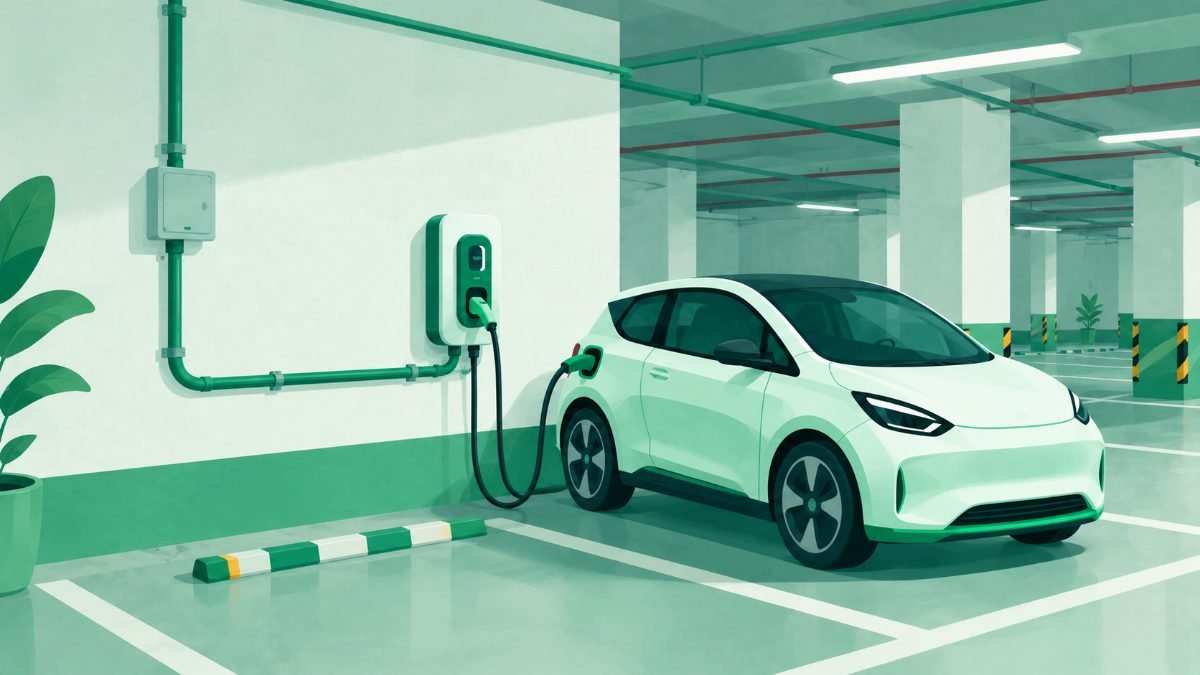
In most apartment buildings, a handful of EVs charging slowly overnight is unlikely to overload the electrical system — the fear usually comes from imagining every car fast-charging at once, which is not how home charging works. A typical slow charger draws about as much as an air conditioner and geyser running together, it runs at night when the building's common demand is lowest, and residents never all plug in simultaneously. That said, "usually fine" is not the same as "always fine". Older buildings, heavily loaded transformers, and long-neglected panels do need a professional check before chargers multiply. This guide explains the numbers that matter — building supply versus flat sanctioned load — and when a genuine capacity review is worth commissioning.
The two numbers that matter: your sanctioned load and the building's supply
Every flat has a sanctioned load — the maximum demand you have contracted with your DISCOM, usually printed on your electricity bill. Separately, the building has a common supply that runs lifts, water pumps, and common-area lighting, fed through infrastructure sized for the society as a whole. These are different pools of capacity, and it matters enormously which one a charger draws from.
A private charger wired to your own meter counts against your flat's sanctioned load, exactly the way an air conditioner or geyser does. A shared charging station on the society's common meter draws from the common supply instead. Most overload fears blur these two together. One resident adding a 3.3 kW charger to their own connection is a flat-level load question; twenty residents drawing from a common feeder is an infrastructure question. Charger size matters here too — the difference between 3.3 kW and 7.2 kW charging is the difference between a modest extra appliance and something that may exceed a typical flat's spare capacity while it runs.
Diversity: fifty EVs does not mean fifty chargers running at once
Electrical engineers size buildings around a principle called diversity: not every appliance in every flat runs at the same moment, so the supply never needs to equal the sum of every possible load. Your building's geysers alone would trip the system if all of them heated water simultaneously — they never do. The same logic applies to EV chargers, and even more strongly, because charging is infrequent and flexible.
A worked illustration, with round example numbers: say your society has 100 flats and, today, 10 EVs. Say each car does about 1,000 km a month and consumes roughly 140 units — check your own figures with the monthly charging cost calculator. On a 3.3 kW charger, that is roughly ten to twelve hours of charging per week — three or four overnight sessions, not nightly ones. Each car sits parked far longer than it charges. For all ten chargers to hit peak draw at the same instant, every owner would have to plug in the same evening with a drained battery and no timer. It is possible, but rare — and a simple staggered-timing norm in the society's charging policy makes it rarer still.
Why slow overnight charging is easy on the building
The distinction that defuses most overload arguments is energy versus power. The energy an EV needs is fixed by the kilometres it drives; the power is how fast that energy is delivered. Thirty-three units delivered at 3.3 kW over ten hours puts far less stress on wiring, panels, and transformers than the same thirty-three units forced through in ninety minutes. Slow charging spreads the load thin.
Overnight timing helps further. Lifts run less, pumps are mostly idle, and common-area demand drops after residents settle in for the night. A charger on a simple timer — starting after other heavy appliances are off — slots its demand into hours when the building has room to spare. This is why the boring option, a small charger running while everyone sleeps, is also the most infrastructure-friendly one.
When a transformer or panel review is genuinely needed
None of the above means capacity questions never arise. They do — and the honest position is that some situations justify paying a professional to look before anyone installs anything. Use this as a rough triage, not a verdict:
| What is happening | What it suggests | Sensible next step |
|---|---|---|
| One or two owners want private 3.3 kW chargers on their own meters | A flat-level load question, not a building-wide one | Each owner has an electrician check their sanctioned load and wiring; enhance load via the DISCOM if needed |
| Several chargers planned, or anyone wants 7.2 kW or more | Peak demand on shared cable runs and panels starts to add up | Commission a load assessment of the affected panels and cable routes before approving |
| A shared station on the common meter is proposed | New standing load on a supply sized before EVs existed | Get a professional load study; ask the DISCOM about spare capacity or a separate connection |
| Breakers already trip, lights dim, wiring is old | The existing system may be near its limits regardless of EVs | Full electrical audit before adding any new load at all |
| Chargers planned in basement parking with long cable runs | Ventilation, routing, and protection questions on top of load | Work through the basement parking charger checks with your electrician |
If you are unsure where your building stands, the eight-question readiness self-check is a sensible first pass before paying for a professional study — it will not replace one, but it tells you which questions to bring.
Think in stages, not a one-shot mega-project
Societies that handle EV charging well rarely build everything on day one. A staged approach keeps costs low and lets measured data replace committee-meeting guesswork:
- Allow private slow chargers first. Owner-funded, on the owner's own meter, subject to an electrician's sign-off. This adds EV capability with almost no call on common infrastructure.
- Measure before you assume. Fit early installations with sub-meters or metered smart chargers so the society sees actual consumption, not imagined worst cases. The comparison of sub-meter versus smart-charger billing covers the options.
- Write a review threshold into the policy. For example: after every five new chargers, or before any unit above 3.3 kW, the committee commissions a fresh load check. The RWA EV policy generator can draft this clause for discussion.
- Lay shared groundwork once. If civil work happens anyway — conduits, cable trays — size them generously for future chargers. Trenching twice costs more than trenching once with headroom.
- Upgrade when the numbers say so. A transformer or panel upgrade decided from measured demand is an investment; one decided from a heated general-body meeting is a gamble.
Common questions
Can a single charger trip my flat's supply?
It can, if your sanctioned load is modest and the charger runs alongside ACs, geysers, and the kitchen at peak hours. The fix is usually simple: charge on a timer after heavy appliances are off, or ask your DISCOM about enhancing your sanctioned load. An electrician can confirm whether your meter, wiring, and MCB are matched to the extra draw.
Does the society need to upgrade its transformer before the first charger?
Rarely, for one slow private charger on the owner's own meter — that load sits on the flat's connection, not the common supply. But "rarely" is not "never", and only an assessment of your specific building can say. If the first request triggers a quick professional review, that is money well spent, and it sets a sound precedent for the requests that follow.
Are 7.2 kW or faster chargers a bad idea in apartments?
Not bad — just heavier. A 7.2 kW unit charges roughly twice as fast as 3.3 kW but also doubles the peak draw, which may exceed a typical flat's spare sanctioned load and push the decision toward dedicated wiring or a load enhancement. Many apartment owners find overnight charging at 3.3 kW covers their weekly driving comfortably.
Who can actually tell us how much spare capacity the building has?
A licensed electrician or the society's electrical maintenance contractor, working from the building's single-line diagram and panel ratings, combined with your DISCOM's records of the sanctioned common load. Estimates from residents — however well-informed — are a starting point for that conversation, not a substitute for it.
A final note on limits: this article explains concepts, not your building. Wiring condition, transformer headroom, panel ratings, and earthing can only be judged on site. Before installing any charger — and certainly before a society approves several — have a licensed electrician assess the actual installation, and confirm load-enhancement and connection requirements with your DISCOM. Their word on your building's capacity is the one that counts.