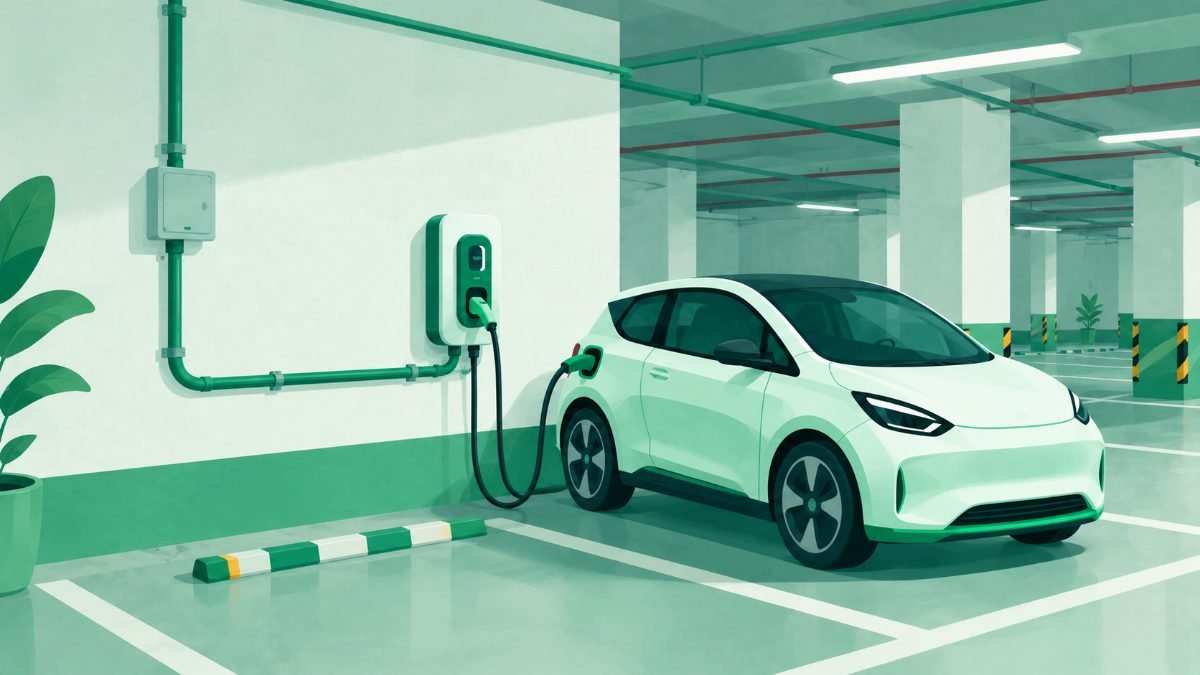
Basement charging is normal and can be done safely, but an enclosed, below-ground parking level adds four checks on top of the standard apartment safety checklist: ventilation and heat, fire-safety systems and clearances, water and flood risk, and emergency access and traffic. None of these is answered by the charger's brochure. Each is a property of your specific basement, your specific parking bay, and the route the cable takes to reach it. Walk the spot with a licensed electrician before you spend any money, and treat their written opinion — not this article — as the decision.
Why a basement is a different problem
A basement is kinder to equipment in some ways — no rain, no sun, no UV degrading a cable — so much of our guide to outdoor charging points during monsoon does not apply. It is harsher in others: air does not move unless something moves it, water that enters cannot drain by gravity, and escape routes usually funnel toward one ramp. That is why committees get nervous about basements specifically, and why a proposal that meets the concern head-on moves faster.
Check 1: Ventilation and how hot that corner gets
Charging produces modest but continuous heat from the charger, the cable and the car. Where ventilation works, it disperses unnoticed. In a sealed corner behind a column, served by a fan on a 7am-to-10am timer, it accumulates around equipment designed assuming airflow.
- Visit the bay mid-afternoon on a hot day, not at 8am when you normally park. Air that feels completely still is a finding worth reporting.
- Ask the facility manager for the ventilation schedule. Many basements run exhaust fans only during set hours, or only on a smoke trigger — which matters if you charge overnight.
- Leave a cheap thermometer in the bay for a summer day. Compare the maximum against the charger's rated ambient temperature, and have the installer confirm in writing that the spot sits inside that rating.
- Expect derating, not failure. Many chargers cut output when hot, giving a longer session rather than a fault — so if you plan around a fixed overnight window, see how charging time is calculated.
Check 2: Fire-safety systems, clearances and approvals
This is where most basement proposals stall, because nobody can say what the rules are. The honest position: fire-safety requirements for Indian buildings come from national and state codes that are revised periodically and interpreted locally by the fire officer who issues and renews your building's NOC. Whether anything specific to EV charging in enclosed parking applies to you depends on your state, the building's category and when it was approved. Anyone who answers without opening your building's fire file is guessing. Ask your society's fire consultant, or the vendor who services the fire systems.
What you can check yourself first:
- Extinguisher and hose-reel access. Walk from the proposed position to the nearest one. Nothing you install may block that path or hide the equipment.
- Sprinkler and detector coverage. Look up. Charger and conduit must not obstruct a sprinkler's spray pattern or airflow to a detector; altering either touches the building's approvals.
- Documentation. The fire register or as-built drawings should record the installation, its circuit and where it isolates — free now, painful to reconstruct later.
For several shared points rather than one private charger, the fire question changes scale: see fire-safety planning for societies.
Check 3: Water, drainage and flood risk
Basements take water — monsoon ingress down the ramp, seepage through a retaining wall, a burst riser, a sump pump that fails during the very power cut that caused the flooding. Equipment mounted at knee height because that is where the cable reached is the first casualty. Your best data source is not a drawing; it is the guard who has worked there eight years. Ask how high the water came, then look for watermarks on plaster and rust lines on column bases.
- Mount the charger and its isolator above the highest plausible water line — based on what you were told, not on convenience.
- Route cable high along wall or ceiling rather than along the floor, with fittings rated for the location; our guide to cable routing options covers the trade-offs.
- Put the isolation point where you can reach it without wading toward energised equipment, and make sure your family and the security desk know where it is.
- Confirm earthing and residual-current protection for a damp location specifically — RCCB, MCB and RCBO explained covers why that matters more below ground.
Check 4: Emergency access, traffic and the cable route
Basements are tight and cars manoeuvre with limited visibility. The installation has to survive that for years, not just look neat on day one.
- The cable must never cross a driving lane or walkway, not even briefly. If the only route to your car crosses a lane, the bay or the charger position is wrong.
- Columns get clipped. Anything mounted facing traffic needs physical protection, or a position out of the swept path.
- Escape routes keep their full width. Measure with a tape; never let a conduit reduce a clear width someone else certified.
- Light the spot and label the circuit at the board, so a guard or electrician can isolate it in seconds.
The four checks, who signs off, and what to put in writing
| Check | What to look at on site | Who confirms it | What to attach in writing |
|---|---|---|---|
| Ventilation and heat | Airflow at the bay, fan hours, peak temperature vs rated ambient | Licensed electrician; facility manager for fan hours | A line confirming the spot is within the equipment's rated conditions |
| Fire safety and clearances | Extinguisher and hose-reel access, sprinkler and detector positions, conduit path | Society's fire consultant or fire-systems vendor | Confirmation that clearances are unaffected, plus a fire-register note |
| Water and flood risk | Historic water levels, watermarks, drains, mounting height, isolator position | Licensed electrician, informed by guards and long-term residents | Mounting height, ingress rating of fittings, isolation point location |
| Access and traffic | Cable route, escape-route widths, swept paths, column protection, lighting | Licensed electrician with the estate or facility manager | A marked-up parking layout showing route, position and clear widths |
How to present this to your society
The proposal that gets approved is rarely the one with the best charger. It is the one that leaves the committee nothing left to worry about.
- One page per check, using the table above as the spine, with photographs of the actual bay: mounting position, nearest extinguisher, cable route.
- The electrician's written site assessment — the one document that moves the risk from "resident's opinion" to "professional's signature". See what a site assessment should cover.
- The load position. Someone will ask whether the building can take it, so arrive with an answer: start at sanctioned load and apartment EV charging.
- A formal request, not a WhatsApp message — use the permission request letter template and the process in requesting permission from your RWA.
Not sure where you stand yet? The readiness checklist tells you in a few minutes whether your situation looks straightforward or needs a professional assessment first.
Common questions
Can I install an EV charger in basement parking in India?
There is no single national yes-or-no answer, and be sceptical of anyone who offers one. It turns on the conditions attached to your building's fire NOC, your society's own rules, and whether a licensed electrician judges your particular bay suitable. Many societies do permit it after a site assessment.
Is charging an EV in a basement a fire risk?
Any electrical installation carries risk, and an enclosed basement makes a problem harder to manage than the same problem in open air. That argues for a properly designed, professionally installed and correctly protected circuit — not extension boards, loose sockets and informal wiring. Your society is entitled to insist on professional installation and documentation, and you should want that too.
What happens if the basement floods while my car is charging?
This is exactly why the isolation point's position matters. You should be able to cut power without approaching or wading toward energised equipment, and your household plus the security desk should know where that switch is. Mounting height, ingress-rated fittings and correct residual-current protection are the decisions that reduce this risk — all three belong to your electrician.
Do I need society permission if the bay is allotted to me?
Almost always, yes. An allotted bay usually gives you the right to park, not the right to alter common property — and the wall, column, ceiling and cable route between the board and your bay are common property in most societies. Asking in writing, with the electrician's assessment attached, beats installing first and negotiating afterwards.
Where this ends: professional review
This article is meant to make you a better-informed client, not to replace the person who signs off. Only a licensed electrician who has stood in your basement can confirm a position is suitable, size the circuit and protection correctly, and put that in writing — and where fire systems are involved, the building's fire consultant belongs in the conversation too. If the work needs a new connection, a separate meter, or an increase in sanctioned load, confirm the current procedure, documents and charges directly with your DISCOM, since these differ by state and utility and change over time.