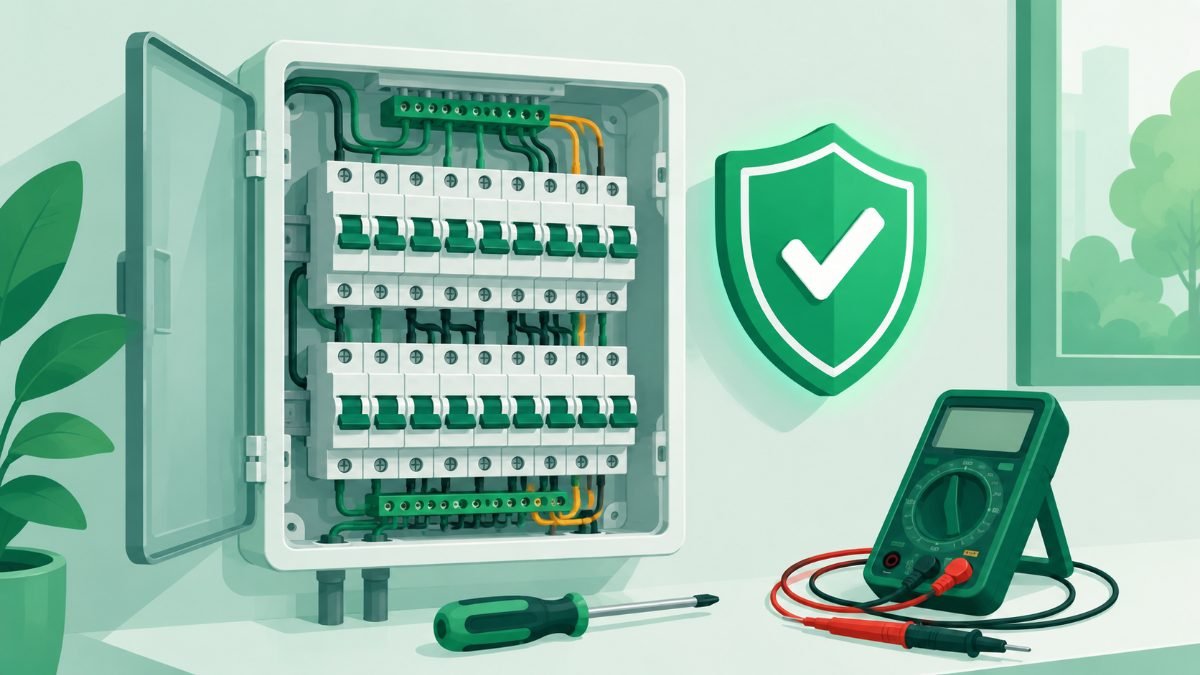
An electrician carrying out an EV-charging site assessment typically checks six things: your sanctioned load and how much of it is already in use, the condition and spare capacity of your distribution board, the quality of your earthing, the physical cable route from the meter to your parking bay, the protection devices and cable size the new circuit needs, and the metering and society formalities that affect the work. A good visit takes thirty minutes to an hour and ends with measurements, not guesses. Knowing what each check means helps you follow the conversation, ask sharper questions, and tell a thorough quote from a thin one — though reading this is no substitute for the visit itself.
The site inspection checklist at a glance
Here is the whole visit in one view. If an assessment skips a row, ask why — occasionally there is a fair reason, but the omission should be explained, never silent.
| Check | What the electrician actually does | What a good visit produces |
|---|---|---|
| Load reading | Reads your sanctioned load from the bill and estimates your existing evening peak | Whether the charger fits, or advice to apply for load enhancement |
| Panel inspection | Opens the distribution board, checks spare ways, wiring age, and signs of overheating | Whether the board can take a new dedicated circuit or needs upgrading first |
| Earthing test | Measures earth resistance with an instrument and inspects the earth connection | An actual reading, plus a remediation plan and cost if the reading is poor |
| Route survey | Walks and measures the cable path from the meter room to your parking bay | A metre count, a conduit plan, and a list of society permissions the path will need |
| Protection sizing | Works out breaker rating, residual-current protection, and cable gauge for the run length | Named device types and cable sizes on the quote, not just a line saying "wiring" |
| Paperwork | Flags metering options and any DISCOM or society formalities | A short list of approvals to obtain before work starts |
Load reading: does your connection have room?
Every domestic connection has a sanctioned load — the maximum demand your DISCOM has approved for your meter. The electrician finds this figure on your electricity bill or meter records, then estimates how much of it your flat already draws at peak: air conditioners, geyser, and kitchen appliances running together on a summer evening.
A worked example with illustrative numbers: say your sanctioned load is 5 kW and your evening peak already touches 4 kW (check your own bill — every flat differs). A 7.2 kW charger plainly will not fit; even a 3.3 kW unit would need disciplined late-night charging or a load-enhancement application to your DISCOM. A good assessment states this trade-off openly. Our comparison of 3.3 kW versus 7.2 kW charging for apartment use covers when the smaller unit is the smarter fit.
Panel and wiring condition
Next, the electrician opens your distribution board, looking for three things: a spare way to mount a breaker for a dedicated charger circuit, the board's condition — discoloured terminals, loose connections, or a burnt smell all signal trouble — and the age and type of the existing wiring. A charger runs at high load for hours at a stretch, unlike a geyser, so marginal wiring that has coped until now may not cope with charging.
In older buildings this check sometimes reveals work unrelated to the charger: a corroded board, an undersized incomer, or circuits with no earth conductor at all — far better discovered now than after installation.
Earthing: the test worth insisting on
Earthing is the safety net that lets protection devices trip quickly when something goes wrong, and charging is unforgiving of a poor one because the vehicle body itself is part of the picture. A proper assessment includes an actual earth-resistance measurement taken with a tester — not a glance at the earth wire and a nod. Ask to see the reading, and ask what your electrician considers acceptable and why.
If the reading is poor, remediation might mean re-terminating connections or installing a new earth electrode; get that as a separately priced line item. Our apartment EV charging safety checklist explains why earthing sits at the top of the safety list.
The cable route survey
The electrician then traces the path a cable would take from your meter or distribution board to the parking bay, measuring the distance and noting every obstacle: walls to drill, corridors to cross, and stretches that need conduit. Cable is priced per metre and civil work per obstacle, so this survey usually decides more of the final cost than the charger itself. Length also affects thickness — a long run needs heavier-gauge cable to limit voltage drop, which a careful electrician calculates rather than guesses.
Covered and basement routes bring extra questions about ventilation, water lines, and escape paths; our guide to what to check before installing a charger in basement parking walks through them. And since the route almost always crosses common areas, settle early who pays for which stretch of the wiring — the assessment report is the ideal document to take into that conversation with your society.
Protection sizing: the part hidden inside the quote
The new circuit needs its own protection, sized to the charger and the cable. Expect the electrician to specify a breaker rated for the charger's current draw and a residual-current device suited to EV charging — some chargers can produce leakage currents that ordinary devices are not designed to detect; choosing the right class is your electrician's call to make and explain. Surge protection is worth asking about too, especially where supply quality is uneven.
You do not need to know the device catalogue. You only need the quote to name each device and rating rather than burying everything under one "electrical materials" line — that makes it far easier to compare and verify on installation day.
Judging the quote that follows
A thorough quote reads like the visit happened: cable priced per metre with the size stated, conduit and civil work itemised, protection devices named with ratings, earthing remediation listed separately if needed, metering work identified, and labour on its own line. Warning signs worth a second opinion: a single lump-sum figure, a confident quote issued without any site visit, or no mention of earthing anywhere.
It also helps to arrive informed. Run through our apartment EV readiness checklist before booking to learn your likely weak spots, and use the apartment charger cost calculator to build a rough estimate you can hold the quote against. If the two differ wildly, ask which assumption differs — that single question exposes most padded quotes.
Common questions
How long should a site assessment take?
Typically thirty minutes to an hour, longer if the meter room is far from the parking. A five-minute visit with no instruments and no measurements is not really an assessment — treat any quote that follows as a rough indication and consider a second opinion.
Should I expect to pay for the visit?
Practices vary. Some electricians charge a visit fee, some adjust it against the job if you proceed — ask before booking. A fee is not a red flag: a written report with readings in exchange for it is entirely reasonable.
Can an electrician quote accurately without visiting?
Only roughly. The three biggest cost drivers — route length, earthing condition, and panel state — cannot be judged over a phone call or from photos. A remote figure helps you decide whether to explore further, but treat it as indicative until someone has stood in your parking bay with a measuring tape and a tester.
What if the assessment says my site is not ready?
That is useful information, not a dead end. The usual paths forward are a load-enhancement application to your DISCOM, a panel or earthing upgrade, a lower-power charger, or a shared charging point in a better-served corner of the parking. Get the findings in writing so your society and any second electrician can work from the same facts.
A final word: this article is preparation, not a substitute. Every check described here must be done in person by a licensed electrician, and any question about your sanctioned load, metering, or connection belongs with your DISCOM. Use this guide to arrive well prepared — then let the professional take the measurements.