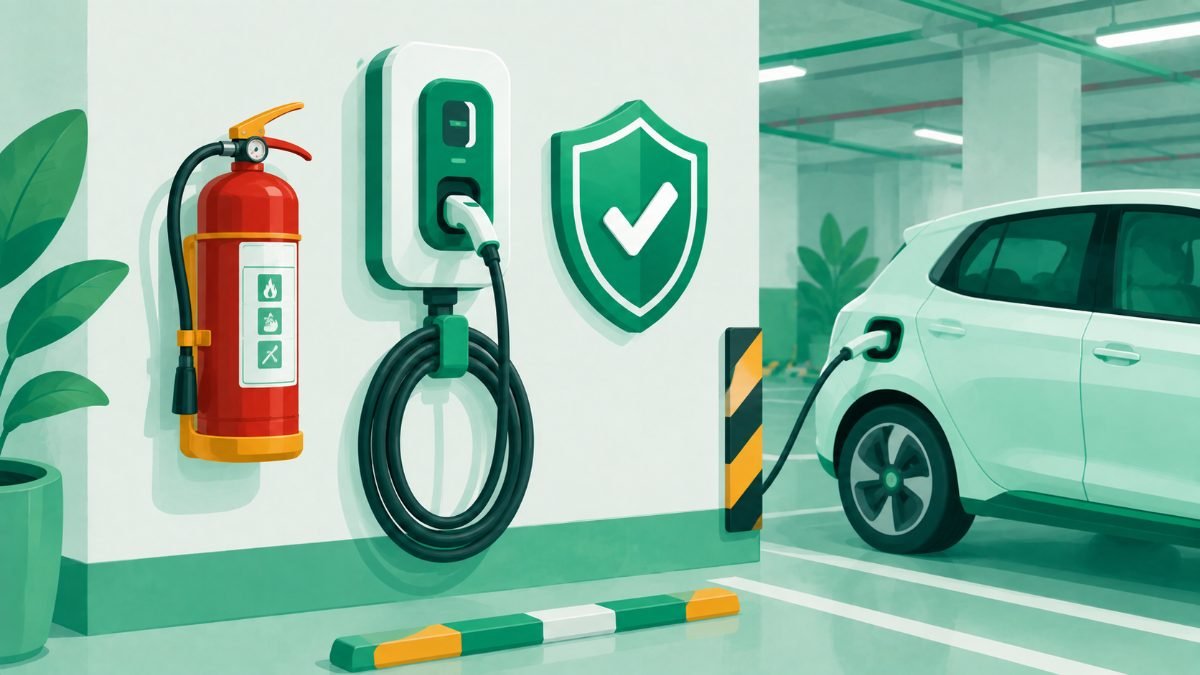
Good EV fire-safety planning for a housing society rests on four controllable pillars: professional installation of every charging point by a licensed electrician on a dedicated circuit, correct protection devices such as an MCB and RCCB, firm rules against extension cords and improvised wiring, and a short written emergency plan covering extinguisher access, emergency contacts and clear space around charging bays. Societies that get these four things right have addressed the risks they can actually control. Blanket bans, on the other hand, tend to push residents towards the riskiest behaviour of all — quietly charging from ordinary plug points with trailing extension leads. This guide works through each pillar calmly, without alarm and without pretending any risk is ever zero.
Start with a level head, not a ban
After every EV fire headline, some managing committee somewhere proposes banning charging outright. It is an understandable instinct, and usually a counterproductive one. A ban does not remove electric vehicles from your parking — residents will still buy them, park them and need to charge them. What a ban removes is the society's ability to insist on safe, professionally installed charging. The predictable result is hidden charging: cables dangled from balcony plug points, multi-plugs in stilt parking, extension cords snaking across driveways. Every one of those improvisations is worse than a properly wired charging point.
The level-headed alternative is managed charging: allow it, but only on the society's written terms. That position protects residents who own EVs, residents who do not, and the committee itself — because the society can show it acted with reasonable care rather than ignoring the issue or overreacting to it.
What actually reduces risk at each charging point
Fire risk at a charging bay is not mysterious. The factors within your control are the same ones a good electrician worries about on any sustained high-load circuit:
- A dedicated circuit, professionally installed. The charging point should run on its own wiring from the resident's meter or distribution board, sized for the charger's load and installed by a licensed electrician — never tapped off a lighting or general-purpose socket circuit.
- Proper protection devices. An MCB protects the wiring against overload and short circuit; an RCCB (or a combined RCBO) protects people against earth leakage. Both, plus sound earthing, should be non-negotiable in your society's rules.
- No extension cords, ever. Ordinary extension leads and multi-plugs are not designed to carry charging loads for hours at a stretch. A firm rule against them is the cheapest fire-safety measure your society will ever adopt.
- Sensible cable routing. Cables should be clipped or run in conduit, protected from vehicle tyres, waterlogging and physical damage along the route.
- Clear surroundings. Keep cartons, tyres, paint tins and other stored combustibles away from charging bays, and keep each bay accessible rather than boxed in by clutter.
Our apartment EV charging safety checklist turns these points into a walk-through you can do bay by bay, and the step-by-step installation guide explains what a professional installation should include from day one.
Put the rules in writing before the tenth EV arrives
Informal understandings work when one resident has an EV. They start failing by the time there are ten. A short written policy makes safety expectations enforceable and even-handed. Clauses worth including:
- Every charging point must be installed by a licensed electrician and registered with the society before first use.
- Required protection: dedicated circuit, MCB, RCCB and proper earthing, with the installer's completion note kept on file with the society office.
- A clear prohibition on extension cords, multi-plugs and charging from common-area sockets.
- A periodic inspection commitment — say once a year — for society-owned and private points alike, framed as maintenance rather than policing.
- Housekeeping rules: no storage around charging bays, and cables unplugged and stowed when not in use.
The RWA EV policy generator will draft these clauses for your society to debate, and the model society charging policy shows what a complete document looks like. Treat both as discussion drafts for your committee, your electrician and, where needed, a fire-safety professional to review — not as finished rules.
An emergency plan you can write in one evening
Most societies already have fire measures for the building. EV charging does not demand a parallel system — it needs those existing measures extended to the parking area, plus clarity about who does what. The table below is a starting checklist for your committee.
| Item | What good looks like | Who owns it |
|---|---|---|
| Electrical isolation | A clearly labelled switch or MCB that cuts power to charging bays, and security staff who know where it is | Committee + electrician |
| Extinguishers | Types suited to electrical fires placed near parking, chosen on your fire-equipment vendor's advice and serviced on schedule | Facility manager |
| Emergency contacts | Fire brigade, society electrician, DISCOM complaint line and committee numbers displayed at the gate and lift lobby | Committee |
| Access | Driveways and charging bays kept clear so a fire tender can approach without obstruction | Security |
| Staff briefing | Guards know the isolation switch, the extinguisher points, and the instruction to raise the alarm and call the fire brigade first | Facility manager |
| Annual review | Plan re-read once a year and after any incident or new installation | Committee |
Two points deserve emphasis. First, large battery fires can behave differently from ordinary fires and can reignite even after they appear to be out — so the plan should prioritise raising the alarm, isolating power, evacuating and calling the fire brigade over heroics with a hand extinguisher. Second, having an emergency plan is not an admission that charging is dangerous. It is the same reasonable care a society already takes for its lifts, gensets and LPG connections.
Basements and stilt parking deserve extra attention
Enclosed parking concentrates smoke and complicates access, so charging in a basement raises questions that open parking does not: ventilation, detector coverage, distance from exits, and how a vehicle could be reached in an emergency. None of this automatically rules basements out — but it does mean the society should commission a professional site assessment rather than deciding by a show of hands. Our guide to basement parking charger checks lists what to examine before approving an installation below ground, and a fire-safety consultant can tell you what requirements apply to your specific building.
Common questions
Are EVs more likely to catch fire than petrol cars?
We will not quote statistics we cannot verify, and you should be wary of anyone quoting them loosely in a society meeting. What is fair to say: every parked vehicle — petrol, diesel, CNG or electric — carries some fire risk, and the EV-specific risks a society can influence are installation quality, protection devices and charging discipline. Keep the debate focused on those, not on numbers nobody in the room can source.
Should we ban charging in the basement?
Not by default. A blanket basement ban often just moves improvised charging to worse locations. The sound approach is a professional site assessment: if it says a particular bay is unsuitable, follow that advice; if it sets conditions — on ventilation, protection or placement — write them into the society's policy and enforce them evenly.
Do we need special extinguishers for EV fires?
Ask the vendor who services your society's fire equipment — they can advise what suits electrical fires in your parking layout. Be honest with residents that a large battery fire is a job for the fire brigade; your extinguishers, isolation switch and evacuation plan exist to control the first minutes, not to replace professionals.
Who is liable if a private charger causes a fire?
It depends on your society's bye-laws, the installation's history and the insurance policies involved, so no article can settle it for you. What a society can do is reduce the ambiguity: require professional installation, keep completion records on file, spell out responsibilities in the written policy, and ask both the society's insurer and residents' own insurers how charging equipment is treated.
Finally, know where this guide's authority ends. Electrical protection, load capacity and fire measures for your specific building are matters for a licensed electrician, a qualified fire-safety professional and your DISCOM — confirm current requirements with them before your society finalises any charging arrangement. And if your building is earlier in the journey, the apartment EV readiness checklist is a sensible five-minute first step.