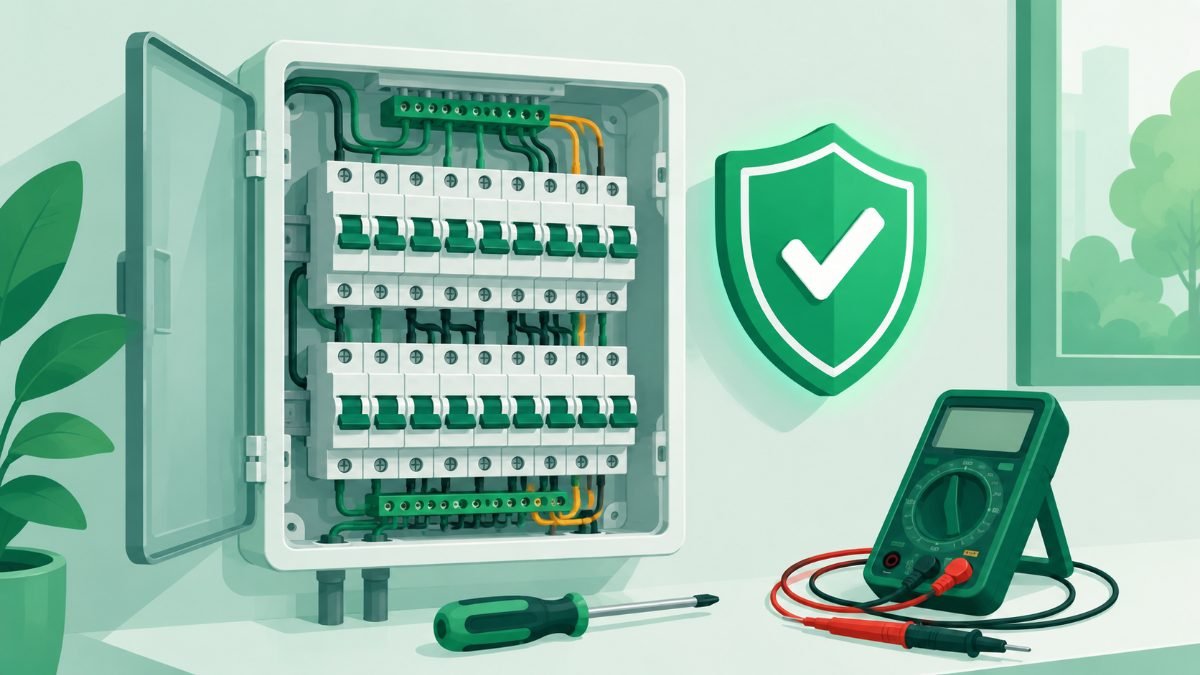
Earthing gives fault current a safe, low-resistance path into the ground so that protective devices trip instead of your car's body — or your hand — carrying the current. EV chargers depend on it more than almost any other appliance in a flat: they run at high power for hours, sit outdoors or in basements, and connect to a large metal vehicle that people touch. In many Indian apartment buildings, especially older ones, the earthing was designed decades ago for lighter loads and may have corroded or been quietly bypassed during renovations. Before any charger goes in, a licensed electrician should test the building's earthing and the run to your parking spot — not assume it is fine.
What earthing actually does, in plain language
Every circuit in your flat has a live wire carrying current in and a neutral carrying it back. Earthing is the third path: a wire bonded to the metal parts of your appliances and connected, ultimately, to an electrode buried in the ground near your building. In normal operation it carries nothing. Its job begins the moment something goes wrong — insulation fails, a wire chafes, moisture bridges a connection. Fault current then flows through the earth wire instead of through whoever touches the appliance, and it flows heavily enough that the MCB or earth-leakage device trips in a fraction of a second.
Think of earthing as the drainage system of your electrical installation. You never notice it on a dry day. On the day it matters, you find out very quickly whether it was built properly.
Why EV chargers depend on earthing more than other appliances
Three things make a charging point unusually demanding.
- Sustained high power. A geyser runs for twenty minutes; a charger can draw close to its full rated load for four to six hours, night after night. Small weaknesses — a loose earth connection, a corroded joint — heat up and get worse under this kind of duty.
- A large touchable metal body. The car itself is connected to the circuit while charging. If a fault develops and the earth path is poor, the vehicle body can sit at a dangerous voltage while looking completely normal. Anyone who touches the door handle completes the circuit.
- Harsh locations. Chargers live in stilt parking, basements, and open lots — damp, dusty places where insulation and connections degrade faster than they do inside a flat.
Modern chargers also carry their own protective electronics, and many will refuse to start — or trip repeatedly — when they detect missing or high-resistance earthing. A charger that keeps cutting out is sometimes the earthing telling you something. This is one reason the difference between charger sizes matters less than the wiring behind them; our guide to 3.3 kW versus 7.2 kW apartment charging covers how load and wiring interact.
Signs your building's earthing may be poor
None of these prove a fault, and their absence proves nothing either — earthing problems are usually invisible until measured. But treat any of the following as a reason to insist on testing before a charger is installed:
- A mild tingle when you touch a geyser, fridge body, washing machine, or metal tap.
- Shocks that appear in the monsoon and vanish in summer — moisture is completing a path your earth wire should already be providing.
- Earth-leakage devices (RCCB or ELCB) that trip often with no traceable cause — or, equally worrying, an installation with no earth-leakage protection at all.
- Sockets where the earth pin connects to nothing, or widespread use of two-pin adapters around the building.
- An earth pit nobody can locate, or one that is dry, buried under debris, or visibly corroded at its connections.
- Burnt smells, discoloured switchboards, or flickering near the meter room.
Why old buildings need testing, not assumptions
A society built twenty or thirty years ago was wired for fans, lights, one fridge per flat, and perhaps a window AC. Since then, flats have been renovated by different contractors, circuits have been extended and tapped, and earth wires have sometimes been cut, reused, or simply left disconnected behind a false ceiling. Meanwhile the earth electrode itself ages: soil dries out, salts leach away, joints corrode, and the resistance of the path to ground creeps upward year by year. The building can look and behave perfectly normally through all of this.
Testing is quick and inexpensive compared with what it protects against, and it produces a number your society can act on rather than an argument. If you are still at the exploring stage, run through our apartment EV readiness checklist — earthing is one of the eight questions it asks. If your parking is below ground, the stakes are higher still; see the basement parking charger checks before you go further.
What the electrician verifies before installation
A proper pre-installation check is more than a glance at the distribution board. Expect a licensed electrician to work through checks like these, with instruments, and to compare readings against the standards applicable to your installation:
| Check | What it involves | Why it matters |
|---|---|---|
| Earth electrode and pit condition | Physical inspection of the pit, electrode, and connections for corrosion, dryness, or damage | The entire system depends on this final connection to ground |
| Earth resistance measurement | Measuring with an earth resistance tester and judging the reading against applicable norms | High resistance means fault current may be too weak to trip protection quickly |
| Earth continuity to the parking bay | Confirming the earth conductor runs unbroken from the panel to the proposed charging point | A perfect earth pit is useless if the wire to your bay is cut or missing |
| Socket polarity and wiring | Confirming live, neutral, and earth are landed on the correct terminals | Reversed or floating connections can defeat the charger's own protections |
| Residual current protection | Test-tripping the earth-leakage device on the circuit and confirming it is a type suitable for EV charging | This is the device that disconnects fastest when current leaks to earth |
| Neutral health | Checking for broken or shared neutrals and abnormal neutral-to-earth voltage | Neutral faults can put stray voltage on earthed metal without any appliance failing |
Raising earthing with your RWA
Earthing is common infrastructure, so fixing it usually needs the society's involvement, not just yours. Frame it that way: a test report benefits every resident, whether or not they ever buy an EV, and a documented reading strengthens your case rather than complicating it. When you write to the managing committee, ask for permission to have the earthing at your proposed charging point tested, and offer to share the results. Our guide on how to request charger permission from your RWA walks through the full process, and the apartment EV charging safety checklist gives the committee a neutral document to review alongside your request. How any repair costs are split will depend on your society's bye-laws and whether the fault lies in common wiring or your own extension.
Common questions
Can I just add a separate earth pit for my charger alone?
Sometimes a dedicated electrode for the charging circuit is a sensible upgrade, but it is a design decision, not a shortcut — a new pit must be built, bonded, and tested correctly, and how it relates to the building's existing earthing matters. Let a licensed electrician decide whether your installation needs one, and get the society's written consent before digging anything on common ground.
My charger works fine — doesn't that mean the earthing is fine?
Not necessarily. A charger can operate normally on marginal earthing for months because the earth path is only truly exercised when a fault occurs. Some chargers detect gross problems, but they cannot certify your building's installation. If the earthing has never been formally tested, a working charger is reassurance, not proof.
Does a three-pin plug mean I am earthed?
No. The third pin only helps if the socket's earth terminal is actually wired back to a healthy earth electrode. In many older flats the earth terminal connects to a wire that goes nowhere, or to a conductor that was broken years ago. Only continuity and resistance testing can tell you what that pin is really connected to.
Who pays if the society's earthing needs repair?
There is no single answer. Repairs to common electrical infrastructure are often treated as society expenses funded through maintenance dues, while work on your private extension is typically yours to bear — but your society's bye-laws may say otherwise. Read our guide on who pays for apartment EV charger wiring and agree on the split in writing before work begins.
A final word: this article gives you background so you can ask sharper questions, not a substitute for measurement. Earthing verification needs instruments and professional judgment about your specific building. Before installing anything, have a licensed electrician test the earthing end to end, and confirm with your DISCOM whatever requirements apply to new charging points or load changes at your address.