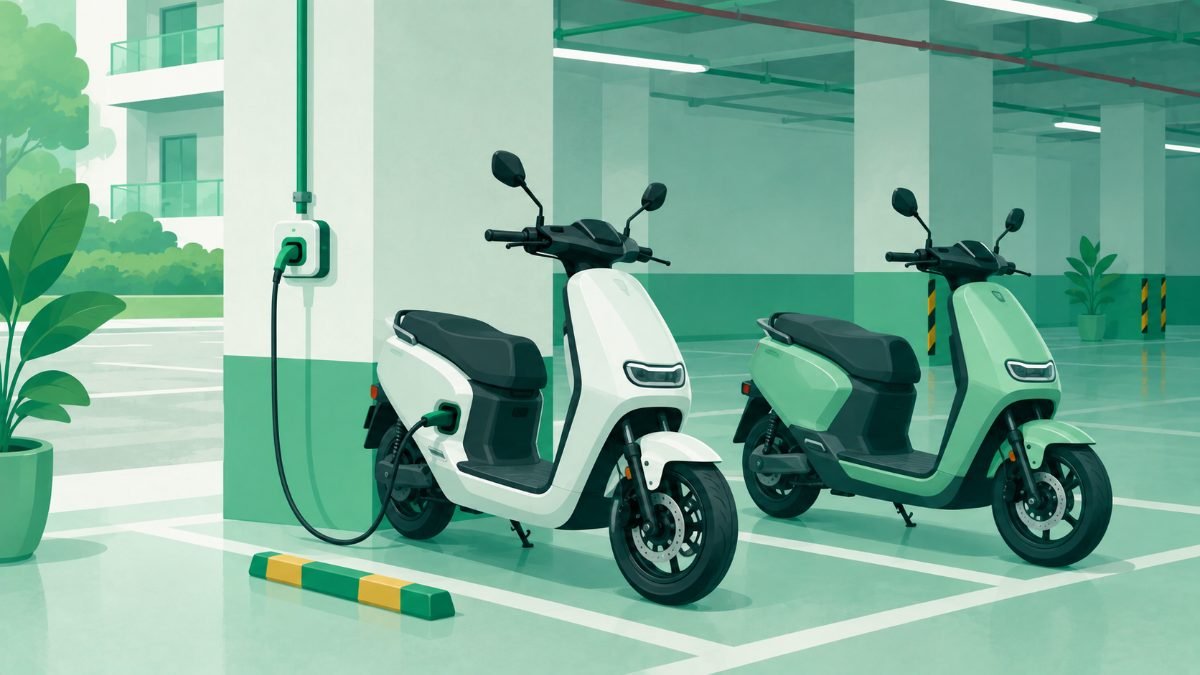
Shared EV charging in a society runs smoothly on ten simple courtesies: move your car promptly once charging finishes, book slots honestly and only for what you need, charge at quiet hours when you can, handle the cable like shared property, report faults the same day, leave the bay as you found it, ask before plugging in a guest's vehicle, pay your share on time, share the crunch during festival weeks, and raise disputes through the committee rather than the WhatsApp group. None of these are usually written into a society's policy — but they decide whether your charging point becomes a shared asset or a monthly argument.
Why unwritten rules matter as much as the written policy
Societies setting up shared charging put their energy into the big decisions — where the charger goes, how the wiring runs, how billing works. Those matter, and if you are still at that stage, start with the trade-offs between private and shared charging in apartment parking. But once the point is live, daily peace depends less on the policy document and more on how a dozen residents behave around equipment that everyone paid for and nobody individually owns.
No committee can draft a clause for every situation: the neighbour who is five minutes late, the cousin visiting for the weekend, the festival week when four cars want a full battery on the same evening. Etiquette fills that gap. The ten habits below cost nothing, and they are the difference between a charger that quietly works and one that becomes a standing agenda item.
Rules 1–3: Respect the queue
Rule 1: Move your car as soon as charging finishes. A fully charged car occupying the charging bay is the single biggest source of friction, because it blocks the point without using it. Treat the bay as a charging spot, not a parking spot: set an alarm for the expected finish time and build the walk to the basement into your evening. If someone is waiting and you are already above 80 per cent or so, consider stopping early — charging typically slows as the battery fills, so the last stretch costs the queue the most time for the least added range.
Rule 2: Book honestly, and only what you need. If your society runs a slot roster or booking sheet, book the hours you genuinely expect to use, and release a slot the moment your plans change. Blocking slots "just in case" feels harmless once, and corrosive when three people do it.
Rule 3: Charge at quiet hours when you can. If your routine allows overnight or mid-morning sessions, take them, and leave the evening peak for neighbours with less flexible schedules. Your DISCOM may also offer a time-of-day tariff that makes off-peak charging cheaper — check your own bill or ask your DISCOM, since this varies.
Rules 4–6: Treat the charger as everyone's property
Rule 4: Handle the cable like shared property. Coil it back on its hook after every session, keep the connector off the floor, and never stretch it taut or drive over it. A damaged cable takes the whole point out of service and starts an awkward conversation about who pays.
Rule 5: Report faults the same day — and never improvise a fix. An error light, a breaker that trips, a connector that feels loose or unusually warm: message the committee member or facility manager in charge immediately, and stop using the point until it is checked. Do not reset a tripping breaker repeatedly, and never open a panel yourself — the apartment EV charging safety checklist explains why these symptoms deserve a professional's attention.
Rule 6: Leave the bay as you found it. No litter, no cartons or cycles stored in the charging bay, and report any water pooling near the unit. A clean, clear bay is also a safer one.
Rules 7–8: Guests and money
Rule 7: Ask before plugging in a guest's vehicle. Your visiting cousin's car draws the same electricity your neighbours pay for, so a quick message to whoever manages the charger — before the session, not after — keeps everything above board. Many societies simply bill guest units to the host flat. As an illustration only: if your society recovers costs at, say, ₹9 per unit (your society will set its own figure), a 15-unit guest session comes to about ₹135. Small money — but asking first buys a lot of goodwill.
Rule 8: Pay your share on time, whatever the method. Whether your society reads sub-meters monthly or bills automatically through a smart charger, pay promptly and keep your own note of readings or sessions. If your society has not yet settled how to split costs, the comparison of sub-meter versus smart-charger billing lays out the options, and a written shared-charging billing agreement saves everyone from relying on memory.
Rule 9: Share the crunch in festival weeks
Before Diwali, over long weekends, and through wedding season, everyone wants a full battery on the same two evenings. No roster survives that unchanged, so agree the crunch protocol in advance: shorter sessions for everyone, priority for residents actually travelling the next day, and a request that those staying home charge two or three days early. Most city driving needs far less than a full battery, so a little planning usually lets you skip the rush entirely. A one-line message in the group — "travelling Friday, need the 9 pm slot, happy to swap" — does more for harmony than any rule.
Rule 10: Escalate without drama
When a neighbour repeatedly overstays or skips payments, the worst venue for the complaint is the society WhatsApp group at 11 pm. Escalate the way you would want to be escalated against: a friendly word in person first, then a private message to the committee member handling the charger, then — only if it continues — a written note asking for the matter to be taken up at the next committee meeting. Keep it factual: dates, times, what happened. Most people correct course after the first friendly word.
| Situation | The considerate move | What to avoid |
|---|---|---|
| Your charging session ends | Move the car within a few minutes; set an alarm for the finish time | Leaving a full car in the bay overnight |
| Someone is waiting and you are above ~80% | Offer to stop early and free the point | Insisting on 100% while the queue grows |
| The charger shows an error or trips | Report it the same day and stop using it | Repeated resets or opening the panel yourself |
| A guest needs to charge | Ask the charger in-charge first; pay for the units | Quiet sessions on the society's meter |
| Festival-week rush | Shorter sessions; charge early if you are not travelling | Blocking a peak slot you do not really need |
| A neighbour keeps breaking the rules | Friendly word, then the committee, in writing if needed | Naming and shaming in the group chat |
If the same disputes keep recurring, that is a sign the unwritten rules need to become written ones. The RWA EV policy generator can turn your society's habits into a draft policy the committee can discuss and adapt.
Common questions
Should these rules be written into our society's charging policy?
The ones with money or safety attached — payment timelines, fault reporting, guest billing — belong in writing, because memory fades and committees change. Pure courtesies like moving promptly work better as a short etiquette note near the charger and in the group description. A one-page note agreed at a general body meeting carries surprising weight.
What if a fully charged car blocks the charger overnight?
The first time, assume forgetfulness and send a friendly message. If it becomes a pattern, ask the committee to adopt an idle-time understanding — for example, cars move within a fixed grace period after charging ends, with a reminder for the first lapse. Some societies add a small idle fee later, but start with reminders; most repeat offenders are disorganised, not malicious.
Can the society charge guests a different rate?
Many societies bill guest sessions to the host flat at the same per-unit recovery rate residents pay; some add a small margin towards shared costs. Whatever yours chooses, decide it openly at a meeting, record it, and apply it uniformly — a guest rate invented per incident is where resentment starts. Your society's bye-laws may also have a say, so check them.
Who pays if the shared cable gets damaged?
If a specific resident clearly caused the damage — drove over the cable, dropped the connector — most societies expect that resident to bear the repair. Wear and tear with no clear cause is normally treated as a common expense, like a lift repair. Decide this before it happens and record it alongside your billing arrangement.
One final note: etiquette keeps neighbours happy, but it is no substitute for a sound installation. Anything involving the charger's wiring, breakers, earthing, or a fault that keeps recurring belongs with a licensed electrician, and questions about connections, sanctioned load, or time-of-day tariffs belong with your DISCOM. Get those two relationships right, and the ten rules above will do the rest.