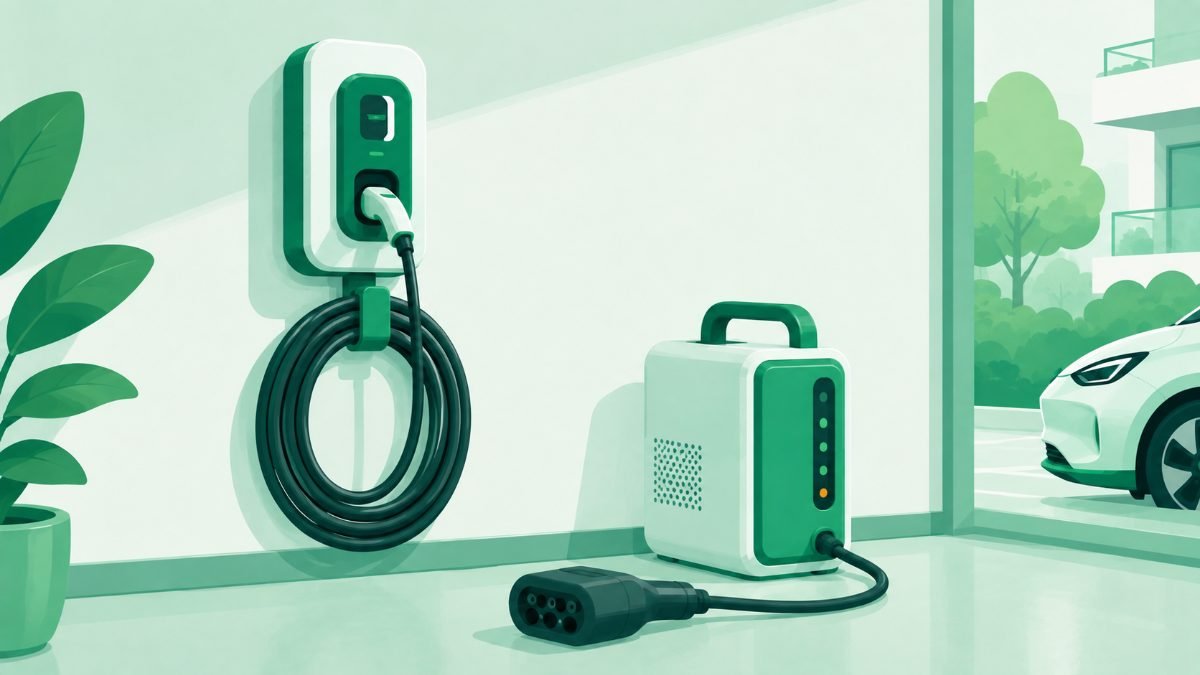
An existing parking socket can become a supervised interim shared charging point, but the outlet you already have is a location, not a charging point, and this is a decision before it is a piece of hardware. Answer four questions first: how many residents own an EV now, how many expect to within two years, how far the outlet sits from the distribution panel, and whether parking bays are fixed or floating. If those answers point to an interim arrangement rather than a commissioned station, hand your licensed electrician a written question sheet instead of a specification, agree a booking rota and a logbook, and record in advance the trigger that ends the arrangement.
Which of the three columns your society is in
Score your building against these axes before anyone mentions equipment.
| Decision axis | Do nothing yet | Interim shared point | Commissioned station |
|---|---|---|---|
| EV owners today | None, or one who charges elsewhere | Two or three, willing to share a queue | Four or more, or a waiting list forming |
| Owners expected in two years | Nobody has said they are buying | One or two more, named, from your own count | Enough that a rota runs out of nights |
| Distance to the distribution panel | Not yet relevant | Short enough your electrician calls the run straightforward | Long, or heavy in civil work, so worth building once |
| Fixed or floating bays | Either | Floating suits it: the point stays still, cars come to it | Fixed bays push you to a point per bay, which is a station |
| Who owns the hardware | Nothing to own | Society owns the point; residents own their cables | Society, or an operator under contract with an exit clause |
| What the society commits to | Nothing — but minute it | A rota, a logbook and a maintenance line; reversible in an afternoon | Capital and a routine that outlives this committee |
| Trigger to move one column right | A second resident buys an EV, or asks in writing | A fourth owner joins, the rota fills, clashes recur, or a fault repeats | — |
The middle column is the one nobody writes about, and it is the honest home for a building with two or three EVs. If the scoring pushes you right instead, pick the thread up at private versus shared charging in apartment parking.
The question sheet the committee hands the electrician
The risk is not the car; it is asking a fitting and circuit chosen for short jobs to carry close to full load for most of a night, perhaps on wiring shared with lights or a pump — the case our comparison of a portable charger against a wall box makes in full. The committee cannot write a specification, so do not accept a quote that is only a price: hand over this sheet, and ask for each answer in writing and on the completion note.
- Is this outlet on its own circuit? If it is shared, with what, and what do you propose instead?
- What conductor size does this run need, and on what basis? Ask for the factors — length, method, grouping, temperature — not just a size; cable routing in apartment buildings shows why the route drives it.
- What overcurrent and residual-current protection will you fit, and why here? We name no figure on purpose: it depends on the draw, the cable, the run and what else shares the supply — see RCCB, MCB and RCBO explained.
- What earthing is present, what did you measure, and with what instrument? Ask for the reading, not a reassurance.
- What fitting replaces the outlet, and does its documentation call it fit for continuous duty? Ask to see it, and whether it can be unplugged only when dead.
- What current and voltage did you measure under load? The next section's arithmetic runs on both.
- Where does the enclosure go, and how does it keep water out here? Ask them to answer for monsoon, alongside monsoon-proofing an outdoor charging point.
- What load does this add, to which meter, and what to check how often? Put the answer, with a name and number, inside the enclosure.
Do not skip the sign-off: nobody plugs in until the licensed electrician has run the point under load and issued a written completion note, of the kind covered in what an electrician checks in a site assessment.
How many cars one slow point can actually serve
The ceiling is not a property of the socket. It is the ratio between the hours the bay is free and the hours one car needs. Every figure below is an illustrative assumption — substitute your own completion note and your own odometer.
- Suppose the note records the point set to 15 A with a measured 230 V under load. Then 15 × 230 = 3,450 W, so 3.45 kW, a little over 3 units an hour.
- Suppose a resident drives 40 km on a weekday and their display shows 6 km per unit. That is 40 ÷ 6 = 6.7 units into the battery, and 6.7 ÷ 0.9 = 7.4 units off the wall, since some energy becomes heat instead of range.
- 7.4 ÷ 3 = 2.5 hours a session, before plugging in and moving the car; output is in units an hour, not kilometres an hour, for the reason in 3.3 kW versus 7.2 kW.
- Suppose the bay is free from 10 pm to 6 am, so 8 hours. Then 8 ÷ 2.5 = 3.2, and the answer for that building is three cars of that size in that window.
Change one input and the answer changes: a 100 km day at 5 km per unit needs 100 ÷ 5 = 20 units in the battery, 22 off the wall, 22 ÷ 3 = over 7 hours, so one such car fills the window alone. Run both cases through the apartment charger cost calculator before the rota is drawn up. And note what the arithmetic will not forgive: a single point is a queue, not a capacity, so a second EV moves a session to another night rather than shortening anybody's.
A worked interim budget, and how the money comes back
Every number here is an assumption chosen to show the working. Replace each with the figure from your own written quote, your own society bill and your own logbook.
- Suppose three residents agree to share one interim point and to fund it between them.
- Suppose your electrician's itemised quote for the whole job — run, fitting, enclosure, protection, sub-meter and labour — reads ₹16,500. Split three ways, 16,500 ÷ 3 = ₹5,500 each.
- Suppose your society's own bill shows the common connection billed at ₹9 a unit.
- Suppose the committee adds ₹2 a unit for maintenance, so the billed rate is 9 + 2 = ₹11 a unit.
- Suppose the logbook shows 380 units across the three cars in a month. The society collects 380 × 11 = ₹4,180, pays 380 × 9 = ₹3,420 against its own bill, and reserves ₹760.
- At that rate the reserve matches the original job in 16,500 ÷ 760 = about 22 months — which tells you whether the surcharge funds the next stage or only repairs.
Settle in writing whether each contribution is a deposit or permanent, what happens to it when a contributor sells the flat, and on what terms a fourth may join. The fairness arguments are in how to split shared EV-charging costs.
Running it: the rota, the logbook and the lock
An interim point has no software, so every control is a human one.
- The rota. Fixed windows on the noticeboard, one name per window, booked ahead, with no standing claim on the same slot every night. Agree a grace period for moving the car, and print whatever figure you choose.
- The logbook. A physical book inside the enclosure: date, flat, vehicle number, sub-meter reading at start and end, signature.
- The lock. With no card reader and no app, access is physical: the point and sub-meter sit in a lockable enclosure, and the key is signed out from the guard or issued only to registered users. The key register then is your access list.
Reconcile monthly, in public: logged sessions should sum to the sub-meter's month-on-month difference. When they do not, you have unlogged sessions, a misread meter, or something else on that circuit — the last of which is a question for the licensed electrician. When the logbook starts to feel like a chore, the point is busy, and access control for shared society chargers covers where cards or accounts earn their keep.
Write the end of the arrangement before it begins
An interim point exists to buy time and produce evidence, and both expire. A committee that does not name the end in advance defends a socket for five years because removing it would look like a reversal. Put the triggers from the first table into the resolution, add a review date, and agree that when a trigger fires the task is to move one column right on evidence you already hold.
That evidence is the quiet payoff: after a year the logbook and sub-meter give you real units, session lengths and clash counts for your own building. Carry it into how to propose a common EV-charging station, and record the rules while goodwill is fresh with the society EV-charging policy draft.
Common questions
Is the socket already sitting in our parking good enough to charge from?
Treat it as a useful location, not an answer: what the circuit is and what it needs depends on the hidden wiring, the run length, the earthing and what else shares it, none of which shows in a photograph. Put the question sheet above to a licensed electrician, and let the completion note tell you what you have.
How many cars can realistically share one slow point in twenty-four hours?
Work it out rather than accept a figure: divide the hours the bay is free by the hours one car needs, where hours per car is that car's nightly units off the wall divided by the point's units an hour. A short commute leaves room for several cars a night; one high-mileage car can take the window alone.
What should the committee hand the electrician instead of a specification?
The eight questions above, not a spec sheet, each answered in writing and on the completion note — what the circuit is, the conductor size and why, the protection and why here, the earthing reading, the fitting, the current and voltage, and the maintenance. Questions compare between quotes; a copied specification does not.
Who pays for the upgrade, and how is the cost recovered from the users?
One workable pattern: the users fund the capital between them, and the society recovers running money per unit — the rate on its own bill, plus a maintenance surcharge. Put in writing whether each contribution is a deposit or permanent, what happens when a contributor leaves, and how a later owner may join.
How do we record who used what before there is any smart charger?
A sub-meter gives the total; a logbook in the enclosure gives the attribution — date, flat, vehicle, opening and closing readings, signature. Reconcile against the meter monthly publicly, and let the key register double as the access list.