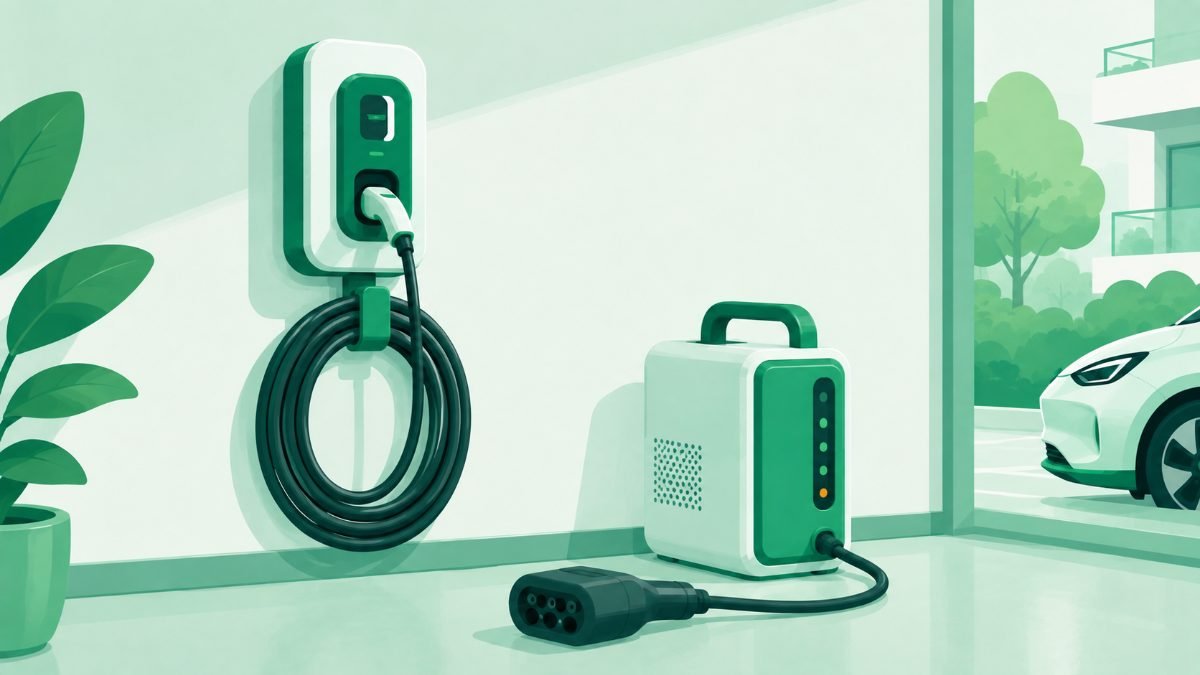
For most flat owners who drive modest daily distances, the portable charger bundled with the car is a perfectly workable start — provided it plugs into a dedicated, properly earthed socket installed by a licensed electrician, never a shared or ageing plug point. A fixed wall-box earns its keep when you drive longer distances, want faster and more predictable charging, need clean metering for society billing, or your parking spot has no safe socket nearby. Four factors decide the choice: charging speed, socket quality, how your society perceives the setup, and simple cost recovery. This guide works through each so you can choose deliberately instead of defaulting to whatever the dealer suggested.
What each option actually is
The portable charger — often called a granny charger or travel charger — is the cable-and-box unit that comes in the boot of most electric cars. One end plugs into a household-style socket, the other into your car, and a small control box in between manages the charge. A wall-box is a fixed unit mounted at your parking spot, wired directly to a supply through its own circuit, usually with its own protective devices and often an energy display or meter.
The distinction that matters is not the hardware but the installation behind it. A portable charger is only as safe and as fast as the socket it plugs into. A wall-box arrives with wiring designed for the job from day one. Everything else in this comparison flows from that difference.
Speed — and whether it matters when you park overnight
Portable chargers are slow by design, typically drawing power in the same range as a large household appliance. A wall-box can deliver two to three times that, depending on the model and your sanctioned load.
Here is a worked example with deliberately round, illustrative numbers. Say your car has a 30 kWh battery (check your own manual) and your portable charger draws about 2.5 kW. Charging from 20 percent to 80 percent means adding roughly 18 kWh, which takes a little over 7 hours. A 7.2 kW wall-box would do the same in about two and a half hours. Now ask the honest question: does that matter if your car sits in the stilt parking for 11 hours every night? For many flat owners driving 30–40 km a day, it does not. The speed argument strengthens when daily kilometres are high, overnight hours are short, or the connection must be shared. Our detailed 3.3 kW versus 7.2 kW comparison walks through this trade-off with more scenarios.
The socket question: where portable chargers go wrong
The genuine risk with portable charging is not the charger — it is asking an ordinary plug point to deliver near-full load continuously for six to ten hours. Sockets in older buildings were rarely wired for that. Loose contacts, thin wiring, weak earthing, daisy-chained extension boards: each one turns a slow charge into a heat problem.
So the fair comparison is never "portable charger versus wall-box". It is "portable charger on a properly installed dedicated socket versus wall-box". That socket should be on its own circuit with suitable protection and verified earthing, installed and certified by a licensed electrician — not the existing common-area plug near the lift. Once you accept that a safe socket itself needs professional work, the gap between the two options narrows. Run through the apartment EV charging safety checklist before either setup goes live.
What your society will make of it
Perception matters more than most buyers expect. A cable trailing from a window or a common-area socket looks improvised, and managing committees read improvised as risky. A neatly mounted wall-box with tidy conduit and its own meter looks professional, and professional setups get approved faster and generate fewer complaints later.
Either way, put the request in writing before any work begins — even a "just a socket" installation touches common wiring and common walls. Our guide on how to request charger permission from your RWA covers what to include so the committee can say yes with confidence.
Billing: the quiet advantage of the wall-box
If your parking spot draws from your own flat's meter, billing is simple with either option. But many parking areas are fed from the society's common supply, and that is where portable chargers cause friction: nobody can prove how many units you consumed, so every charge session becomes a maintenance-dues argument waiting to happen.
A wall-box, or even a dedicated socket fitted with a sub-meter, gives the society a number everyone can trust. If shared or metered billing is likely in your building, read the comparison of sub-meter versus smart-charger billing before deciding.
The cost logic, in round numbers
The portable charger feels free because it came with the car — but a safe installation still costs money. Suppose, purely as illustrative round figures, that a dedicated socket with proper wiring and protection costs ₹8,000, while a wall-box with installation costs ₹45,000. Real quotes vary widely with cable distance, civil work, and hardware, so treat these only as a way to structure the decision, and get two or three written quotes.
The question then becomes: what does the extra spend buy you? Faster charging you may not need, metering you might, and a permanent fixture that stays with the flat. If you may change cars, change flats, or move to a different parking slot, the cheaper socket route preserves flexibility. Use the apartment charger cost calculator to build an estimate around your own distances and options.
The decision at a glance
Neither option is universally better. Match the column to your situation, then verify the electrical side professionally.
| Factor | Portable charger (on a dedicated socket) | Fixed wall-box |
|---|---|---|
| Charging speed | Slow; fine for overnight top-ups | Two to three times faster, subject to sanctioned load |
| Upfront spend | Lower — charger is bundled; you pay for safe wiring | Higher — hardware plus installation |
| Best suited to | Low daily kilometres, long overnight parking | High daily kilometres, short parking windows, shared use |
| Billing clarity | Weak unless a sub-meter is added | Strong — metering is usually built in or easy to add |
| Society perception | Can look improvised; invites objections | Looks professional; easier approvals |
| Flexibility | High — travels with you and the car | Low — a fixture tied to the parking spot |
| Safety hinge point | Quality of the socket and its circuit | Quality of the installation itself |
Common questions
Can I just use the socket already in my parking area?
Usually not, and you should not assume otherwise. Existing common-area sockets are typically wired for light loads, fed from the society's meter, and unverified for continuous charging. Have an electrician inspect any socket before an EV touches it, and settle the billing question with your committee first.
Is a portable charger safe for daily overnight use?
It can be, when it runs on a dedicated, properly earthed circuit with suitable protection, installed and certified by a licensed electrician, and the cable and plug are undamaged and never routed through extension boards. The charger is rarely the weak link; the wiring feeding it is.
Do I need society permission for a portable charger too?
In practice, yes. Even a socket-only setup involves common-area wiring, walls, or supply, and your society's bye-laws may require written consent for any electrical work. A short, well-documented request avoids disputes later and protects you if the committee changes.
Can I start portable and upgrade to a wall-box later?
Yes, and it is often the sensible path: begin with a certified dedicated socket, learn your real charging pattern for a few months, then upgrade if speed or metering becomes a genuine need. Ask your electrician to size the cable route with a future wall-box in mind so you do not pay for wiring twice. The apartment EV readiness checklist helps you spot the constraints before spending anything.
Whichever route you choose, the electrical decisions — circuit sizing, earthing, protection devices, and whether your sanctioned load can take the extra draw — belong to a licensed electrician, and any questions about your connection, load enhancement, or metering belong to your DISCOM. Treat everything above as a framework for that conversation, not a substitute for it.