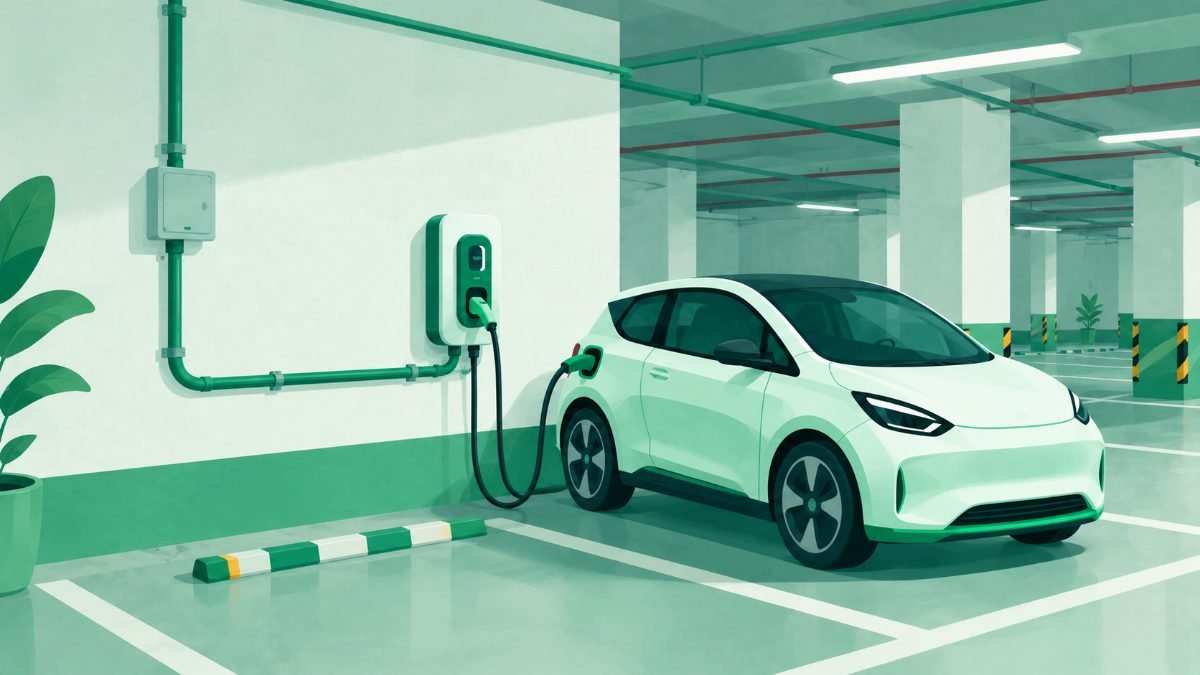
If your parking bay has no wall to bolt a charger to, the job splits into two decisions you can make while standing in the bay. First, what the charger mounts on: a column or common wall within reach, an existing perimeter or boundary wall, or a free-standing pedestal set in its own concrete footing. Second, how power crosses the open ground in between — buried in a trench, clamped along a wall, or fed up inside that pedestal. Settle the mounting point first, because it fixes the route, and the route is what your society has to approve and where most of your quote goes.
Four questions to answer standing in the bay
Do this before you call anyone. An installer quoting from a photograph will change the price once they see the ground, and a committee cannot approve a route nobody has walked.
- Is there anything within reach to bolt to? A stilt column, a common, pump-room or boundary wall. Reach means the charger's own cable meets your inlet with slack, with the car parked as you normally do.
- What does the cable have to cross? Soil, a planted strip, pavers, cast concrete, a lane cars turn in, a storm drain. List each surface in order: each has to be cut, put back and priced.
- How far is the nearest supply point you may use? Pace it along the route the cable can take, around corners, not the straight line. It moves more of your quote than the charger does.
- Who owns the ground in between? Ask the secretary in writing which parts are common property, who approves work on each, and whether any stretch belongs to another flat.
Three ways to reach a bay that touches no building
With the distance paced and the surfaces listed, the job takes one of three shapes. Score your bay against each before asking for a price.
| Route | Dug up and reinstated | What the committee approves | Disruption during the work | If bays are repaved | Where it lands on your quote |
|---|---|---|---|---|---|
| Trench across open ground | A cut line through soil or paving, relaid | Excavation, the exact line, who makes good | Highest; a lane or bays go out of use | Your cable sits under the new surface — get it on a drawing | A civil line per metre plus the cable line |
| Clamped run along a perimeter or boundary wall | Nothing, unless it crosses a gate or entrance | Fixing to a common wall, and how a visible run looks | Low; ladders and clamping only | Untouched by paving; exposed to wall repairs | Conduit, clamps and labour over a longer run, no civil line |
| Free-standing pedestal at the bay | A footing pit at the bay, plus the route feeding it | A permanent object in common parking, and removal terms | Concentrated at the bay while the footing cures | It stays put while markings move around it | Fabrication, footing and bollards as separate lines |
The third row is not an alternative: a pedestal answers what the charger bolts to, and power still reaches it by row one or two.
One shape is worth ruling out: conduit laid loose across a surface cars drive over — wheel loads crush it and work its joints apart, and a cable at ground level gets dragged or struck sooner or later. Put your sketch in front of a licensed electrician to specify the cable and its protection; our guide to cable routing in apartment buildings describes a sound run.
The pedestal, and what to ask before it is fabricated
A charging pedestal is a post set into a concrete footing, carrying the charger at working height with the supply cable rising inside it. It exists for one reason: the bay has nothing fixed within reach, and being fabricated, its quality is set by what you specify in advance.
What separates it from a wall mount is traffic: a post in the open is one cars reverse towards and a van misjudges on a wet evening. Impact protection — bollards, a kerb, a position outside the swept path — belongs on the drawing before the quote, so both fabricators price the same job.
Ask the fabricator these, and get the answers on the quotation:
- What the post and footing are made of, and how the base is protected where it meets standing water.
- What footing they price for the ground at your bay, and who makes the surface good afterwards.
- Whether bollards or a kerb are included, where they stand relative to a reversing car, and how the pedestal comes out if the bay is reallocated.
Ask your licensed electrician these, and keep the answers on the completion note:
- Which protective devices they will fit, at the origin and at the pedestal, and why those.
- How the earth is established and proved for a structure standing on its own.
- How the cable enters and is sealed, and what mounting height they recommend, given the highest water anyone remembers.
Weather is its own reading: an open bay takes the full monsoon and the full afternoon sun. Where water has stood, what each component is rated for, and whether this spot needs a hood are in our guide to monsoon-proofing apartment EV charging.
Run the numbers on your own quote
Every figure below is an assumption chosen to show the working. Replace each with the line from your own written quote; the arithmetic holds.
- Suppose you paced 25 metres from the supply point to the bay.
- Suppose the civil line — cutting, trenching and reinstating the surface — reads ₹450 per metre. That is 25 × ₹450 = ₹11,250.
- Suppose armoured cable and conduit read ₹320 per metre. That is 25 × ₹320 = ₹8,000.
- Suppose the fabricated pedestal, its footing and two bollards read ₹12,500 together.
- Suppose a weather-rated outdoor unit, a lockable enclosure and an isolator read ₹34,000.
- Suppose protective devices and labour read ₹8,500. The five lines add up to ₹11,250 + ₹8,000 + ₹12,500 + ₹34,000 + ₹8,500 = ₹74,250.
The total is not the useful part. Two of the five lines move with the distance you paced and three do not. Suppose the committee offered a bay 12 metres away instead of 25: those lines become 12 × ₹450 = ₹5,400 and 12 × ₹320 = ₹3,840, so that part falls from ₹19,250 to ₹9,240 — ₹10,010 for identical equipment, and the case for asking to be moved closer.
Compare routes the same way. Suppose the perimeter-wall run is longer at 40 metres but needs no excavation, and conduit, clamps, cable and labour together read ₹200 per metre: 40 × ₹200 = ₹8,000, against ₹19,250 for 25 metres of trench. On those assumptions the longer visible route wins, shown rather than asserted. Our notes on comparing installation quotes line two quotes up, and the charger cost calculator moves the distance for you.
An outlet nobody is watching
A charger behind a basement shutter is reached only by people who belong there; an open lot is crossed all day by riders, drivers, staff and visitors. That is two problems with different answers — someone drawing units onto your bill, and someone damaging equipment you paid for. Start with behaviour.
- Leave it dead between sessions. A lockable isolator means the point offers nothing to anyone who walks up. Ask your licensed electrician where it should sit and what it isolates.
- Holster the connector. One left lying in the bay is the part that gets run over.
- Tell the security staff which unit is yours. A line in the gate register naming the bay and the flat turns a vague suspicion into a specific one.
- Read your own meter on a fixed date. A reading you wrote down turns a disputed month into arithmetic.
Then match hardware to the problem: a unit that delivers nothing until a card, tag or app authorises the session refuses strangers with nobody present. If the point is ever shared with a neighbour, that is a billing decision too — see access control for shared society chargers.
Settle the paperwork before anyone digs
A trench, a clamped run and a pedestal are permanent changes to ground outside your flat, so paying for the work settles who bears the cost, not whether it may happen. Put three questions to the secretary in writing: does the committee approve this exact route and mounting position on the attached sketch, and on what conditions; who reinstates the surface after excavation, and who bears it if it later cracks or settles; and what happens to the pedestal and buried cable if the bay is reallocated, the flat sold, or the parking repaved?
Settle the money split in the same letter — who pays for the common-area portion and who pays for the part serving only your bay is what goes wrong most often, and who pays for apartment EV-charger wiring sets out fair ways to divide it. The permission request letter template is a draft to attach your sketch to. Before anything is built, have a licensed electrician survey the bay and size the cable for the run you paced — what an electrician checks in a site assessment lists what that visit covers.
Common questions
There is no wall within reach of my bay — what are my actual options?
Three, worth pricing together rather than one by one: mount on the nearest fixed structure if the charger's own cable reaches your inlet with slack; run to a perimeter or boundary wall if one borders the bay; or set a pedestal at the bay and feed it. Which survives depends on your four answers from the bay.
What is a charging pedestal, and when is it the right answer instead of a wall mount?
A pedestal is a post in a concrete footing that carries the charger where no wall exists, with the supply cable rising inside it. It is the right answer when nothing within the charger's cable reach is solid enough to bolt to, or when the only usable wall is far enough that the extra run outweighs the footing and fabrication.
Who has to approve a cable route that crosses common open ground?
Put that to the committee, not to yourself: the route crosses ground outside your flat, and paying for the work does not change that. Ask for approval of the exact line and mounting position on a sketch, ask which society rules the secretary is applying, and get it in writing.
How do I stop anyone walking up and using or tampering with an outlet nobody supervises?
Layer behaviour over hardware: keep the circuit dead between sessions with a lockable isolator, holster the connector, tell security which unit is yours, and note your meter reading on a fixed date. To refuse strangers with nobody present, choose a unit that delivers nothing until a card, tag or app authorises it.
What about rain, standing water and the monsoon?
Treat it as a separate decision from siting. Ask your installer what rating each component carries and how high water has stood here in the worst year anyone remembers; then have a licensed electrician verify the earthing, the protective devices and the mounting height before the first session.