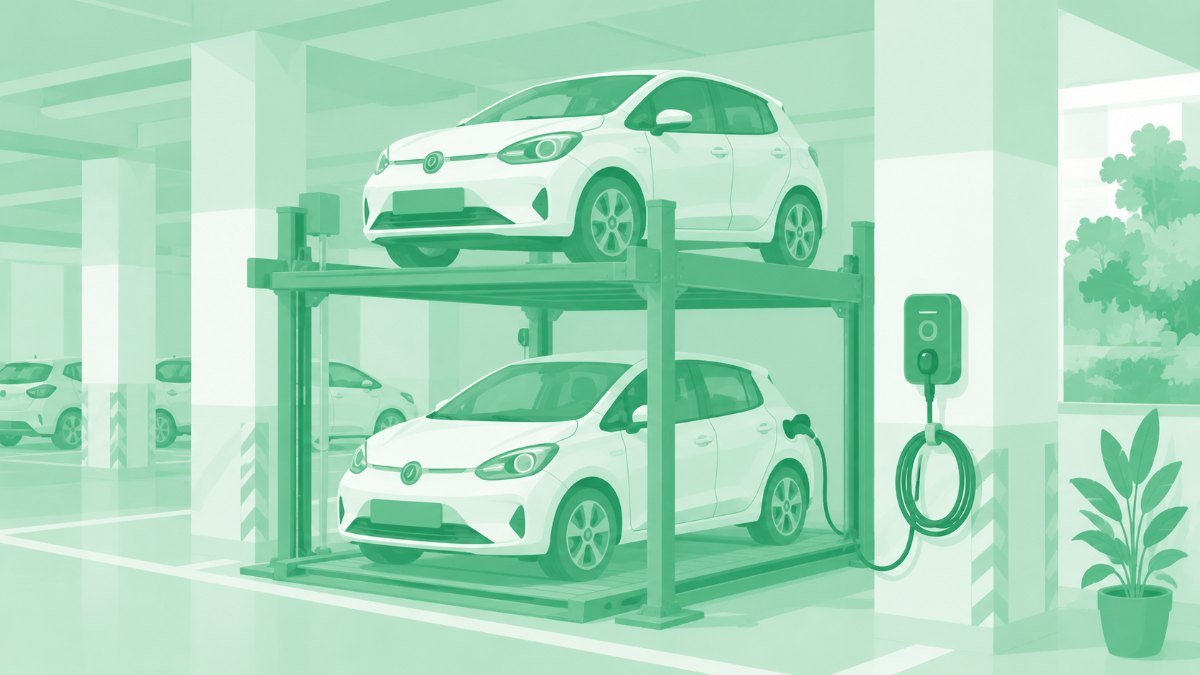
If your flat comes with a stack, puzzle or tower parking slot, you can usually still charge an EV at home, but rarely by mounting a charger at the slot itself. Because the platform moves and the car does not return to a fixed position, the workable answer in most buildings is a charging point at a nearby ground-level bay, plus a booking or swap arrangement so EV owners get their turn. Some systems are sold in charging-ready versions, but only the parking-system manufacturer can confirm whether yours is one, and only a licensed electrician can confirm the supply, earthing and protection at your site.
Why mechanical parking breaks the usual assumptions
Almost everything written about home charging assumes five things: the car returns to the same spot nightly, the spot is one household's, a wall beside it takes a wall-box, a short cable reaches the inlet, and nothing moves.
Mechanical parking breaks all five. The platform travels vertically, horizontally, or both. The steel deck under the wheels is not a wall and not somewhere to drill. In many systems an operator parks and retrieves the car, so the person best placed to plug in is not the owner. The question stops being where to mount a charger and becomes where a car can stand still, unattended, safely, for a few hours.
Stack, puzzle and tower: what each means for charging
Stack (two- or three-level car lifts)
A stack lifts one platform above another. In dependent stackers the lower car must move before the upper platform comes down, so two households are coupled. With a pit, each platform moves independently. The upper platform is the harder case: the car sits above head height, no fixed wall is adjacent, and any cable would have to travel with the platform.
Puzzle (shuffle) systems
Puzzle systems slide pallets sideways as well as up and down, using one empty space to shuffle the rest. Your car may be reachable only after two or three other pallets move. That rules out an overnight plug-in for a second reason beyond the cable: it is not accessible on demand.
Tower, rotary and fully automated systems
The resident never enters the storage area: you hand the car over at a transfer cabin and collect it there, so nobody can walk up to a stored car to plug in. Charging inside such a system exists only if the manufacturer built it in, confirmed in writing for your model.
| System type | Car accessible after parking | Charger at the slot | Who would plug in | Realistic approach |
|---|---|---|---|---|
| Dependent stack, lower platform | Yes, but the car above depends on it | Sometimes, if a fixed wall or column is adjacent | Resident | Wall-box on adjacent structure; cable never crosses the deck |
| Stack, upper platform | No, platform must be lowered | Not normally | Resident, once lowered | Charge at a separate fixed bay on a rota |
| Puzzle or shuffle | Only after other pallets move | Not normally | Operator, if anyone | Ground-level bay away from the pallets |
| Tower, rotary or automated | No, car is inside the machine | Only if built in by the maker | Nobody, or an automated connector | Bay at the transfer level or outside |
The workable pattern: charge at a fixed bay, park in the machine
The arrangement that tends to work separates the two jobs. Charging happens at one or two fixed ground-level bays with solid walls behind; storage happens in the machine.
Choosing that bay is structural and electrical work: a wall or column that can carry a unit at a sensible height, a short protected cable route back to the supply, and clearance so a parked car never intrudes into the machine's operating envelope. Routing options are set out in cable routing for apartment EV chargers.
Because the bay is shared, metering matters more than for a private point: it must record who used it and how many units they took, which is the choice between a sub-meter and a smart charger's own billing.
Charger power reads differently too: on a rota bay a slower unit ties the bay up longer and serves fewer households in an evening, shifting the usual 3.3 kW versus 7.2 kW comparison towards the faster option, subject to what the supply can carry.
Scheduling and swap arrangements that hold
A shared bay works only if the rules are boring, written down and enforced by the society rather than argued out in the basement. Put these in your society's own EV rules:
- A booking method everyone can use: an app, a sheet at the security desk, or slot cards on a board.
- A maximum session length, so nobody holds overnight a bay four households need.
- A grace period after the session ends, and a consequence for overstaying.
- Who returns the car to the system, and whether the operator may move a resident's vehicle.
- Where the key or fob sits while the car is on charge, if an operator moves it.
- What happens when the system is under maintenance and cars are displaced.
- Whether visitors may use the bay, who to call when the unit trips, and who may reset it.
The social half matters as much as the technical half. The habits that keep a rota bay usable are set out in shared EV-charging etiquette, and the process in requesting permission from your RWA applies here too, with the extra step of naming the parking-system supplier.
What the parking-system manufacturer has to confirm
Before anything is drilled or mounted near a mechanical system, get written confirmation from the company that supplied or maintains it; a site technician's verbal assurance is not enough, because this touches their warranty and maintenance contract. Ask:
- The rated load of each platform, and whether your vehicle sits within it. Take the kerb weight from your own vehicle's documentation rather than assuming it matches the car it replaced.
- Whether any cable, conduit or bracket may be attached to the structure, and where.
- Whether a cable may ever be connected to a vehicle on a platform, and what interlock would stop the platform moving.
- The machine's operating envelope, so the bay and cable sit outside every path it sweeps.
- Whether a charging-enabled version of the system exists, and what it requires structurally.
- What the change does to the warranty and maintenance contract, in writing.
- Their position on washing, water ingress and monsoon drainage near a live point.
What your electrician has to confirm
Everything electrical is site-specific and none of it can be settled from an article. A licensed electrician must inspect the building before any equipment is specified, covering the questions in an EV-charging site assessment.
Here they have extra work. The parking machine is itself an electrical load with its own supply, so the electrician must know where the new circuit sits relative to it, whether they share a board, and what happens when both draw at once. The guides to earthing in apartment charging and RCCB, MCB and RCBO explain the vocabulary so you can follow that conversation; they do not replace it.
Where the system sits in a basement, ventilation, drainage, fire detection and fire-service access come into it as well. Work through basement parking charger checks alongside the manufacturer questions above.
The specific hazards: moving steel and trailing cables
Entanglement and shear. A cable draped across a pallet, guide rail or lift well can be dragged into the mechanism, damaging the machine and leaving a conductor exposed. It is the strongest reason not to charge on a platform unless the maker designed for it.
Trip and crush. Cables across a shared drive aisle are a trip hazard for residents and a crush hazard for the cable. Keep them off the floor, in a protected route, short enough to need no coil on the ground.
Water. Pits under mechanical parking can collect water, and monsoon months are when that gets tested. A point near a pit, ramp or washing area needs an enclosure, mounting height and drainage plan chosen for that position. See monsoon-proofing apartment EV charging; the rating for your bay is the electrician's call.
None of this makes EV ownership impossible in such a building. It makes the charging point shared society infrastructure rather than a private fitting, which changes who decides and who pays.
Common questions
Can I install an EV charger on my stack parking platform?
Usually not, and never without written clearance from the parking-system manufacturer. The platform is a moving structural element with a stated load rating and a defined operating envelope; attaching equipment or trailing a cable across it affects both safety and the maintenance contract.
If the maker confirms a charging-ready variant exists for your exact system, the question then moves to your electrician.
My car is in a puzzle system and I cannot reach it at night. How do I charge?
Charge earlier in the evening at a fixed bay, then return the car to the system. How often you need the bay depends on your own daily kilometres, your battery size and the charger's power, so work it out from your own figures using the honest maths on home charging time. The binding constraint is usually bay availability, not charging speed, so agree session length and swap procedure early.
Can I just use a portable charger from a socket near the lift?
Treat that as a last resort, and only after an electrician has inspected the socket, its circuit and its protection. A socket fitted years ago for a light or a pump may never have been sized for a vehicle drawing steady current for hours, and a long extension is the trailing-cable hazard you are trying to avoid. See portable charger versus wall-box.
Does an EV's weight matter for a car lift or puzzle pallet?
Yes, and it is the first thing to check. Every platform has a stated maximum load, printed on the machine or in its documentation. Compare your vehicle's kerb weight against that figure and ask the manufacturer to confirm in writing, particularly where the system predates electric cars.
Who pays for a charging bay that is not attached to my flat?
That is a decision for your society under its own by-laws, and it varies. A point serving several households is often treated differently from a private fitting at one bay, with capital cost, metering and maintenance handled separately. Settle it in writing before installation using the framework in who pays for apartment EV-charger wiring, and take advice from an appropriate local professional.