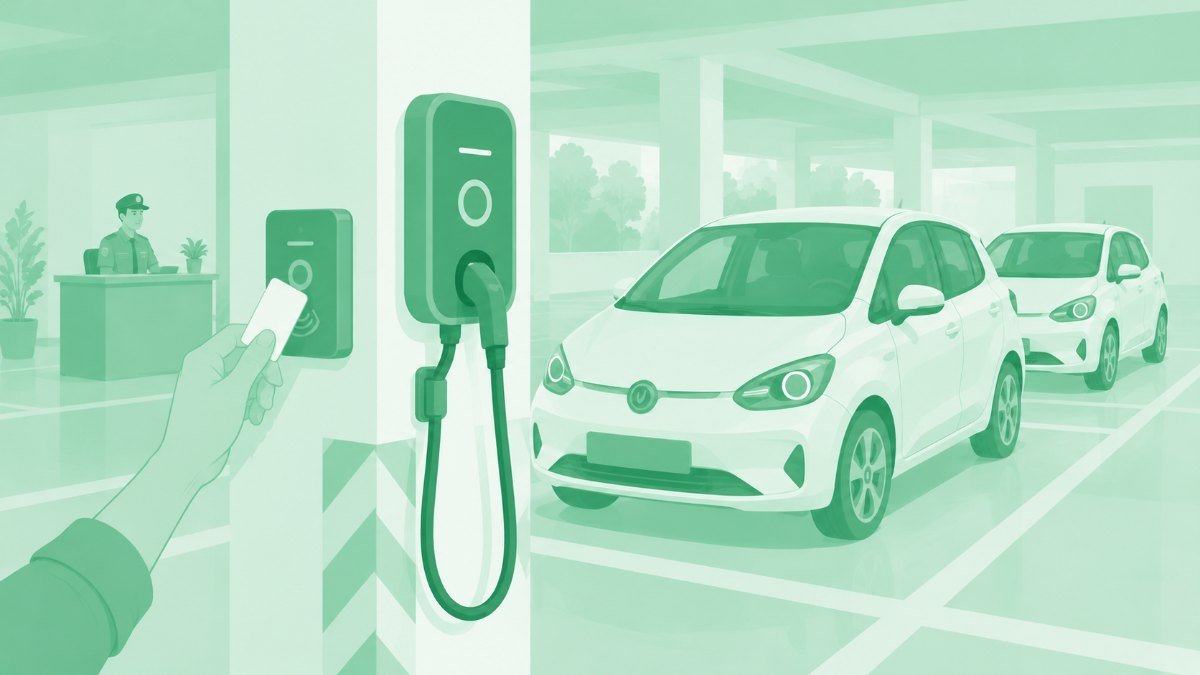
Decide who may plug in, then choose the lightest mechanism that actually enforces it. In a small society with two or three EVs and a guard on the gate, a logbook plus a socket the guard unlocks on request is often enough: it is cheap, never goes offline, and produces a record you can bill from. Card, tag or app-based access earns its keep when the point is busy, when residents charge unattended overnight, or when you need every unit automatically attributed to a flat. Choose for the society you will be three committees from now, not the committee you have today.
Be clear about what you are preventing
Access control is not one problem but four, and each needs a different answer. Decide which ones you have before anyone quotes for hardware.
- Outsiders using the point. Visiting drivers, delivery riders, the shop across the road. Mostly solved by a lock and a guard who knows the rule.
- Residents using it without paying. This needs identity, not just a barrier. Someone must be able to say which flat drew which units.
- Queue and hogging disputes. A car left plugged in for eleven hours is a social problem first, and a booking sheet fixes more of it than hardware.
- Unsafe use. Someone connecting a damaged cable, a household extension board or an unapproved portable unit. This is where a lock genuinely matters, and where a licensed electrician must specify what the point is rated for and what may be connected to it.
The honest low-tech options
Low-tech does not mean second-best; the failure modes are simply visible and already understood.
A logbook at the guard desk
A ruled register with columns for date, flat number, start and end time, meter reading at start and end, and a signature. The resident signs, the guard countersigns, and billing follows the meter readings rather than the clock.
This works when the point is attended and sessions run in daylight or early evening. It stops being reliable once charging runs overnight: nobody reads a meter at 2 am, and the night guard has other duties.
A locked socket or lockable enclosure
The outlet sits in a lockable box, or behind a switch in a locked panel, with the key held by the guard or manager. Nothing can be plugged in without a human agreeing to it, which is what you want if improvised connections are the worry.
Keys get copied, and get lost on a Sunday. A guard in their third week does not know which faces are residents. An enclosure that is fine in March collects water in July. The box, its mounting, the circuit feeding it and that circuit's protection devices must be assessed on site by a licensed electrician, who decides what suits your location; nothing here replaces that visit. That matters most in open stilt and podium parking; see our notes on monsoon-proofing apartment charging points before fixing anything to an exposed wall.
What cards, tags and app accounts add
Electronic access replaces the guard's judgement with a stored list of who is allowed. The gains are specific: identity attaches to the session, so there is no transcription and no argument about a misread meter; unattended overnight charging becomes safe to permit; a lost credential is deactivated in a minute instead of forcing a lock change; and the record exports, making the monthly bill a spreadsheet job.
The costs are mostly administrative. Somebody must own the user list: adding residents, removing leavers, replacing lost tags, reconciling totals against the meter. There may be a recurring platform or subscription charge too, so ask for that figure in writing, annually, and budget it alongside maintenance rather than treating installation as the whole cost. Our walkthrough of which smart-charger features actually matter in apartments covers what to interrogate before agreeing to any of it.
| Method | What it enforces | Who administers it | Behaviour when it fails | Best suited to |
|---|---|---|---|---|
| Logbook only | Nothing physically; it records, it does not restrict | Guard, checked monthly by the treasurer | Degrades quietly as entries get skipped | Two or three EVs, attended daytime charging |
| Locked enclosure, key with guard | Who may connect anything at all | Guard plus whoever holds the spare key | Fails closed — nobody charges until a key appears | Societies worried about unsafe connections |
| Card or tag on the charger | Which credential started each session | One named committee role or the manager | Varies — some units work offline, some refuse | Busy points, overnight use, per-flat billing |
| App or account-based | Identity, plus time windows and session caps | Society administrator, with vendor support | Most exposed to connectivity outages | Multiple points and larger societies with staff |
Tie access to a billing identity, not to a person
Dues are recovered from flats, so every credential must map to a flat number in a register the treasurer holds. A tag issued to "the driver at 402" becomes unbillable the day the driver changes. Issue against the flat, allow a second credential where two vehicles exist, and record the dates of issue and return.
Then reconcile. Each month, compare the energy the access system attributes to sessions with the sub-meter feeding the point. The two rarely match exactly, and the gap is information: standby draw, a missed session, or something connected that should not be. Decide in advance how that difference is shared — our guide to splitting shared charging costs between residents sets out the usual approaches. If you have not yet settled whether billing comes from a sub-meter or from the charger's own record, read sub-meter versus smart-charger billing first: that choice largely determines which access method makes sense.
Tenants, guests and staff
Access should follow occupancy, not ownership. When a flat is let, the credential goes to the occupant for the tenancy and returns at handover. Settle this before signing a lease; our guide for renters explains the same conversation from the tenant's side.
Guests are a separate decision, and it is yours to make: bar guest charging outright, permit it against a flat's credential with that resident liable for the units, or run a paid visitor arrangement. Whichever you pick, write it into the policy rather than leaving it to the desk; handling visitor charging covers the options. The behavioural side belongs in your shared charging etiquette rules, which cost nothing and settle disputes before they start.
Plan for the day it does not work
Every access system fails; ask the supplier in writing how it fails.
- Does the point still deliver charge if broadband or the SIM drops, and store the session locally to upload later?
- What happens during a long power cut and on restoration: does it resume, or must someone press something?
- Is there a documented manual override, who holds the key or code, and where is the second copy?
- If the contract ends, can the society still operate the point and export its own usage history?
Keep a one-page fallback at the guard desk: revert to the register, record meter readings by hand, reconcile later. A society that has practised it once treats an outage as a nuisance.
Data and record hygiene
Usage logs are ordinary society records and deserve ordinary care. Collect the minimum that lets you bill and troubleshoot: flat number, date, energy drawn, amount payable.
Do not circulate per-flat session detail on the notice board or in an open messaging group: charging times reveal when a household is out. Share totals with the general body and detail only with the flat concerned. Agree how long records are kept, who may access the account, and how credentials and exports pass to the next committee. Those lines belong in the policy; the clause-by-clause policy walkthrough shows where they sit.
Choose what survives a committee change
The failure that matters most is not theft of electricity. It is a system that quietly stops being administered because the person who understood it moved out. Test any option against this list.
- Can a new secretary run it after a fifteen-minute handover, from instructions the society owns?
- Is there a named role responsible for the user list, rather than a named individual?
- Does the society hold the administrator account, the passwords and an exported copy of the data, independently of the vendor?
- Does it still work at 11 pm in heavy rain with the internet down?
- Is the rule it enforces one the general body actually voted on?
If a lock and a register pass every question while a connected system fails two, the lock is the better decision for now. Add electronics later, once the register you kept is the evidence for the spend. If you are still at the proposal stage, how to propose a common charging station covers the approvals that should come first.
Common questions
Can our society stop a resident from using the common EV charger?
Access to a common facility is governed by your society's own by-laws and by whatever the general body has resolved, so it turns on your documents rather than any general rule. What is within your control is process: if suspension for non-payment or a safety breach is possible at all, write it into the adopted policy with notice and a route to appeal, and have an appropriate local professional review it first.
Do we need an app to bill shared EV charging fairly?
No. A dedicated sub-meter on the charging circuit plus a well-kept register bills accurately, and a society can run that way indefinitely. An app removes manual effort and makes unattended overnight charging practical; it does not make the arithmetic more correct. Add automation when the number of sessions makes manual recording a chore.
What happens if the charging point loses internet access?
It depends on the equipment, so ask the supplier in writing before you buy. Some units keep authorising known credentials and store sessions locally, uploading them when the connection returns. Others will not start a session at all, so keep a paper fallback at the desk.
How do we stop people from outside the society using our charger?
Layer three cheap things: physical control so the socket cannot be used without a key or credential, a sign saying the point is for residents only, and a guard instruction that unknown vehicles are not admitted to charge.
Should we record every resident's vehicle registration number?
Once, in the issue register, is reasonable: it links a credential to a flat and a vehicle. Recording it against every session creates detail you must then protect for no billing gain.
Collect the minimum, and state in the adopted policy how long those records are kept and who may see them.