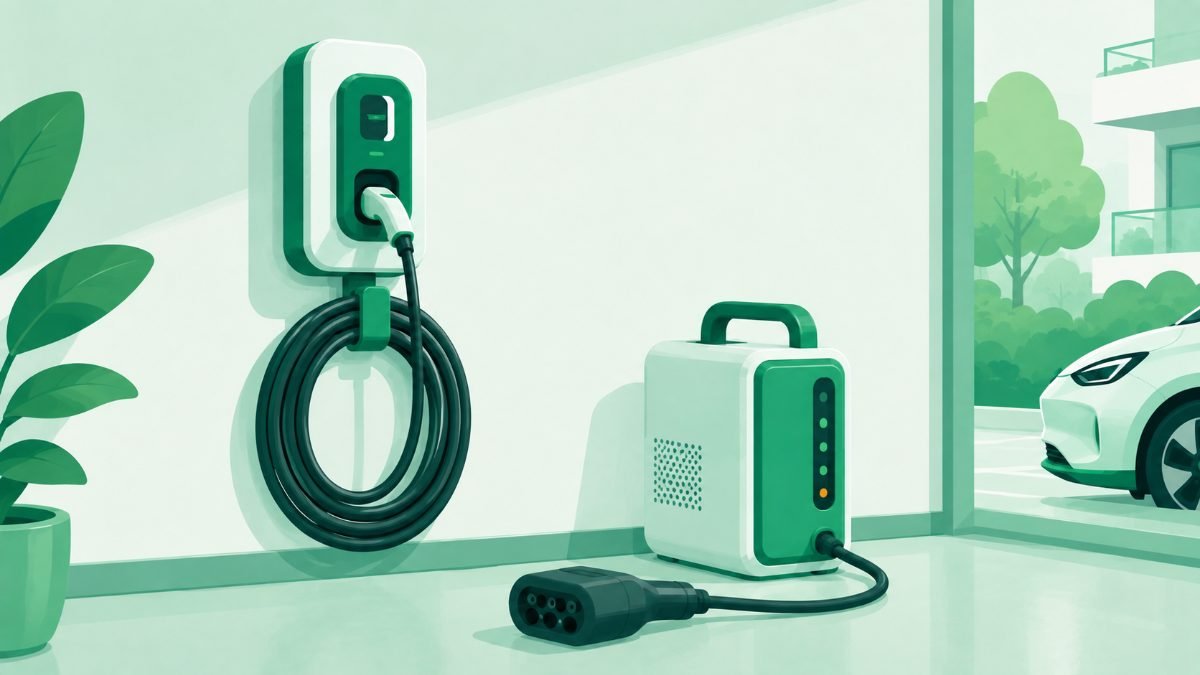
An apartment EV charging point needs very little maintenance, but the little it needs matters. A sensible owner's routine looks like this: a five-minute visual check once a month covering the charger body, cable, connector and the area around your parking bay; a regular press of the RCCB test button; loose coiling and capping of the cable after every session; and a yearly inspection by a licensed electrician — sooner if you notice heat, discolouration, repeated tripping or a burning smell. Keep the installation completion note, service records and warranty papers together in one folder. None of this replaces professional servicing; it simply catches small problems while they are still small and cheap.
The monthly five-minute visual check
Pick a fixed day — the first Sunday of the month works well — and give the charging point the same once-over each time. You are not opening anything; you are only looking.
- The charger body: cracks in the housing, brown or yellow discolouration around vents and cable entries (an early sign of overheating), and looseness in the mounting.
- The cable: run your eyes and hand along the full length, feeling for cuts, flattened sections, kinks or bulges where the outer sheath has been damaged.
- The connector: check the pins for bending, corrosion, dust or insect debris — ants and lizards are common intruders in Indian parking, and a blocked connector heats up in use.
- The surroundings: watch for water seepage, anything dripping from above, and cartons or flammable items stored against the unit.
If your bay is below ground, dampness and drainage deserve extra attention — our basement parking charger checks guide covers what to look for.
Make the RCCB test button a habit
A properly done charging installation will normally include an RCCB (residual current circuit breaker) or equivalent earth-leakage protection on the circuit. It is the component most likely to protect a person from electric shock, and its small button marked "T" or "Test" exists precisely so owners can confirm it still works.
Pressing the button simulates a leakage fault: the device should trip instantly with a firm click, cutting power to the charging point. Reset the lever and you are done — ten seconds in all. If it does not trip, or feels sticky or hesitant, stop using the charger and call your electrician. A non-tripping RCCB is protection that exists only on paper.
Test with the vehicle unplugged, at the interval printed on the device or in its manual; many electricians suggest folding it into the monthly visual check. Not sure you have an RCCB at all? Make it the first question for your electrician — it sits near the top of our apartment EV charging safety checklist.
Cable and connector care between sessions
Most preventable charging-point problems begin with the cable — the one part that gets handled, dropped and driven over. A few habits go a long way:
- Coil the cable in loose, wide loops rather than winding it tightly around the unit — tight winding stresses the conductors at the same two points every day.
- Hang the coiled cable on its hook, off the floor, clear of puddles, tyres and cleaning water.
- Cap or holster the connector when not in use; an open connector collects dust, water and nesting insects.
- Unplug by gripping the connector body, never by yanking the cable — repeated pulling loosens internal terminations long before anything shows outside.
- Never charge through a damaged cable "just this once". A nicked sheath in a damp basement is exactly the fault your RCCB exists for, and you do not want to test it live.
A simple schedule you can actually keep
The routine below assumes a private charging point in your own bay; for a shared society machine the same checks apply, owned by whoever the society's charging policy names.
| Task | How often | What you are looking for |
|---|---|---|
| Visual check of charger body and mounting | Monthly | Cracks, discolouration, loose fixing, insect nests |
| RCCB test button | Monthly, or the interval in your manual | Instant firm trip, clean reset |
| Cable and connector inspection | Monthly, plus after any rough handling | Cuts, kinks, bent or discoloured pins, debris |
| Charging bay surroundings | Monthly | Dampness, seepage, clutter or flammable storage |
| Sub-meter reading, if fitted | Monthly, on a fixed date | Consumption roughly matching your driving |
| Full inspection by a licensed electrician | Yearly, or immediately after any fault | Terminations, earthing, breaker health, load check |
Ten minutes a month, one professional visit a year. That is the whole programme for most owners.
When to call the electrician — and when to stop charging first
Some findings can wait for a scheduled visit; others mean switching off the circuit and stopping use until an inspection. Treat these as stop-now signs: a burning or "hot plastic" smell, a connector that feels distinctly hot rather than mildly warm, scorch marks or browning, sparking, an RCCB or MCB that trips repeatedly during charging, and any tingling sensation when touching the vehicle or charger. Repeated tripping is not the breaker being "oversensitive" — it is the breaker doing its job, and the fault behind it needs finding.
Book a routine visit, without stopping use, for slower-moving issues: a slightly loose mounting, hairline cracks in trunking, or simply because a year has passed. And resist opening the charger housing yourself — nothing inside is user-serviceable, mains voltage is present even with the vehicle unplugged, and DIY entry usually voids the warranty. The logic that applied when you installed the charger in your apartment applies to repairing it: qualified hands only.
Records and warranty sense
A thin folder — paper or a phone album — makes every future conversation with your electrician, service centre, insurer or RWA easier. Keep:
- The installation completion note from your installer, showing what was fitted, the cable size and the protective devices used.
- The purchase invoice and warranty card for the charger, plus the product registration confirmation if the manufacturer offers online registration.
- A one-line log of service visits and faults: date, what was found, what was replaced. Patterns like "trips every monsoon" are gold for a technician.
- Monthly sub-meter readings, if your society bills you through one — consumption that suddenly diverges from your driving deserves a question. Our comparison of sub-meter versus smart-charger billing explains what each record shows.
On warranty: read the card once, note the period and what voids it (often unauthorised opening or damage from water and rodents — your document may differ), and use authorised service for anything inside the housing. If a fault appears within the warranty period, log the complaint in writing before paying anyone privately to fix it.
Common questions
How often should I press the RCCB test button?
Follow the interval printed on the device or in its manual, and if in doubt fold it into your monthly visual check. The test takes seconds, and the one time it fails to trip is exactly the information you need — that device must be replaced before you charge again.
Can I open and service the charger myself?
No. Live terminals are present even with the vehicle unplugged, and opening the housing usually voids the warranty. Your role is observation — looking, smelling, testing the RCCB button. Everything beyond that belongs to a licensed electrician or the manufacturer's service network.
My charger trips occasionally during charging — should I worry?
A single trip after a storm or voltage fluctuation can be innocent. Repeated or patterned tripping — every session, every rainy week — is a symptom, not a nuisance. Stop using the charger and have the circuit inspected; the cause could sit in the charger, the cable, the vehicle or the building wiring, and only testing will say which.
I rarely use the charger. Do I still need the routine?
Yes, and arguably more so. An idle charger still faces dust, damp, insects and knocks, and problems announce themselves only when you finally need a full overnight charge. Keep the monthly look-over and RCCB test, and run a short session now and then so faults surface at a convenient time.
A last word on limits: this routine is about noticing problems, not diagnosing them. Anything involving wiring, earthing, protective devices or the meter belongs with a licensed electrician; questions about your connection, sanctioned load or metering belong with your DISCOM. Our apartment EV readiness checklist makes a good ten-minute companion to this routine.