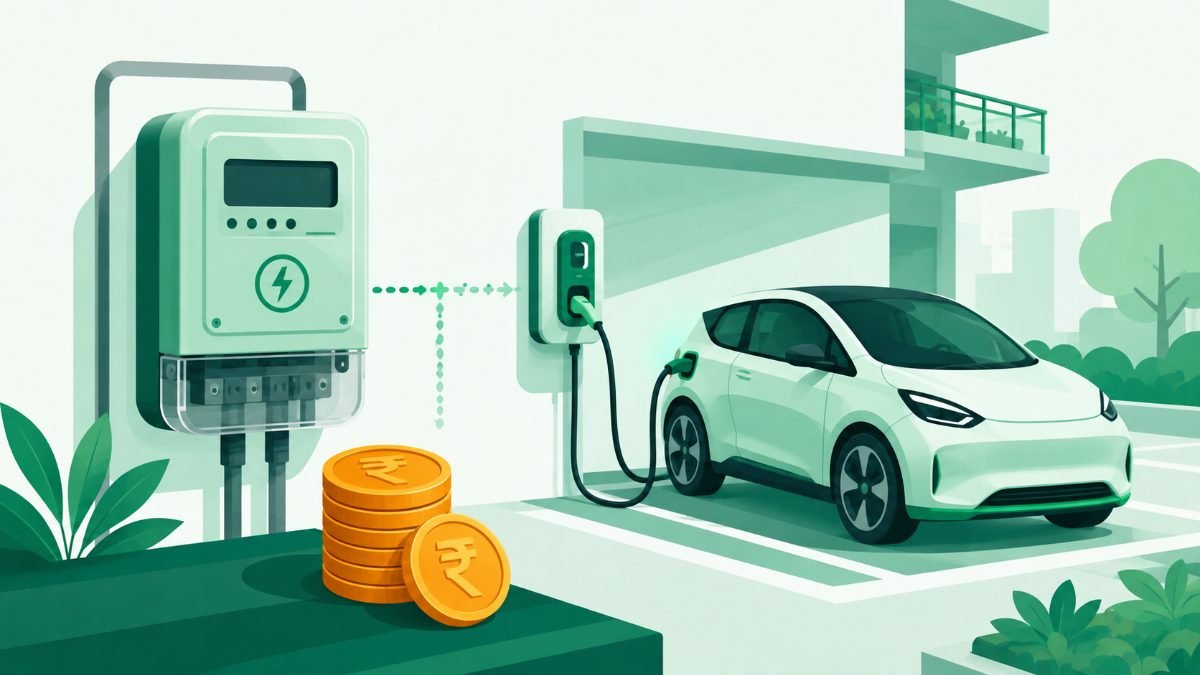
For most apartment households in India, home EV charging adds a modest and predictable amount to the electricity bill — often less than people fear. The impact depends on three numbers: how far you drive each month, how many kilometres your vehicle covers per unit of electricity, and what your tariff charges for those extra units. As clearly-labelled illustrations: an electric scooter doing about 600 km a month may add roughly 20–25 units; a small car doing 1,000 km may add around 150–170 units; and a heavy user can add 400-plus units and sometimes climb into a costlier tariff slab. The worked examples below show the full arithmetic, step by step, so you can repeat it with your own bill.
The only formula your bill cares about
Your electricity meter does not know an EV from a geyser. It simply counts units (kWh), and your DISCOM bills you for them. So the bill impact of home charging comes down to three steps:
- Units consumed: monthly kilometres ÷ your vehicle's real-world kilometres per unit.
- Charging losses: some energy is lost as heat between the wall socket and the battery. A common working allowance is around 10 per cent — treat this as an estimate, not a specification.
- Cost: total units × the per-unit rate those units actually attract on your tariff — which, as household three shows, may not be your average rate.
If you want each step unpacked in more detail, see our guide on how to calculate monthly EV charging cost. Fixed charges, duties, and surcharges vary by DISCOM, so always sanity-check any estimate against a real bill.
Household one: the scooter commuter
Picture a typical scooter household — a 12 km each-way office commute plus errands, roughly 600 km a month. Say the scooter manages about 30 km per unit in real-world riding (check your own model's delivered figure; claimed range and actual range are rarely the same).
- Energy needed: 600 ÷ 30 = 20 units
- With about 10% charging losses: roughly 22 units a month
- At a sample tariff of ₹8 per unit (check your own bill): about ₹175 a month
That is the number most scooter buyers are surprised by. On these illustrative figures, the addition is small enough that many households would struggle to spot it between two ordinary bills — especially in a season when fan or AC use is changing anyway. Charging from a properly-installed point in your parking, with the society's permission and a licensed electrician's sign-off, is usually all this scale of use requires.
Household two: the small-car daily driver
Now take a compact electric car doing about 1,000 km a month — a daily office run plus weekend outings. Say it delivers about 7 km per unit in mixed city driving (again, a deliberately round illustrative number).
- Energy needed: 1,000 ÷ 7 ≈ 143 units
- With about 10% losses: roughly 160 units a month
- At a sample ₹8 per unit: about ₹1,280 a month, or roughly ₹1.30 per km
This is a genuinely visible jump — 160 extra units can be a large share of a typical flat's existing consumption. It changes two practical decisions. First, charger choice: a 3.3 kW point can replenish a day's driving overnight for many users, while 7.2 kW suits bigger batteries or shorter parking windows — our comparison of 3.3 kW vs 7.2 kW apartment charging walks through the trade-offs. Second, metering: at this volume you want the units measured cleanly, not guessed at by anyone.
Household three: the heavy user — and the slab shift
Finally, a high-mileage household: say 2,500 km a month — a long daily commute, or one car shared across the family. At an illustrative 6 km per unit:
- Energy needed: 2,500 ÷ 6 ≈ 417 units
- With about 10% losses: roughly 460 units a month
Here a second effect kicks in. Many DISCOMs bill domestic consumption in slabs, where units beyond certain thresholds cost more per unit. Whether your tariff works this way — and where the thresholds sit — is something to confirm on your own bill or with your DISCOM. To see why it matters, take a purely invented slab structure: the first 200 units at ₹5, the next 200 at ₹7, and everything above 400 units at ₹9.
Suppose this household already used 300 units a month before the EV arrived. The 460 EV units push the total to 760. Only 100 of those EV units are billed at ₹7; the remaining 360 land in the ₹9 slab. The EV's effective rate works out to about ₹8.55 per unit — well above the household's old average rate. In other words, EV units are typically billed at your most expensive marginal rate, not your cheapest. Some DISCOMs offer separate EV connections or EV-specific tariffs that change this arithmetic entirely — ask yours what is available at your address before any wiring goes in. Clean measurement also matters at this scale: if the charging point draws from a shared or society supply, read our comparison of sub-meter vs smart-charger billing.
The three households side by side
All figures below are illustrative worked examples, not quotes or predictions — swap in your own tariff and your vehicle's real efficiency.
| Household | Km per month | Efficiency (sample) | Units added (incl. ~10% losses) | Sample rate applied | Added monthly cost | Approx. cost per km |
|---|---|---|---|---|---|---|
| Scooter commuter | 600 | 30 km/unit | ~22 | ₹8/unit | ~₹175 | ~₹0.30 |
| Small-car daily driver | 1,000 | 7 km/unit | ~160 | ₹8/unit | ~₹1,280 | ~₹1.30 |
| Heavy user (slab shift) | 2,500 | 6 km/unit | ~460 | ~₹8.55/unit effective (invented slabs) | ~₹3,940 | ~₹1.60 |
Two patterns stand out. Cost scales almost linearly with kilometres driven, and the per-unit rate you actually pay can drift upward as total household consumption climbs. Both are worth knowing before you commit to a vehicle or a charger.
Run your own numbers before you buy
Your real answer needs your inputs: the tariff printed on your latest bill, honest monthly kilometres (most of us overestimate), and your vehicle's delivered efficiency rather than the brochure figure. Our monthly charging cost calculator does this arithmetic for you from kilometres driven — you enter your own tariff, and it shows the formula alongside the result so nothing is hidden. And remember the bill is only the running cost: if you are still budgeting for the installation itself — wiring, a dedicated point, possible civil work — the apartment charger cost calculator gives a transparent estimate range for that one-time spend.
Common questions
Will my electricity bill double after I buy an EV?
On the illustrative numbers above, a scooter adds a small fraction of a typical bill. A heavily-driven car, though, can add several hundred units — and for a flat with low existing consumption, that could genuinely rival the current bill. Run your own kilometres through the calculator rather than trusting anyone's average, including ours.
Is it cheaper to charge at night?
Only if your tariff actually offers time-of-day rates for your category of connection, which varies by DISCOM — check your bill or ask them directly before planning around it. Night charging is often still sensible for other reasons: the vehicle sits idle anyway, and the building's supply is under less strain.
Should I take a separate meter or an EV tariff?
Some DISCOMs offer separate connections or EV-specific tariffs; whether one helps depends on how your slabs and fixed charges work out in practice. A separate arrangement can also make society billing cleaner, since your charging never touches common-area supply. Ask your DISCOM what is available at your address and compare both outcomes on paper before deciding.
Will charging affect my sanctioned load?
A 3.3 kW charger draws about as much as a large appliance but runs for hours at a stretch, and a 7.2 kW unit is a substantial continuous load. Whether your existing sanctioned load accommodates it depends on your connection and what else runs at the same time — exactly the question a professional should answer for your specific flat.
A last word: everything above is arithmetic, not a site survey. Before any wiring goes in, have a licensed electrician assess your parking spot, cable route, earthing, and load, and confirm tariff and connection questions directly with your DISCOM. The bill impact is the easy part to estimate — getting the installation safe, correctly metered, and society-approved is where the real work lies.