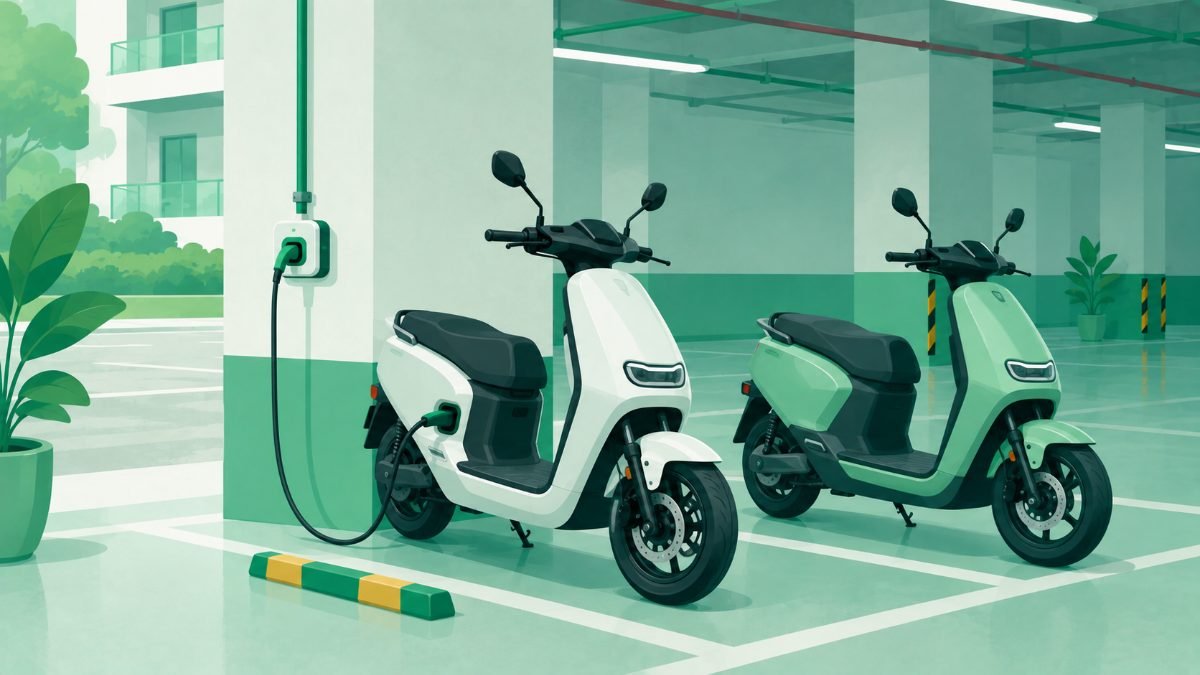
Neither battery swapping nor home charging is cheaper by default. For an e-scooter owner in a flat, three numbers from your own documents decide it: the swap plan's monthly cost at the distance you ride, read from your plan document; your home charging energy cost at your own marginal electricity rate; and the one-time cost of a charging point, spread over the months you expect to stay. If your plan charges a monthly fee with swaps included, that cost stays flat until you pass them. Home charging starts from the point's monthly share and rises with every kilometre. Put all three in one ledger and the cheaper route at your distance becomes plain.
The answer: three numbers from your own documents decide it
This page states no real plan price, tariff or per-kilometre figure, because none would be yours. Gather your plan document, latest electricity bill, a written point quote if you need one, and monthly kilometres from the odometer, then fill both columns.
| Line | Swap plan (from your plan document) | Home charging (from your bill and quote) |
|---|---|---|
| Paid every month | The fee, and the swaps, kWh or distance it includes | Any fixed charge added for the point |
| Using more | Price per swap or kWh beyond the inclusion | Your marginal rate, or the society's rate, per unit |
| Tax | GST inside the printed fee, or added on | Per-unit duties and surcharges, added into your rate |
| One-time amounts | Non-refundable joining fee ÷ months on the plan | Quoted point cost ÷ months you expect to stay |
| Total per month | Fee + extra swaps × overage + one-time share | Energy cost + fixed charge + one-time share |
| Cost per kilometre | Total ÷ your monthly km | Total ÷ your monthly km |
The ledger can favour either route. A long stay or a point you already have pulls towards home charging; a short stay, a costly cable run or a high society per-unit rate pulls towards the plan. Nothing here promises a saving.
First, check whether swapping is open to your scooter
Your vehicle's manual and the plan document decide which columns you fill. Read them rather than relying on the showroom.
| Can your scooter use a swap network? | Is it swap-only? | Does the home ledger apply? |
|---|---|---|
| Yes | Yes: the documents give no way to charge it yourself | No. Compare swap plans with each other |
| Yes | No: it can also be charged from a charger | Yes. Fill both columns and run the break-even |
| No | Not applicable | Yes, alone. This comparison does not apply |
For ways to charge a two-wheeler in a flat, see charging an electric two-wheeler in an apartment; for public charging, making public charging work.
Ledger A: a swap plan, read from your plan document
Read each line from the plan document, not an advert: the fee, what it includes and whether unused swaps lapse, the price per extra swap, whether GST is inside the printed fee, and any non-refundable joining fee. If it charges per swap with no monthly fee, enter fee and included swaps as zero. A refundable deposit is not a running cost, but note how to get it back.
Monthly swap total = fee + (swaps used − swaps included) × price per extra swap + one-time amounts ÷ months on the plan, counting extra swaps only when used exceeds included. Take swaps used from three months of swap history; if you are only considering a plan, estimate monthly km ÷ km you expect per swap, and correct it after a month.
Ledger B: home charging at your marginal rate, plus the one-time point
Home energy cost is one input, from the method in how to calculate your monthly EV charging cost. The rate depends on where the socket draws power. On your own meter, use your marginal slab rate plus per-unit duties (see reading your electricity bill, and what EV charging does to your bill if you cross a slab). On the society's common supply, use the rate or flat charge in its written billing rule.
The Ministry of Power's Guidelines for Installation and Operation of Electric Vehicle Charging Infrastructure-2024, dated 17 September 2024, say in clause 15(4), under "Charging at Residence": "Domestic electricity rates will apply to charging EVs at home." (beeindia.gov.in; last verified 15 October 2026.) Clause 15(1) adds that owners "can request for a separate metered connection from Distribution Licensee with a dedicated EV charging tariff"; with one, use that connection's bill. Neither settles the rate for a bay point on the society's common meter; the society's billing rule shows it.
Then add the one-time point: a licensed electrician's written quote ÷ the months you expect to stay. If it needs a higher sanctioned load and your bill's fixed charge is tied to that load, any rise is a monthly line too (sanctioned load and EV charging). The wiring must be specified and certified by a licensed electrician. With a usable point already in place, this line is zero.
Break-even: the monthly distance that tips it
Within its inclusion a fee-based plan costs the same however far you ride; home charging starts from the point's share and rises per kilometre, so the lines can cross.
- Home cost per km = monthly home energy cost ÷ the km it covers.
- Home fixed share = point cost ÷ months you expect to stay + any monthly fixed charge for the point.
- Crossing = (swap fee − home fixed share) ÷ home cost per km.
- Allowance = included swaps × your km per swap. Beyond it, each plan kilometre adds the price per extra swap ÷ your km per swap: the plan's extra cost per km.
- Second crossing = (home fixed share − swap fee + allowance × plan's extra cost per km) ÷ (plan's extra cost per km − home cost per km).
These steps assume the plan's extra cost per km is above your home cost per km; if not, compare the two totals at your own distance. If the swap fee is below the home fixed share, the plan is cheaper from the first kilometre up to the second crossing. If the first crossing lands past the allowance, the lines never meet and home charging stays lower.
Every figure below is invented to show the working; substitute your own. Suppose your plan document shows ₹1,200 a month including GST, 30 swaps included and ₹60 per extra swap, and your log shows 50 km per swap. Suppose the linked method gives ₹400 of home charging for 1,000 km, and your electrician quotes ₹24,000, spread over a 24-month stay.
Home cost per km = ₹400 ÷ 1,000 = ₹0.40. Home fixed share = ₹24,000 ÷ 24 = ₹1,000 a month. Crossing = (₹1,200 − ₹1,000) ÷ ₹0.40 = 500 km a month. Allowance = 30 × 50 = 1,500 km. Beyond it the plan adds ₹60 ÷ 50 = ₹1.20 a kilometre against ₹0.40 at home, so second crossing = (₹1,000 − ₹1,200 + 1,500 × ₹1.20) ÷ (₹1.20 − ₹0.40) = ₹1,600 ÷ ₹0.80 = 2,000 km.
On these invented numbers, home charging is cheaper below 500 km a month, the plan from 500 to 2,000 km, and home charging above that. Suppose the quote were ₹12,000 instead: fixed share = ₹12,000 ÷ 24 = ₹500, crossing = (₹1,200 − ₹500) ÷ ₹0.40 = 1,750 km, past the 1,500 km allowance, so home charging is lower at every distance.
What the ledger doesn't capture: time, availability, society rules
- Time: a trip and a wait at a station, against plugging in for the charging time your manual states.
- Availability: before subscribing, visit the stations on your routes at the hours you ride and check for charged batteries.
- Society rules: get the society's permission before any bay point is wired, and note that a society may restrict carrying batteries through common areas.
- The battery: check in your plan and vehicle documents who owns it, replaces it and bears damage.
In Maharashtra: what the electrical inspector's advisory says
The Office of the Chief Electrical Inspector's safety advisory and standard operating procedure for EV charging stations in multistorey buildings, outward no. CEI/Tech/283/2022, dated 10 October 2022 (ceimah.in; last verified 15 October 2026), is a state advisory, not a statute. Its item 1 on e-scooters reads in full: "While it is recognized that the users of this equipment have mobility difficulties, in blocks or flats and similar accommodation, e-scooters should not be taken to floors / Individual Flats for Charging Purpose." Its opening refers to users with mobility difficulties; the advisory's title covers two-wheelers, but item 1 does not define "e-scooter", so whether it reaches an electric two-wheeler is unsettled.
Item 7 is broader: "For the E-Scooters/Bicycles with detachable/Portable batteries owner shall not use household 15A/3 pin switch socket for EV charging purpose." It continues: "Dedicated EV Charger confirming to relevant standards shall be installed and used for the said purpose." So in Maharashtra, with a detachable battery, price ledger B's one-time line on a dedicated charger, not a household 15A socket, specified and certified by a licensed electrician. None of this is legal or tax advice.
Common questions
Is battery swapping cheaper than charging my scooter at home?
Not by default, in either direction. It turns on the plan's cost at your distance, your home energy cost at your own rate, and the point's cost spread over your stay. Run the break-even above on your own figures.
My society won't allow charging in the parking. Is swapping my answer?
It can be, if your scooter can use a swap network and a station on your routes has charged batteries when you need them; a plan needs no wiring in the building. Price it with ledger A alone. Then read what to do when your society says no, and charging without an allotted slot if parking is the obstacle.
What happens to the comparison in a month when I ride past the plan's included swaps?
Each extra swap adds your plan's overage, so beyond the allowance each kilometre costs the price per extra swap ÷ your km per swap. Compare that with your home cost per km. If you pass it most months, ask whether the operator offers a plan with more included swaps, and re-run the ledger.
Does the swap plan's price include GST, and where do I check?
Check the plan document or your first invoice for "inclusive of GST" beside the fee, or a separate GST line; if neither shows it, ask the operator in writing. Enter the inclusive figure, since ledger B's rate already includes your bill's per-unit duties. We state no GST rate, and this is not tax advice.
Can I switch from a swap plan to home charging later?
Check your vehicle's manual for whether the scooter can be charged outside the swap network, and your plan document's exit terms: lock-in, notice, deposit refund, and who owns the battery when the plan ends. If you switch, the point's cost enters ledger B from the day you install it, and the work needs a licensed electrician.