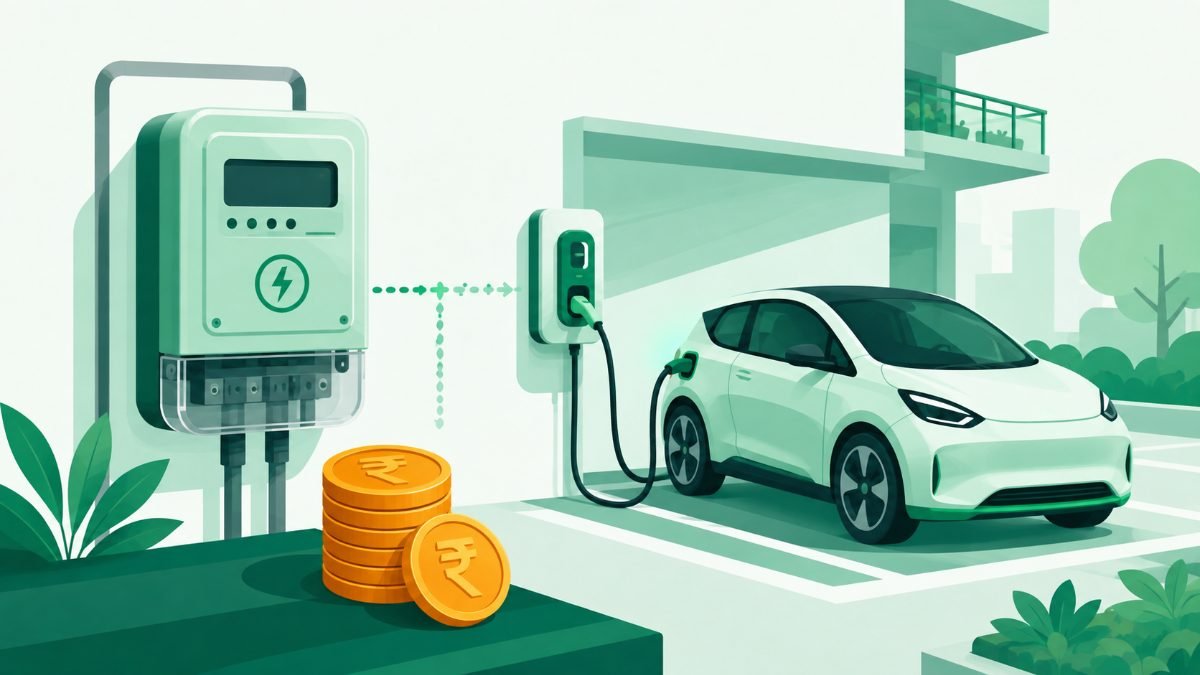
On your Hyderabad flat's domestic (LT-I) meter, the month's total decides the price of every unit. Under the 2026-27 tariff order of the Telangana Electricity Regulatory Commission (TGERC), a month above 200 units moves the whole bill to the LT-I(B)(ii) table, so even the first 200 units rise from "3.40" and "4.80" rupees to "5.10". An eligible Gruha Jyothi household also loses that month's zero bill. A separate LT-IX meter bills "6.00" a unit with a "0" fixed charge, carries a one-time service-line charge under Regulation No. 01 of 2026, and is no cheaper at night. Whether LT-IX covers a private parking-slot charger is not settled.
LT-I or LT-IX: the two tariffs a Hyderabad flat owner chooses between
Hyderabad flats are supplied by TGSPDCL, the state's southern distribution company, at rates set by TGERC's Order on Revised Aggregate Revenue Requirement and Retail Supply Tariffs for FY 2026-27, passed in O.P. Nos. 79 and 80 of 2025 and dated 30.03.2026. Para 4.1.1 makes it applicable "with effect from 01.04.2026 to 31.03.2027" (tgerc.telangana.gov.in; last verified 16 October 2026). Its Appendix A abstract is published as the Tariff Schedule 2026-27 (last verified 16 October 2026); we checked every figure below against both.
Your flat's connection is LT-I, which para 4.2.1 applies to supply "for lights, fans and other domestic purposes to domestic premises". LT-IX, under para 4.10.1, "is applicable to Electric Vehicle Charging Stations, EV Battery Swapping Stations". The Ministry of Power's EV charging guidelines of 17 September 2024, clause 15, describe both routes for a home: owners "can use their existing electricity connection", or "can request for a separate metered connection from Distribution Licensee with a dedicated EV charging tariff" (beeindia.gov.in copy; last verified 16 October 2026; our clause-by-clause reading).
| Bill line | LT-I domestic (your flat's meter) | LT-IX (separate EV meter) |
|---|---|---|
| Energy charge, Rs per unit (para 4.2.4, 4.10.2) | Depends on the month's total; above 200 units: "5.10" for 0-200, "7.70" for 201-300, "9.00" for 301-400, "9.50" for 401-800 | "6.00" at any volume |
| Fixed charge, Rs per kW of contracted load per month | "10" (Rs 50 above 800 units) | "0" |
| Customer charge, Rs per month (para 4.13) | "90" at 101-200 units, "100" at 201-300, "120" at 301-400 | "120" |
| Minimum charge | None printed for LT-I | "Rs. 65 per month for single phase supply", "Rs. 200 per month for three phase supply" |
| Time-of-day pricing (para 3.32.1) | None | None |
| Free units | Gruha Jyothi zero bill for eligible households up to 200 units | None |
Para 4.1.2 adds that fuel cost adjustment "will be extra" and that tariffs are "exclusive of the Electricity duty". Read both lines off your own bill rather than estimating them; our guide to reading an electricity bill shows where they sit.
What a month above 200 units does to every unit on an LT-I bill
Para 4.2.3 sorts domestic consumers by the month's consumption. LT-I(A) is for consumption "not exceeding 100 units per month"; LT-I(B)(i) is "above 100 units but not exceeding 200 units per month"; LT-I(B)(ii) is "above 200 units per month". Para 4.2.4 then gives each sub-category its own slab table. The month's total picks the table first, and only then do the slabs inside it apply.
- LT-I(A): "0-50" at "1.95", "51-100" at "3.10".
- LT-I(B)(i): "0-100" at "3.40", "101-200" at "4.80".
- LT-I(B)(ii): "0-200" at "5.10", "201-300" at "7.70", "301-400" at "9.00", "401-800" at "9.50", "Above 800 units" at "10.00".
Run it one unit either side of the line. At 200 units the energy charge is 100 × 3.40 + 100 × 4.80 = ₹820. At 201 units it is 200 × 5.10 + 1 × 7.70 = ₹1,027.70. The 201st unit adds ₹207.70 in energy charges, and the customer charge moves from Rs 90 to Rs 100. The same repricing happens at 100: 50 × 1.95 + 50 × 3.10 = ₹252.50 at 100 units, but 100 × 3.40 + 1 × 4.80 = ₹344.80 at 101.
The reading period matters at the line. Appendix B, directive 8, tells the distribution companies "to take the meter readings of the domestic consumers only on completion of one month and calculate the number of units consumed for calendar month." It repeats a FY 2025-26 direction (para 3.33.19), given after the companies explained that on an early reading "average units are taken to decide the slab" (para 3.33.11), which scales a short period up to a full month. Check the billing days on your bill, and read your meter mid-month to see how close you are.
Para 4.11.1(b) decides the hardware: "For Categories LT-I, LT-II and LT-VII supply shall be extended on a single phase only up to 5 kW of Contracted Load." A 7.2 kW charger is above 5 kW on its own, so raising your flat's contracted load to carry one means three-phase supply. Whether your riser has three phases to give, and what load to apply for, must be specified and certified by a licensed electrician; see three-phase charging in a flat and sanctioned load.
Gruha Jyothi: how an EV can turn a zero bill into a full bill
The scheme was notified by G.O.Ms.No.7, Energy (Power.I) Department, dated 26.02.2024. We could not find the G.O. itself on a government host. We quote it as the Commission, then styled TSERC, reproduces it in its order in O.P. No. 6 of 2024, dated 16.03.2024, which accepted the Government's direction (tgerc.telangana.gov.in; last verified 16 October 2026). The eligibility clause reads: "Each household covered under this scheme will be eligible for free electricity of up to 200 units of domestic consumption per month for one service connection." Coverage needs an application "entered in Praja Palana portal having details of valid Food Security Card (white ration card) and linked with Aadhaar card together with a domestic service connection number".
The billing clause: "Each eligible household whose consumption for a particular month is up to 200 units will receive a zero bill for that month." As reproduced, the G.O. offers nothing for a month above 200 units: no partial relief, no first 200 free. So for an eligible household, the vehicle's units are not priced at 7.70. The whole LT-I(B)(ii) bill becomes payable, from the first unit. A stakeholder submission recorded in the FY 2025-26 order describes the same result for a household billed at 203 units: it "is losing the benefit of Gruha Jyothi scheme and has to pay Rs. 1140 as the bill amount" (para 3.33.5). We have not read any later departmental instruction, so check your own bills for a month that went past 200.
The test: headroom = 200 − your highest non-EV month. Suppose your last twelve bills peaked at 170 units, so your headroom is 30. A scooter drawing 25 units a month at the wall fits with 5 to spare. A car drawing 140 does not fit in any month. Use the summer peak, not the average: one hot month is enough to lose the zero bill.
Two points in the G.O. are not settled for EV owners. Clause 6 says a beneficiary "found using the benefits for non-domestic purposes will be liable for action". Neither the G.O. text nor TGERC's order says whether charging your own vehicle at home counts as domestic consumption. The Ministry's clause 15(4), "Domestic electricity rates will apply to charging EVs at home", is about the tariff, not about the scheme. If your household depends on the zero bill, ask TGSPDCL in writing (question 6 in the letter below). Clause 4 also keeps bills "in the name of recorded service connection holder only", which matters to tenants (renting with an EV).
Worked bills: a scooter and a car on your flat's own meter
The figures below are illustrative assumptions; substitute your own. Suppose your flat's contracted load is 5 kW, so the fixed charge is 5 × 10 = ₹50 a month; if you raise the load to carry a charger, add Rs 10 for each extra kW. Electricity duty and fuel cost adjustment are left out because they are on your bill, not in the order. The vehicle's units are what it draws at the wall, which our monthly charging cost method works out from your kilometres.
Scooter. Suppose the flat uses 185 units a month and the scooter adds 25.
- Without the scooter: 100 × 3.40 + 85 × 4.80 = ₹748; with the customer charge of Rs 90 and the ₹50 fixed charge, ₹888.
- With it, at 210 units: 200 × 5.10 + 10 × 7.70 = ₹1,097; with Rs 100 and ₹50, ₹1,247.
- Extra cost: 1,247 − 888 = ₹359, which is 359 ÷ 25 = ₹14.36 for each scooter unit.
- If the household is an eligible Gruha Jyothi household, the bill goes from zero to ₹1,247.
Car. Suppose the flat uses 180 units and the car adds 140.
- Without the car: 100 × 3.40 + 80 × 4.80 = ₹724; with Rs 90 and ₹50, ₹864.
- With it, at 320 units: 200 × 5.10 + 100 × 7.70 + 20 × 9.00 = ₹1,970; with Rs 120 and ₹50, ₹2,140.
- Extra cost: 2,140 − 864 = ₹1,276, which is 1,276 ÷ 140 = ₹9.11 for each car unit.
- For an eligible Gruha Jyothi household, the bill goes from zero to ₹2,140.
Suppose instead the flat uses 120 units and the scooter adds 25. At 145 units the month stays in LT-I(B)(i), so the scooter costs 25 × 4.80 = ₹120, and an eligible household still gets its zero bill. For that household the scooter adds nothing to the bill, subject to the domestic-use question above. If your flat is already above 200 every month, nothing below the line is repriced: each EV unit is billed at the slab it lands in, "7.70", "9.00" or "9.50", and the customer charge steps up as each slab is crossed.
LT-IX: one rate all day, no fixed charge, and two monthly floors
Para 4.10.2 prices LT-IX as "kW 0 6.00", which means no fixed charge per kW and Rs 6.00 a unit. It adds "Minimum monthly charges Rs. 65 per month for single phase supply Rs. 200 per month for three phase supply". Para 4.13 sets the LT-IX customer charge at "120" rupees a month. Below 10 kW of contracted load, billing is on kWh (para 4.12.35(c)). Para 4.1.3 treats LT-IX connections "up to 150 kW/ 201 HP" as low tension, so a single resident's point is far inside the LT range.
An LT-IX month is units × 6.00 + 120, plus duty and fuel cost adjustment. With the same assumptions as above, the scooter's 25 units cost 25 × 6.00 = ₹150, which clears the Rs 65 single-phase minimum, so the month costs ₹270. The car's 140 units cost 140 × 6.00 = ₹840, so the month costs ₹960. In a month when the vehicle barely charges, you still face the customer charge and a minimum. The order does not spell out how TGSPDCL combines the two on one bill, so ask.
On a separate meter the flat's own bill is unchanged. The monthly comparison:
| Case (your figures will differ) | Extra cost on the flat's LT-I meter | Cost on a separate LT-IX meter | Monthly difference |
|---|---|---|---|
| Scooter, 185 + 25 units, no Gruha Jyothi | ₹359 | ₹270 | ₹89 in favour of LT-IX |
| Car, 180 + 140 units, no Gruha Jyothi | ₹1,276 | ₹960 | ₹316 in favour of LT-IX |
| Car, 260 + 140 units (already above 200) | ₹1,228 | ₹960 | ₹268 in favour of LT-IX |
| Scooter, 185 + 25 units, Gruha Jyothi household | ₹1,247 | ₹270 | ₹977 in favour of LT-IX |
| Car, 180 + 140 units, Gruha Jyothi household | ₹2,140 | ₹960 | ₹1,180 in favour of LT-IX |
| Scooter, 120 + 25 units, Gruha Jyothi household | ₹0 | ₹270 | ₹270 in favour of the flat's meter |
Third row: at 260 units the flat pays 200 × 5.10 + 60 × 7.70 = ₹1,482 plus Rs 100 and ₹50, which is ₹1,632; at 400 units, 200 × 5.10 + 100 × 7.70 + 100 × 9.00 = ₹2,690 plus Rs 120 and ₹50, which is ₹2,860.
Charging at night does not change any of these numbers on a low-tension connection. Para 3.32.1 of the 2026-27 order lists the categories with time-of-day tariffs: HT-I(A) industry and poultry farms, HT-II(A), HT-II(B), HT-III and "HT-IX Electric Vehicle Charging Stations". No LT category appears, so on LT-I or LT-IX a unit at 2 am costs what it costs at 7 pm. Even HT-IX pays "Normal energy charges" from 10 pm to 6 am under Table 3-53, with "Plus Rs.1.50/unit" from 6 to 10 am and 6 to 10 pm, and "Less Rs. 0.50/unit" from 10 am to 6 pm. HT-IX did have a night discount until March 2026: para 3.18.65 of the FY 2025-26 order records that ToD "is already in place for HT IX" and that "the ToD incentive for off-peak period i.e., 10 PM to 6 AM is Rs. 1.50 per unit" (tgerc.telangana.gov.in; last verified 16 October 2026). The 2026-27 table removed it. The general question is covered in whether night charging saves money.
Connecting an LT-IX meter: what Regulation No. 01 of 2026 charges
The one-time charge comes from the TGERC (Licensee's Duty for Supply of Electricity on Request) Second Amendment Regulation, 2026, Regulation No. 01 of 2026. It is signed 17.01.2026 (tgerc.telangana.gov.in; last verified 16 October 2026), and the Commission's Regulation No. 07 of 2026, dated 29.09.2026, records that it was notified "on 19.01.2026" (tgerc.telangana.gov.in; last verified 16 October 2026). It applies to "applications for new LT connections/Additional Load under LT categories through overhead lines" within 1 km of the electrified network, and/or where supply "requires extension of line from the existing distribution mains to the consumer's premises". The charges are "for the Contracted Load excluding the cost of terminal and metering arrangements".
| Contracted load | LT-IX: Electric Vehicle Charging Stations (Rs) | LT-I: Domestic, for comparison (Rs) |
|---|---|---|
| Up to 1 kW | "1,000" | "500" |
| Above 1 kW and up to 20 kW | "1,000 plus 1,200 per kW or part there of the contracted load" | Above 1 kW and up to 5 kW: "500 plus 600 per kW or part there of the contracted load"; above 5 kW and up to 20 kW: "2,900 plus 1,500 per kW or part there of the contracted load" |
| Above 20 kW | "8,000 per kW or part there of the contracted load" | "10,000 per kW or part there of the contracted load" |
"1,000 plus 1,200 per kW" can be read two ways: per kW above the first, or per kW of the whole load. The regulation's own tables support the first reading. Under LT-II, the identical "1,000 plus 1,200 per kW" reaches the "5,800" that opens the next band only if counted above the first kW (1,000 + 4 × 1,200 = 5,800). LT-I's "500 plus 600" reaches its next band's "2,900" the same way (500 + 4 × 600). Suppose your licensed electrician specifies a 4 kW contracted load: 1,000 + 3 × 1,200 = ₹4,600, or ₹5,800 on the other reading. For 8 kW it is 1,000 + 7 × 1,200 = ₹9,400, or ₹10,600. The two readings always differ by one step of Rs 1,200, so ask the estimate to show its working.
The service-line charge is not the whole one-time cost. The regulation's substituted clause 8.3 adds "Development Charges as per Schedule (Annexure -I) of Principal Regulation" for loads up to 20 kW. We did not obtain a copy of that schedule as it applies in Telangana, so we do not quote it. The other lines:
- The meter. Regulation No. 1 of 2015 says "Either the Licensee or the Consumer can bear the cost of meter and allied equipment". If you elect to buy it, it must meet the licensee's specification and the licensee tests it "at its own cost"; if the licensee bears the cost, it may collect meter rent (Telangana Gazette, 20 January 2015; tgerc.telangana.gov.in; last verified 16 October 2026).
- An application registration fee of Rs 50 "For all other LT Categories" (para 4.13).
- Any security deposit your distribution company asks for, which we have not verified.
- The cable from the meter room to your bay, which is your installer's quote, not the DISCOM's (what decides installation cost).
One line works in your favour: for connections under the proviso, the licensee "shall not charge the cost of Distribution Transformer". One line is uncertain for apartments. The text does not say whether a meter fed from your building's existing LT panel falls under "through overhead lines" or "extension of line". Ask which clause your estimate is drawn under before you pay it.
Months to earn back the connection, on your own numbers
Both routes need a cable to your bay, so compare only the extra one-time cost of the LT-IX route over charging from your flat's meter. The sum is: months to recover = extra one-time cost ÷ monthly difference. Suppose your two written quotes and the DISCOM's estimate put the extra cost at ₹25,000; substitute your own figure.
- Scooter, no Gruha Jyothi: 25,000 ÷ 89 = 281 months, over 23 years. On these numbers the separate meter does not pay.
- Car, no Gruha Jyothi: 25,000 ÷ 316 = 79 months, about six and a half years.
- Scooter, Gruha Jyothi kept every month: 25,000 ÷ 977 = 26 months.
- Car, Gruha Jyothi kept every month: 25,000 ÷ 1,180 = 21 months.
The Gruha Jyothi rows assume your flat would stay at or under 200 units every month without the vehicle, which your summer bills may not support. Suppose that without the car you stay under 200 for 8 months, and sit around 260 units in the other 4. The yearly difference is 8 × 1,180 + 4 × 268 = ₹10,512. That is 10,512 ÷ 12 = ₹876 a month, and 25,000 ÷ 876 = 28.5 months.
The period lengthens in months the vehicle is away, since the Rs 120 customer charge still runs. The order fixes rates only to 31.03.2027, and a move or a new vehicle can end the arrangement early. This is arithmetic on assumptions, not a promise of savings; our monthly charging cost calculator gives the vehicle's units to feed into it.
Societies: what the order puts on domestic rates, and what it leaves out
Para 4.2.2 extends the domestic tariff to "RO plants, sewerage treatment plants (STP), yard/streetlights which are established and operated by the owner's welfare associations in gated communities having individual connections or single point supply". EV charging is not on that list. A society charger should not be assumed to get domestic rates. Para 4.12.2 bills common services "like water supply, RO/sewerage treatment plant, common lights in corridors and supply for lifts" at LT-I(B)(ii) where domestic plinth area is "50% or more", otherwise at LT-II(B). Under 4.12.2(e), several common meters are "clubbed". EV charging is not named there either.
A society may instead apply for a separate LT-IX connection for a shared charger, which stays LT up to 150 kW under para 4.1.3. Regulation No. 01 of 2026 prints "combined contracted load shall be considered" for apartments under its LT-I and LT-II tables, but not under LT-IX, so ask how a society's LT-IX application will be assessed. Above 150 kW, HT-IX applies: "100" rupees per kVA a month and "6.00" per kVAh (para 4.25.3), with the time-of-day adjustments above. If your society is on a single-point HT-VI connection, para 3.29.139 directs what it may recover from residents. Charges "shall be strictly proportionate to actual consumption and shall not exceed the applicable HT-VI tariff under any circumstances". To divide a shared charger's bill fairly, see splitting shared charging costs.
The private-slot question the order leaves open, and the letter to send
Para 4.10.1 names "Electric Vehicle Charging Stations, EV Battery Swapping Stations" and defines neither. Nothing in the 2026-27 order says whether one resident's point in an allotted slot, charging only that resident's vehicle, is a charging station for LT-IX. Para 4.11.1(d) says the licensee "shall have the right to classify or re-classify the category of supply of energy to any premises under an appropriate category of LT Tariff". The Ministry's guidelines support the request: clause 16(1), on community charging, lists "an owner of a flat" among those who "can request for a separate metered connection from Distribution Licensee with a dedicated EV charging tariff". They are guidelines, not TGERC's tariff. So ask TGSPDCL in writing:
- Will you release an LT-IX connection under para 4.10 of the FY 2026-27 order for a charging point in my allotted parking slot that charges only my own vehicle? If not, under which category?
- What contracted load and phase will you sanction for a charger of the rating my licensed electrician has specified?
- Please itemise the estimate: service-line charges under Regulation No. 01 of 2026, showing the per-kW working; development charges under Annexure-I; the meter; the registration fee; and any security deposit.
- Will supply come from the building's existing LT distribution, and does the proviso to clause 7.1 apply to it?
- In a month with little or no charging, how will the Rs 65 or Rs 200 minimum and the Rs 120 customer charge be applied?
- If I charge on my existing LT-I connection instead, does charging my own vehicle count as domestic consumption for Gruha Jyothi? And would a separate LT-IX connection in my name affect that zero bill?
The meter position and cable route also need your committee's permission (requesting permission). The circuit, cable, earthing and protective devices must be specified and certified by a licensed electrician after a site assessment. This page reads published orders and regulations; it is not legal or electrical advice.
Common questions
Does TGSPDCL have a special EV tariff for home charging?
TGERC's LT-IX category bills "6.00" rupees a unit with a "0" fixed charge and a Rs 120 customer charge. Para 4.10.1 applies it to "Electric Vehicle Charging Stations, EV Battery Swapping Stations". The 2026-27 order does not say whether a private point in your parking slot qualifies, so ask TGSPDCL in writing. Charging through your flat's own meter is billed with the rest of the flat at LT-I rates.
Will charging my EV make me lose Gruha Jyothi?
Only in a month when your flat's total goes past 200 units. The G.O., as TGERC's order reproduces it, gives a zero bill to an eligible household "whose consumption for a particular month is up to 200 units". Above that, the full LT-I(B)(ii) bill applies. Subtract your highest non-EV month from 200 to see whether your vehicle fits.
Is it cheaper to charge my EV at night in Telangana?
Not on a low-tension connection. Para 3.32.1 of the 2026-27 order lists time-of-day tariffs only for HT categories, so LT-I and LT-IX units cost the same at any hour. Even HT-IX pays normal energy charges from 10 pm to 6 am.
Once I cross 200 units, are all units billed at the higher rate?
Yes. The month's total puts you in LT-I(B)(ii), whose table starts at "5.10" for the first 200 units. That is why 200 units cost 100 × 3.40 + 100 × 4.80 = ₹820 in energy charges, but 201 units cost 200 × 5.10 + 7.70 = ₹1,027.70.
Can I keep single-phase supply with a 7.2 kW charger on my flat's meter?
Para 4.11.1(b) limits single-phase LT-I supply to "5 kW of Contracted Load", and a 7.2 kW charger is above that by itself. So a load increase to carry one means three-phase. Whether your riser can provide it is for a licensed electrician to check.
Is a separate LT-IX meter worth it for an electric scooter?
Only where the scooter would push your flat past 200 units, and on our assumed numbers mainly for an eligible Gruha Jyothi household: a ₹977 monthly gap repaid an assumed ₹25,000 extra cost in about 26 months, against 281 months at an ₹89 gap without the scheme. If the flat stays under 200 with the scooter, its own meter costs less.