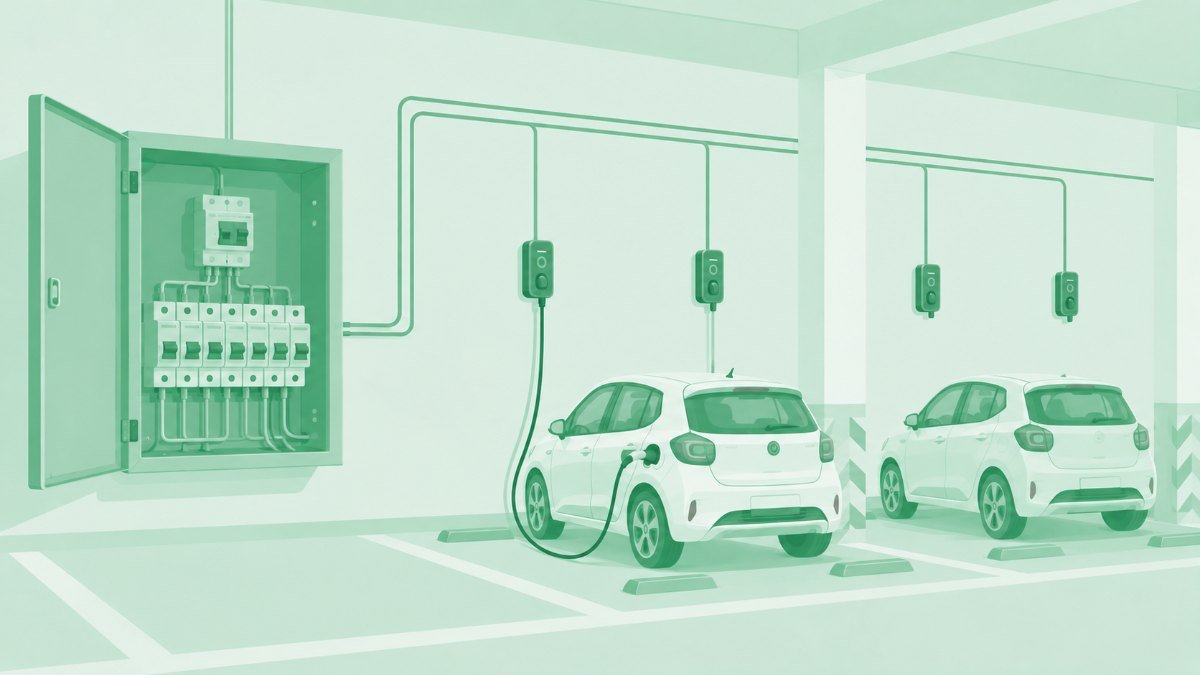
If you live in a flat in Noida, Greater Noida or Ghaziabad, three things decide how your EV charging is billed: whether your building takes supply at a single point, at multiple points or through individual connections; which distribution licensee serves your address; and Rate Schedule LMV-11 in that licensee's current tariff order from the Uttar Pradesh Electricity Regulatory Commission. LMV-11 sets out three routes — your existing connection with a load increase if you need one, a separate connection for a common charger in a multi-storey building, or a public station. This page works each route on figures from your own bill. It is not legal, tax or electrical advice.
Which of the three supply arrangements your building is on
Settle it from paper: who sends the bill for your flat, and do you hold a consumer number of your own? If you cannot tell, ask the committee in writing for the building's consumer number, its tariff category and one licensee bill.
| Arrangement | Who meters your flat | Who bills you | Which schedule prices those units at the building boundary |
|---|---|---|---|
| Single point | The association or developer | The association or its maintenance agency | LMV-1(b), or HV-1(b) on 11 kV with a mixed load; the association apportions |
| Multipoint | The licensee | The licensee, flat by flat | LMV-1 domestic; common services billed separately |
| Individual connection | The licensee | The licensee | LMV-1 domestic |
Which licensee bills you, and which tariff order sets your rate
Noida and Ghaziabad fall in the area of the state-owned western-zone distribution company, Pashchimanchal Vidyut Vitran Nigam Ltd, Meerut. Part of Greater Noida is served by a separate private licensee, licensed on 30 August 1993 under section 3(1) of the Indian Electricity Act, 1910 for supply "in the Greater Noida of the State of Uttar Pradesh" (paragraph 1.2.5 of its order), with a licensed area that "falls within GNIDA's notified area" (paragraph 4.3.5) — so neighbouring addresses can sit with different licensees. The Commission determines a tariff for each separately under sections 62 and 64 of the Electricity Act, 2003: a figure from one order does not price a unit in the other's area.
Both current orders are dated 2 July 2026. The FY 2026-27 order for the five state distribution companies, Petition Nos. 2316, 2314, 2318, 2317 and 2315 of 2025, covers the Noida and Ghaziabad licensee (uperc.org; last verified 21 October 2026); the Greater Noida licensee's order is Petition No. 2330 of 2025 (uperc.org; last verified 21 October 2026).
For FY 2026-27 every figure this page uses — LMV-11, the single-point LMV-1 and HV-1 rates, the non-rural domestic slabs — is printed identically in the two orders; the presentation is not. The state companies' lifeline and rural tables print a tariff excluding subsidy, the State Government subsidy under its letter No. 1307/2020 dated 19 May 2026, and a tariff payable. Their non-rural domestic table prints a "Cross Subsidy adjustment" instead, which the schedule says "is only adjusting value and shall not be shown in the bills of the consumers". The Greater Noida schedule prints one fixed and one energy charge. Open the order naming your own licensee: a figure without an order and a date is not evidence in a meeting.
Rate Schedule LMV-11: the three routes, as the schedule prints them
Rate Schedule LMV-11, headed "ELECTRIC VEHICLE CHARGING", is an annexure to each order. Its three numbered paragraphs are the three routes, and they are not alternatives you pick freely: each is tied to who charges and where. Paragraph 1 applies to consumers already on LMV-1, LMV-2, LMV-4, LMV-6, LMV-9, HV-1, HV-2 or HV-3. Paragraph 2, headed "EV Charging Stations for Common Usage in Multistoried Buildings (Single-Point / Multi-Point)", states that development authorities, builders, promoters, colonisers and resident welfare associations wishing to install such a station "will have to take a separate connection for EV Charging Station" and "will be required to pay applicable connection charges". Paragraph 3 covers public charging stations, battery-as-a-service installations including battery swapping, and state road transport stations. The headings quoted are the state schedule's; the Greater Noida schedule prints "Multi storeys Buildings", with the same figures.
| Clause and category as printed | Energy charge, FY 2026-27, both orders of 2 July 2026 |
|---|---|
| Paragraph 1(a), (b): a resident on their own connection | Your own category's rate; no LMV-11 rate |
| Paragraph 2, "Multistoried Buildings (LT)" | "Rs. 6.20 / kWh" |
| Paragraph 2, "Multistoried Buildings (HT)" | "Rs. 5.90 / kWh" |
| Paragraph 3, "EV Charging Station (LT)" | "Rs. 7.70 / kWh" |
| Paragraph 3, "EV Charging Station (HT)" | "Rs. 7.30 / kWh" |
No demand charge is printed against any LMV-11 category. The time-of-day structure applies to the "LMV-11 (3) Category" only — "(-) 20%" of energy charges between 09:00 and 16:00 hours, zero either side — so a common charger under paragraph 2 gets no daytime discount, and planning one around solar hours earns nothing on the input tariff. Both orders also set a penalty for exceeding contracted demand of "Rs. 150.00 / kVA / month for LT and Rs. 250.00 / kVA / month for HT" on the excess demand only.
Route 1: your own vehicle on your own connection
If your flat has its own licensee connection, paragraph 1(a) settles the ordinary case: those categories "shall use their existing electricity connection to charge their EVs", billed under your own domestic category, with no separate EV tariff and no new connection. Paragraph 1(b) adds that if charging "requires more power than the current sanctioned load, the consumer can apply to the Distribution Licensee for seeking increase in sanctioned load". The note beneath is worded differently in the two orders — the state schedule advises the consumer "may take precautions to take adequate contracted load", the Greater Noida schedule "should take precaution" — and both add: "In case the contracted / connected load is breached then the consumer will be liable to pay penalty."
So the question is arithmetic, not permission: add the charger's rating to the load you already draw at those hours and compare with the sanctioned load printed on your bill. If it does not fit, see sanctioned load in apartments, the load-enhancement process and 3.3 kW versus 7.2 kW.
A national route sits beside LMV-11. Rule 4(15) of the Electricity (Rights of Consumers) Rules, 2020, inserted by the Electricity (Rights of Consumers) Amendment Rules, 2024, notified 22 February 2024 as G.S.R. 125(E), provides that on the request of an association, an owner of a flat or house in an association, or any other consumer, the licensee "shall provide a separate connection for supply of electricity for Electric Vehicle charging system", on the rule 4(11) clock (egazette.gov.in; last verified 21 October 2026). Rule 4(11) does not itself fix your deadline — it requires the Commission to "specify the maximum time period" within stated outer limits — so ask what period the Commission has specified for your classification, and treat remedies against a DISCOM sitting on an application as a separate subject.
The cable from your meter to your parking space crosses space you do not own alone. Under the Uttar Pradesh Apartment (Promotion of Construction, Ownership and Maintenance) Act, 2010, section 5(6) requires work relating to the "modification or relocation" of the common areas and facilities and "the making of any additions or improvements thereto" to be carried out "only in accordance with the provisions of this Act and the bye-laws", and section 6(1) binds each owner to comply strictly with the bye-laws and the deed of apartment (archived India Code copy; last verified 21 October 2026). Your own bye-laws and deed therefore decide the route; see cable routing options. Conductor size, protective devices, earthing and the point of tapping must be specified and certified by a licensed electrician who has inspected the building, not settled from a tariff schedule: a site assessment comes first.
Route 2: a society's common charger needs its own connection
On paragraph 2's wording a common-usage station is not something an association may hang off the existing common-area supply: it "will have to take a separate connection for EV Charging Station". The heading covers both arrangements — "(Single-Point / Multi-Point)" — so single point is not an exemption. Three consequences follow:
- The application is for a new connection in the society's name, with "applicable connection charges" payable, not a load increase on the common-services connection. Get those from the licensee's cost data book, in writing, first.
- The input rate for those units is the paragraph 2 figure, not the common-area rate or a domestic slab.
- What the society may recover from residents is a different question: whether your society's rate is within the service-charge ceiling. Not the same figure.
Shared point or one of your own is a total-cost comparison, not a per-unit one; own meter, sub-meter or common meter sets out the metering consequences.
Worked bills on your own figures
These sums use the quoted figures as the input price and your own consumption as the variable; replace every assumption. Suppose you drive 1,000 km a month at 6 km per kWh on your vehicle's long-term display. Energy into the battery = 1,000 ÷ 6 = 166.7 kWh; allowing for charging losses at 0.9, energy drawn from the wall = 166.7 ÷ 0.9 = 185.2 kWh. Suppose also your flat consumes 260 units a month before the car. The monthly charging cost calculator runs the same arithmetic, and reading your bill explains where each figure sits.
- On your own domestic connection. Rate 3(c)(2), for metered domestic consumers other than rural, prints a tariff payable of "Rs. 5.50 / kWh" up to 150 units, "Rs. 6.00 / kWh" for 151-300 and "Rs. 6.50 / kWh" above 300, on a fixed charge of "Rs. 110.00 / kW / month". From a base of 260 units, 40 charging units sit in the 151-300 band and 145 above 300: (40 × ₹6.00) + (145 × ₹6.50) = ₹240 + ₹942.50 = ₹1,182.50, or ₹1,182.50 ÷ 185.2 = ₹6.39 a unit.
- On a society charger under paragraph 2 at low tension. The society's input for the same energy is 185.2 × ₹6.20 = ₹1,148.24, with no demand charge. Anything added on top is the committee's own figure, to be had in writing.
- Behind a single-point connection. The society buys at the LMV-1(b) figures below: 185.2 × ₹7.00 = ₹1,296.40.
None is the whole cost: the first ignores slab movement in heavier months and the fixed charge on a raised sanctioned load, the second connection charges and anything the society adds, the third your share of "Rs. 110.00 / kW / Month" and losses inside the building. The ranking is specific to a flat above 300 units a month. For dividing a shared charger's output, how societies can bill EV charging fairly is the method.
Single point: what the deemed franchisee owes the residents it bills
The body taking supply at a single point "shall be considered as a deemed franchisee of the Licensee". Two schedules apply, by load and voltage, and both orders print the same figures. LMV-1, rate 3(b) covers single-point bulk supply at 50 kW and above where at least 70 per cent of the contracted load is exclusively for domestic light, fan and power, including lifts, water pumps and common lighting: "Rs. 110.00 / kW / Month" plus "Rs. 7.00 / kWh". HV-1, rate 3(b) covers public institutions, registered societies and residential multi-storied buildings on 11 kV and above at 75 kW and above: "Rs. 380.00 / kVA / month" and "Rs. 7.70 / kVAh" at 11 kV, "Rs. 360.00 / kVA / month" and "Rs. 7.50 / kVAh" above 11 kV.
Both orders attach the same duties to that status — the paragraphs to cite if you suspect overcharging:
- A detailed computation of the amounts realised from individual consumers and the amount paid to the licensee, for every billing cycle, given to all consumers half-yearly by electronic means: April-September "by November end", October-March "by May end of the next financial year".
- Accounts audited by a chartered accountant "mandatorily", available to all consumers within three months of the financial year's close.
- Uploading both on an online system the licensee must develop, which each order says "should become fully operational within six months from the date of issuance of this Order" — early January 2027. Ask whether it is live before alleging a default; once it is, late upload is penalised at "Rs. 5,000/-", "Rs. 10,000/-" and "Rs. 15,000/-" for the first, second and third default.
- Three defaults in a two-year period raise a presumption that the developer or association "is not willing to comply with the directions of the Commission", on which the single point facility "will be withdrawn and the Licensee shall mandatorily convert it to multiple point connection."
- Back-up from DG sets metered separately, the bill to "clearly depict the units and rate" of each — which matters if your charger can run on backup: see EV charging on society DG backup.
- "No disconnection can be effected by the Franchisee on account of non-payment of general maintenance charges" unless the separately shown electricity charge is proved unpaid.
- Where the deemed franchisee exceeds the contracted load or demand, it recovers that only from the members responsible, on their individual excess demands. A charger at a peak hour is exactly the load that can put a name to an excess — agree charging hours in writing first.
Multipoint conversion under the 13th Amendment, and what EV load does to your share
The instrument behind every conversion argument in these cities is the Uttar Pradesh Electricity Supply Code (Thirteenth Amendment), 2018, "No.: UPERC/Secy/Regulations/Supply Code/2018/206", dated 10 August 2018, which replaces clause 4.9 of the Supply Code, 2005 in full and amends clauses 4.6, 9.3, 9.4 and annexure 4.12. The copy archived from the western-zone licensee's own site carries the Hindi notification on its first eleven pages and the English text on the eighteen that follow; the quotations below are from the English (web.archive.org; last verified 21 October 2026). Clause 4.9 has two parts.
Part A governs new buildings and colonies, and Part B imports its requirements into a converted building, so it applies either way. Connections are released by the licensee to individual owners or residents at multiple points. The developer or development authority "shall continue to be responsible for" four things "even after handover of the electrical system to licensee", among them that "Maintenance of internal wiring & internal network shall be the responsibility of RWA/ developer", "To maintain and replace the transformer, if required", and "To provide back-up power from separate cable through separate meter". Individual connections "shall be provided only through smart pre-paid meters, the cost of which shall be borne by the individual owners/ occupiers", at rates "governed by Cost Data Book".
A further proviso puts a reference meter on the building: "the meter installed by the licensee at the incoming supply of the multi-story building will act as reference meter", and its reading "shall be compared with the total electricity consumption of all the individual meters installed in the building for each billing cycle". "An energy difference of up to 4%, in case of supply up to 11 kV, and up to 5% in case of supply at higher voltages shall be treated as permissible towards transformation and LT losses." Beyond that the excess "shall be calculated in terms of units and ... added in the consumption of common services", and for residential buildings those units "shall attract the energy charges as applicable to the highest slab under LMV-1 category" — so a building with an ageing internal network pays for its own losses at the top slab, through the common-services bill every resident shares.
Part B governs conversion of existing single-point connections. Its text required them to "convert their single point connection into multiple point connection by 31/03/2019", and adds in the same clause that "The Commission may extend the date in exceptional circumstances upon request". The licensee then has 30 days to inspect the existing network for "assessing feasibility of effecting such change", and the "next 30 days" to instruct the builder or RWA. On completion the association hands over "the entire distribution system of the building up to the interface point with the licensee", with "no compensation ... for the redundant material". Three provisions decide what you pay and get back:
- "The entire cost of such conversion from single point to multi point supply shall be borne by the RWA/builder who in turn can recover this cost from the individual residents in proportion to the contracted load allotted to each individual resident." The expenditure "shall be vetted by the concerned Executive Engineer" — ask to see that vetting before paying.
- On the new connection "the service connection charges, cost of meter, etc. shall be borne individually by the applicant inhabitants/occupier", but "the system loading charges shall not be levied again as it has already been recovered". Check your demand note against that sentence.
- "The Licensee shall refund the security deposit as per the provision given in clause 4.20. The developer/RWA in turn will refund this security amount to individuals." Get that in writing before the old arrangement closes.
Read that apportionment together with a load increase: raise your contracted load from 3 kW to 7 kW mid-conversion and your share is computed on the higher figure. Suppose the vetted estimate works out at ₹1,200 per kW of allotted load — substitute your own society's figure — then 3 kW × ₹1,200 = ₹3,600 becomes 7 kW × ₹1,200 = ₹8,400, a difference of ₹4,800 that has nothing to do with the charger. Ask the committee in writing, before you apply, whether your load increase will count and at what rate.
Whether conversion is now compulsory for your building is unsettled, and you should not let either side assert it. The Part B date passed years ago and the clause itself allows extension. In the Greater Noida licensee's FY 2025-26 order of 22 November 2025 the Commission reproduced at paragraph 6.3.42 a table from its suo motu order dated 6 May 2024 recording 134 multi-storied buildings on single-point connection, 88 marked "Opted for Single Point", and observed at 6.3.43 that "the majority of multi-storied buildings (88 out of 134) have opted to retain single-point connections" (uperc.org; last verified 21 October 2026). In the current order the same licensee submits at 6.7.4 that the amendment "mandates that all existing multi-storied housing societies currently receiving electricity under the Single-Point Bulk Supply system must be converted to Multi-Point connections", and proposes to convert 4,000 of them in FY 2026-27. Both current orders record at paragraph 3.9 complaints of conversions done without proper surveys or consent, and in both the Commission says it "is developing a concept paper to holistically address different concerns raised by the consumers in multi-storeyed buildings, both on single-point and on multi-point supply subsequent to implementation of the 13th Amendment in Supply Code" (3.9.3 of the Greater Noida order; 3.9.5 of the state order, which spells it "multistoried"). Until that paper issues, the licensee's position and the Commission's own record do not match. Get your licensee's position in writing, not from a circular forwarded in a group.
When the association or the maintenance agency charges more than the tariff
This is the complaint the Commission itself records. At paragraph 3.9.1 of both current orders, residents raised that collections by the builder or association exceed what is paid to the licensee, that rebates are not passed on, that unrelated amounts are deducted from prepaid meters, and that bills are not issued. Its answer, at 3.9.6 of the state order and 3.9.4 of the Greater Noida order, is the sentence to quote back: a deemed franchisee "operates as an extended arm of the Licensee and is therefore bound by the provisions of the Electricity Act 2003, the UP Electricity Supply Code 2005 and all other Regulations and Orders issued by the Commission", so that "All individual consumers under the single-point arrangement shall be treated at par with direct consumers and shall be covered under all relevant Regulations of the Commission, including the CGRF and Ombudsman Regulations."
Alongside sit the national rules, cited by number because their mechanics belong elsewhere: rule 4(14)(a) on the ballot between single point and individual connections, 4(14)(b) on separate metering, 4(14)(c) on who meters, bills and collects, 4(14)(d) on no-profit-no-loss billing and its caps. The 2024 guidelines read clause by clause cover the rest.
Rule 4(14)(d)(ii) says the licensee's tariff for a single point connection to associations "shall not exceed the average billing rate for low tension domestic category". The rule does not say which published figure that is, and the orders print several against the single-point energy charge of "Rs. 7.00 / kWh". The state order's Table 9-12 approves an average billing rate for "LMV-1: Domestic Light Fan & Power" of "6.98" rupees per kWh at tariff payable plus subsidy. The Greater Noida order's Annexure-II gives sub-category rates — "Rural Metered 4.56", "Other Metered 6.26", "Registered Societies 6.00" — under a note that these "shall be used only for computation of Fuel Surcharge". The state order's revenue table yields a third: single-point bulk domestic sales of 2,213.82 million units on revenue of ₹1,675.74 crore give ₹16,757.4 million ÷ 2,213.82 million units = ₹7.57 a unit including fixed charges, against ₹6.80 by the same method for individually metered domestic consumers. Each is a defensible reading, and we found no order of the Commission choosing between them. Put it to your licensee as a question, not a settled entitlement.
An escalation, each step on paper: ask the association for the half-yearly computation, the audited accounts and back-up shown separately; then, on the paragraph quoted above, go to the licensee's Consumer Grievance Redressal Forum and, if needed, the Ombudsman. Resolving EV charging billing disputes in a society covers the internal steps.
Common questions
Can my association refuse a charger because the building is on single-point supply?
Not under the tariff schedules. Paragraph 1 lets consumers on their own connection charge on it, and rule 4(15) lets an owner of a flat in an association ask the licensee for a separate EV connection. What single-point supply changes is that you may not hold your own connection, so the route runs through the association. Whether it may refuse consent for work in common areas is decided by your registered bye-laws and deed of apartment, not the tariff order.
Can the society charge me more per unit than it pays the licensee?
For individual consumption behind a single point connection, rule 4(14)(d) requires no-profit-no-loss billing and caps the association's total billing at the overall tariff it pays, plus a sub-distribution network amount as prescribed by the appropriate commission. For a common charger on its own connection the input is the paragraph 2 rate, and what may be added is the service-charge ceiling question.
Does the LMV-11 daytime rebate apply to my society's charger?
No. It applies to the "LMV-11 (3) Category" — public, battery-as-a-service and state road transport stations. A common-usage station in a multi-storey building sits under paragraph 2, where no time-of-day structure is printed, so charging the shared point at midday does not reduce the input tariff.
My building was handed over with an incomplete electrical network. Whose problem is that?
The association's or developer's. Under clause 4.9, "Maintenance of internal wiring & internal network shall be the responsibility of RWA/ developer" even after handover, and residents told the Commission at paragraph 3.9.3 of the state order that buildings had been handed over without complete infrastructure. Before any charger is added, the network's condition, headroom and protective devices need inspection and certification by a licensed electrician.
Which rate applies if the society's charger is opened to people from outside?
Paragraph 2 is for a station "for Common Usage in Multistoried Buildings". One anyone may use fits paragraph 3 instead, at "Rs. 7.70 / kWh" at low tension, with its own obligations. Decide and document who may use the point before applying: the category follows the use.