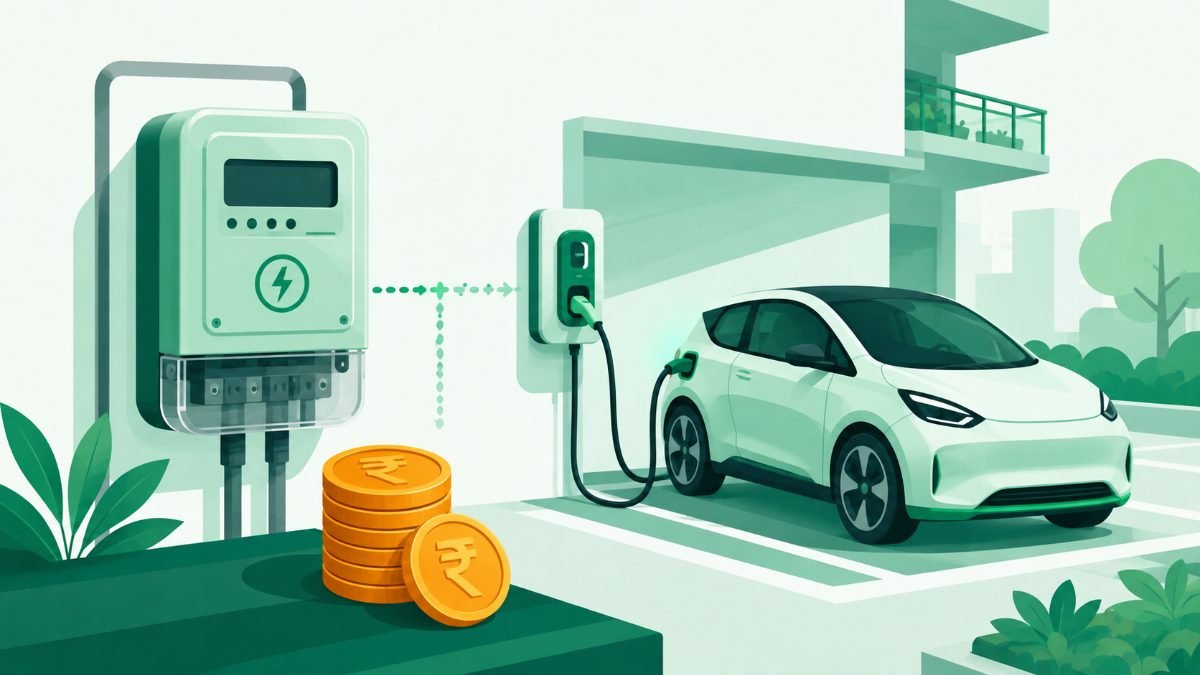
A society charging station budget has eight cost components: the electricity supply or new connection, the charger hardware itself, cabling from the meter room to the parking bay, civil work such as trenching and mounting, metering and billing equipment, signage and bay marking, an ongoing maintenance reserve, and a small admin allowance. Hardware is usually the most visible line, but cabling and civil work together often cost as much or more, especially in basement parking. Most societies fund the project through the corpus fund, direct contributions from EV-owning residents, or a hybrid of the two. Budget each line separately, add a contingency of around 10 to 15 percent, and get at least two written quotations before the general body votes.
Start with the electricity supply — it decides everything else
Before pricing chargers, answer one question: where will the power come from? There are usually three options, and each has a different cost profile.
- Spare capacity on the common-area meter. Cheapest to start, but charging then runs on the society's existing tariff and eats into sanctioned load meant for lifts, pumps, and lighting. Fine for one or two slow chargers; risky as demand grows.
- A new dedicated connection from your DISCOM. A separate meter just for EV charging keeps billing clean and protects the common supply. It involves an application, possible load enhancement, and connection charges — ask your DISCOM for the current process and fee schedule, because these vary and change.
- Load enhancement on an existing connection. A middle path where the society increases its sanctioned load. Your electrician and DISCOM can tell you whether the transformer and incoming cable can take it.
Whichever route you take, have a licensed electrician confirm the society's spare capacity in writing first. The apartment EV readiness checklist walks through the questions to ask before you spend anything.
Hardware: three tiers, three very different budgets
Charger hardware comes in rough tiers, and the right tier depends on how residents will actually use the station.
- Basic AC points (around 3 to 3.5 kW). Essentially heavy-duty metered sockets with protection. Lowest cost per bay, slowest charging — well suited to overnight charging in private bays.
- Standard AC wallbox chargers (around 7 kW). Faster, with better safety electronics and often built-in energy metering. The common choice for a shared station.
- Smart or networked chargers. Add app access, user authentication, and automatic session billing. Costlier upfront but they solve the "who used how many units" problem without a manual register.
For a shared station serving many residents, faster charging means shorter occupancy per car, which matters more than raw speed for any one owner. The trade-offs are covered in detail in the 3.3 kW versus 7.2 kW comparison.
The hidden heavyweights: cabling and civil work
Committees are routinely surprised that the wire costs rival the charger. Cable cost scales with distance and current: a bay 60 metres from the meter room needs a thicker, longer, costlier run than one 10 metres away. Budget separately for:
- Cable supply — sized by your electrician for the load and the run length, with voltage drop in mind.
- Containment — conduit, cable tray, or trenching, plus making good any surfaces that are cut.
- Protection devices — dedicated breakers and earth-leakage protection at the distribution board.
- Earthing — verified, and upgraded if the existing earthing is weak or old.
- Mounting and finishing — wall or pedestal mounting, weather protection for open-air bays, and bollards if vehicles could hit the unit.
Basement locations add ventilation and fire-safety considerations that deserve their own review — see the basement parking charger checks before finalising a location. Choosing bays close to the electrical room is the single biggest cost saver available to most societies.
Metering, billing, and signage — small lines that prevent big fights
A station without clean measurement becomes a monthly argument. Budget for either calibrated sub-meters per charging point or smart chargers with built-in session logging; the sub-meter versus smart-charger billing guide compares the two approaches. Also include modest amounts for bay marking, "EV charging only" signage, basic usage instructions, and an emergency-contact notice. A written billing agreement between users and the society, settled before the first unit flows, is worth more than any hardware — the shared charging billing agreement template is a starting draft.
A worked example budget (illustrative numbers only)
The figures below are round, made-up numbers for a hypothetical two-point AC station, shown only to demonstrate the structure of a budget. Your quotations will differ — possibly by a lot — depending on city, distance, and site condition. Use the charger cost calculator with your own inputs.
| Cost line | Example amount (illustrative) | What drives it up or down |
|---|---|---|
| New connection / supply work | say ₹40,000 | DISCOM charges, load enhancement, meter type |
| Charger hardware (2 points) | say ₹90,000 | Tier chosen, smart features, warranty |
| Cabling and protection | say ₹50,000 | Distance to bays, cable size, board upgrades |
| Civil and mounting work | say ₹30,000 | Trenching, surface repair, pedestals, bollards |
| Metering and billing setup | say ₹15,000 | Sub-meters vs smart-charger software |
| Signage and bay marking | say ₹5,000 | Number of bays, quality of boards |
| First-year maintenance reserve | say ₹20,000 | Servicing, spares, insurance rider if taken |
| Admin and contingency (~12%) | say ₹30,000 | Quotation gaps, minor surprises, paperwork |
| Example total | say ₹2,80,000 | Every line varies by site — get local quotes |
Notice that hardware is barely a third of this example. That pattern — electrical and civil work rivalling the chargers — is common, and it is why quotations must itemise every line rather than quote one lump sum.
Funding models: corpus, user-funded, or hybrid
Once the budget exists, the general body must decide who pays. Three models cover most societies.
- Corpus or sinking fund. The society treats the station as common infrastructure, like a gym or generator. Fairest when many residents are likely to use it over time; harder to pass when only two or three flats currently own EVs.
- User-funded. Current EV owners pay the capital cost, sometimes recovering it if new users join later. Easiest to approve, but ownership and exit questions (what happens when a funder sells their flat?) must be written down.
- Hybrid. The society funds the shared backbone — connection, main cabling, distribution board — while each user pays for their charger and final connection. This mirrors how the cost naturally splits and is often the easiest compromise. The who-pays-for-wiring guide goes deeper into these splits.
Whichever model you pick, record it in a written society policy along with billing rates, booking rules, and maintenance responsibility. The RWA EV policy generator produces a discussion draft you can table at the meeting.
Do not skip the maintenance reserve
Capital budgets get all the attention, but a station also needs money every year: periodic inspection by an electrician, replacement of worn connectors or cables, software or connectivity fees if you chose smart chargers, and eventual replacement of the units themselves. A simple approach is to add a small per-unit surcharge on top of the electricity rate charged to users, flowing into a dedicated reserve. That way the people using the station fund its upkeep, and the committee is never forced to raid maintenance dues for a repair. Decide the surcharge before launch — introducing it later always feels like a price hike.
Common questions
How much does a society EV charging station cost in total?
There is no single honest number — it depends on how far the bays are from the meter room, whether a new connection is needed, how many charging points you install, and the hardware tier. The realistic path is to define the scope, then collect two or three itemised quotations from licensed installers. Treat any figure you read online, including the example above, as a structure to copy rather than a price to expect.
Can the society recover the cost from users?
Many societies do, either through an upfront contribution from participating residents or a per-unit surcharge on charging bills that repays the corpus over time. Whether and how you can do this depends on your society's bye-laws and what the general body approves, so put the recovery mechanism in the written policy and have the committee confirm it against your bye-laws before spending.
Is it cheaper to let residents install private chargers instead?
Often, yes, for the society — private installations shift capital cost to individual owners. But a shared station serves residents without fixed bays, visitors, and future EV buyers, and it uses fewer total charging points. Many societies end up with both. The private versus shared charging comparison lays out the decision factors.
What contingency should we keep?
Around 10 to 15 percent of the estimated total is a sensible working figure for a straightforward site. Older buildings, long cable runs, or any earthing and distribution-board upgrades discovered mid-project can push surprises higher, which is another reason to have the electrical survey done before the budget is voted on, not after.
Finally, remember that every number here is an estimate and every site is different. Before approving any budget, have a licensed electrician survey the parking area and electrical room, and confirm connection options, load requirements, and current charges directly with your DISCOM. Their written inputs — not a spreadsheet — should be the foundation of the figure your general body votes on.